Astronomers Reveal the ‘Farthest-Inbound’ Comet Ever Seen: A 6-Million-Year Journey from the Edge of Our Solar System
C/2025 D1 (Groeller) was first spotted by Hannes Gröller from the Catalina Sky Survey in February 2025. In May 2028, it will swing as close as roughly 14 astronomical units (AU) from the Sun, corresponding to 2 billion kilometres away, beyond the orbits of all planets except Neptune and Uranus. That makes it the new record holder for the ‘farthest-inbound’ comet ever documented.
By digging into archival telescopic images from observatories in Hawaii and Arizona, the team was able to trace the comet way before the official discovery to when the comet was more than 20 AU away (over 3 billion kilometres) from the Sun. Even at that extreme distance, the comet had already begun to glow as sunlight started turning its frozen gases, such as carbon monoxide, into vapour and pushing dust away, forming a tenuous atmosphere and hazy glow called coma around it.
Then, unexpectedly, the comet began to fade starting from around late 2023, even though it was still heading inward to the Sun and should have been getting brighter. The team speculate that this slowdown could be linked to changes in the types of ice driving the activity: possibly carbon monoxide giving way to carbon dioxide, or the comet’s water ice shifting from the disorder form (amorphous ice) to the familiar crystalline form we frequently see on Earth. Such a transition tends to quickly release heat and would heat up trapped gases inside the comet, causing sudden bursts in the comet’s activity. It is also possible that the comet's supply of easily released gases was running low. Astronomers will keep on searching for other comets with similar behaviours before they can have a grasp of what is really going on.
The comet also stands out for its reddish hue, which makes it appear warmer-toned than most other comets. By crunching the numbers on its activity and the way its dust scatters sunlight, the team estimates the comet's solid core is at least 0.4 kilometers across—roughly the length of four football fields.
Most excitingly, detailed path calculations confirm that C/2025 D1 (Groeller) is a ‘newcomer’ to the inner solar system. It hails from the Oort Cloud, a distant shell of icy objects surrounding our solar system like a cosmic bubble wrap, about 6 million years ago. Its last close pass by the Sun was well over the planetary region, and after this visit, the gravity of giant planets such as Jupiter is likely to fling it out of the solar system forever.
‘This comet is a frozen time capsule from the dawn of our solar system,’ said lead author Dr. Man-To Hui of the Shanghai Astronomical Observatory, Chinese Academy of Sciences. ‘Watching it wake up so far out from the Sun is helping us understand how these ancient relics behave when they finally feel the warmth of the Sun after millions of years in the cosmic deep freeze.’
With powerful new surveys such as the Chinese Space Station Telescope and the Vera C. Rubin Observatory come online, astronomers expect to find more of these distant travelers, shedding light on how our planetary family formed and evolved.
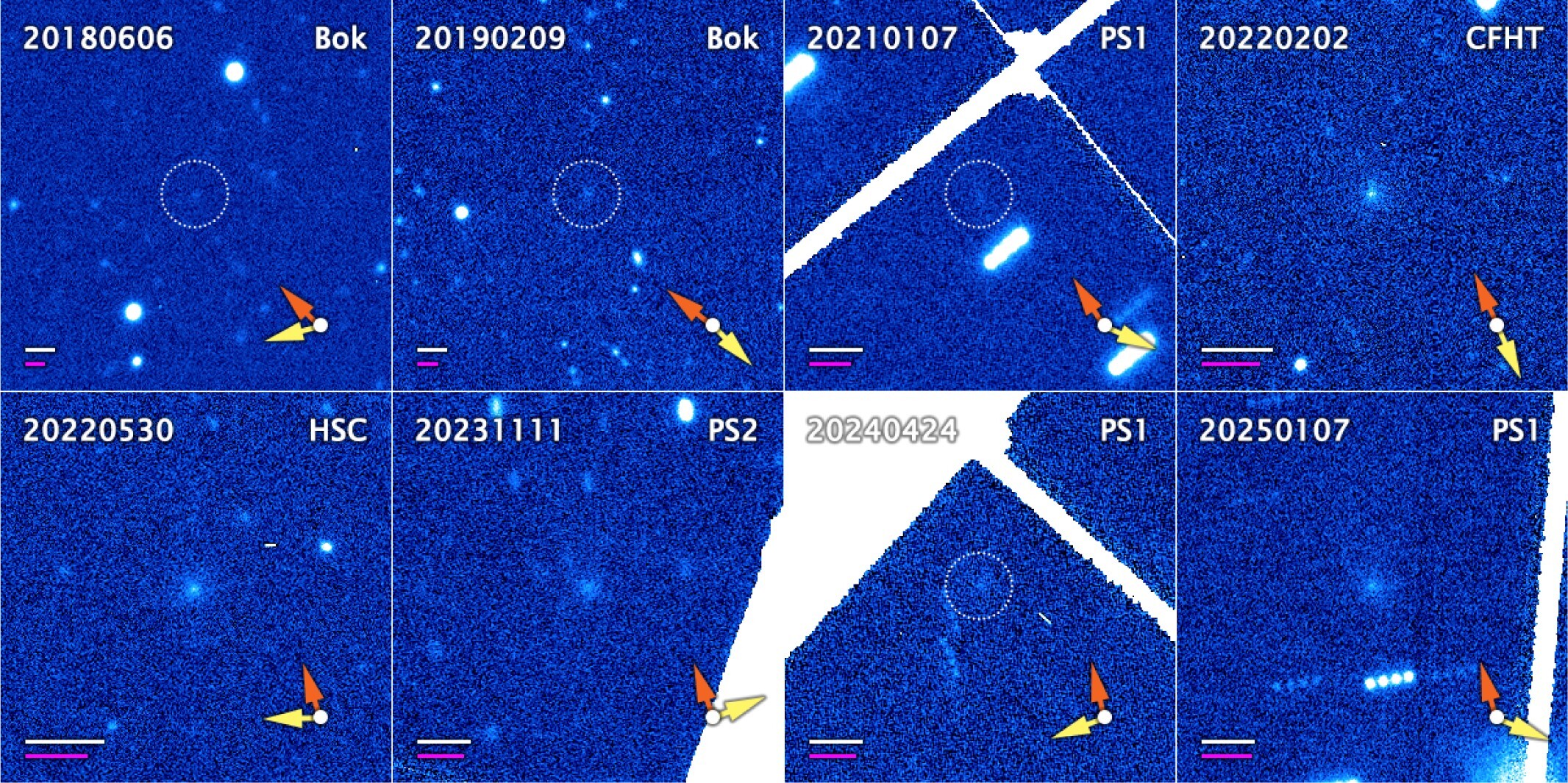
Fig:Selected archival observations of comet C/2025 D1 (Groeller). In some of the panels where the comet appears faint, a dotted white circle marks its location. The white and magenta scale bars represent an angular distance of 10′′ and a linear distance of 105 km projected at the observercentric distance of the comet, respectively. J2000 equatorial north is up, and east is to the left. In each panel the antisolar direction (yellow arrow) and the projected negative heliocentric velocity of the comet in the observer’s sky plane (dark orange arrow) are also indicated.
The study, titled ‘Dynamically New Comet C/2025 D1 (Groeller) with Record Perihelion Distance’, was published online on 5 December 2025 in the journal 《Astronomy & Astrophysics》. It was co-authored by Robert Weryk from the University of Western Ontario, Canada, amateur astronomer Sam Deen from the US, David Tholen and Richard Wainscoat both from the University of Hawai‘i, Marco Micheli from the European Space Agency, and Jianchun Shi and Xian Shi from the Shanghai Astronomical Observatory in China.
Article:https://www.aanda.org/articles/aa/abs/2025/12/aa57175-25/aa57175-25.html
Contact person:Dr. Man-To Hui mthui@shao.ac.cn
Download attachments:




