Tianma Telescope Reveals Dominant Contribution of Ice Grain Sublimation in the Coma to Water Vapor Production of Interstellar Comet 3I/ATLAS
Recently, researchers from the Shanghai Astronomical Observatory of the Chinese Academy of Sciences conducted high-sensitivity radio observations of the interstellar comet 3I/ATLAS using the Tianma Telescope, marking the first observation of an interstellar object by this facility. The study reveals that this small body, originating from outside the solar system, released substantial amounts of water vapor and carbon monoxide as it approached the Sun. Notably, a significant fraction of this water vapor did not originate directly from the comet's nucleus, but rather from the secondary sublimation of icy grains within the coma. This discovery provides new critical clues for understanding the formation environments and volatile compositions of small bodies in other planetary systems. The relevant findings have been published in the Astrophysical Journal Letters under the title "Preperihelion Volatile Evolution of Interstellar Comet 3I/ATLAS Indicating Significant Contribution from an Extended Source in the Coma."
Significant "Extended Source" Effect
Discovered in July 2025, 3I/ATLAS is the third interstellar object confirmed by humanity after 1I/ʻOumuamua and 2I/Borisov, and the second confirmed interstellar comet exhibiting clear cometary activity, garnering significant attention from both the scientific community and the public. Previous multi-wavelength observations had already indicated that 3I/ATLAS displayed dust and gas activity at large heliocentric distances, exhibiting characteristics distinct from typical solar system comets.
In this new study, the research team utilized the Shanghai Astronomical Observatory's Tianma 65-meter radio telescope to conduct continuous monitoring of 3I/ATLAS, tracing the variation of water vapor release with heliocentric distance using the OH spectral line at 1.6 GHz. The team successfully detected OH signals when the comet was at heliocentric distances of approximately 2.27 astronomical units (au) and 1.96 au. The results show that at 2.27 au, 3I/ATLAS was releasing about 0.43 tons of water vapor per second, a production rate that increased to 0.62 tons per second at 1.96 au, an increase of over 40%.
The research team found significant discrepancies in water production rates measured by different telescopes even at similar heliocentric distances. Through analysis, they attributed this to a pronounced "extended source" effect in 3I/ATLAS, where ice-containing particles that have already left the nucleus continue to sublimate within the coma, releasing substantial additional water vapor. Telescopes with smaller fields of view can only measure water vapor from the central part of the coma, yielding values much lower than the total production rate.
To quantify this mechanism, the research team developed a two-component parametric model to distinguish the production rate contributions originating from the nucleus and from the coma (Figure 1). Monte Carlo analysis indicates that before 3I/ATLAS reached perihelion, the extended source could contribute up to 80% of the total water production rate, meaning the majority of observed water was not ejected directly from the nucleus surface but was continuously released by icy grains within the coma. As 3I/ATLAS moved closer to the Sun, this proportion gradually decreased, but even near perihelion, the extended source might still contribute about half of the water release (Figure 1d).
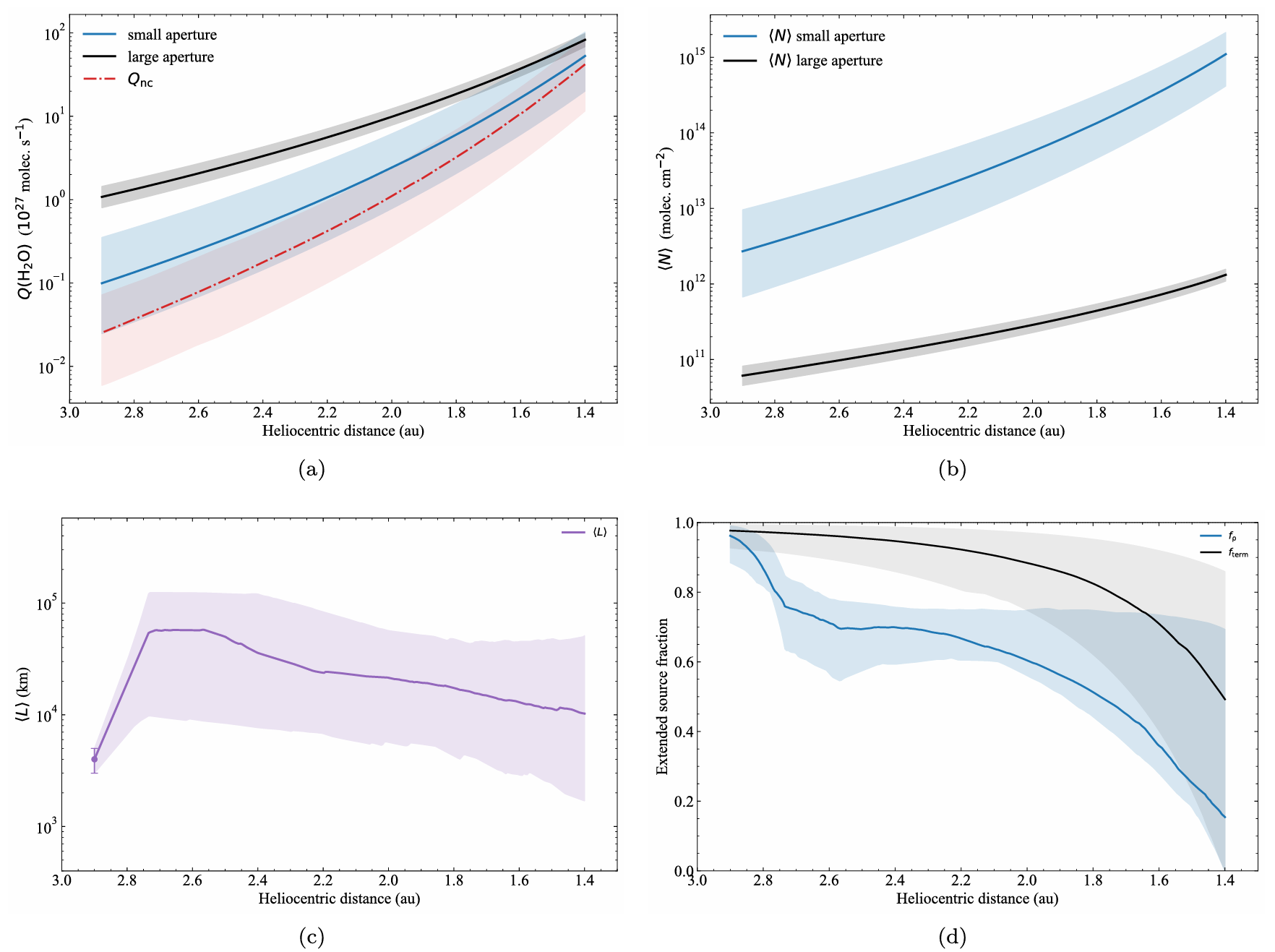
Figure 1. Simulation of the extended source contribution in 3I/ATLAS. (a) Power-law relationship between H₂O production rate and heliocentric distance (Black: large aperture data; Blue: small aperture data; Red: production rate directly from the nucleus). (b) Variation of column density with heliocentric distance. (c) Variation of the equivalent spatial scale of the H₂O extended source with heliocentric distance. (d) Variation of the fraction of the extended source contribution to the water production rate measured by different apertures with heliocentric distance.
Previously, the solar system comet 103P/Hartley also exhibited a strong extended source sublimation phenomenon. However, not all comets possess this mechanism; the famous 67P/Churyumov-Gerasimenko, for instance, ejects grains that are overall "dry." Regarding why the grains ejected by 3I/ATLAS are rich in water ice, the researchers will conduct further studies integrating the overall activity evolution around perihelion.
The Tianma Telescope, owing to its high sensitivity and L-band wide beam coverage, can fully capture the OH signal across the coma, providing critical data support for studying cometary activity mechanisms, particularly the "extended source" effect. Previously, the Tianma Telescope has successfully observed multiple comets, including C/2013 US10, 12P/Pons-Brooks, C/2023 A3 (Tsuchinshan-ATLAS), and C/2024 G3 (ATLAS) (as shown in Figure 2), establishing itself as an important platform for cometary radio observations.
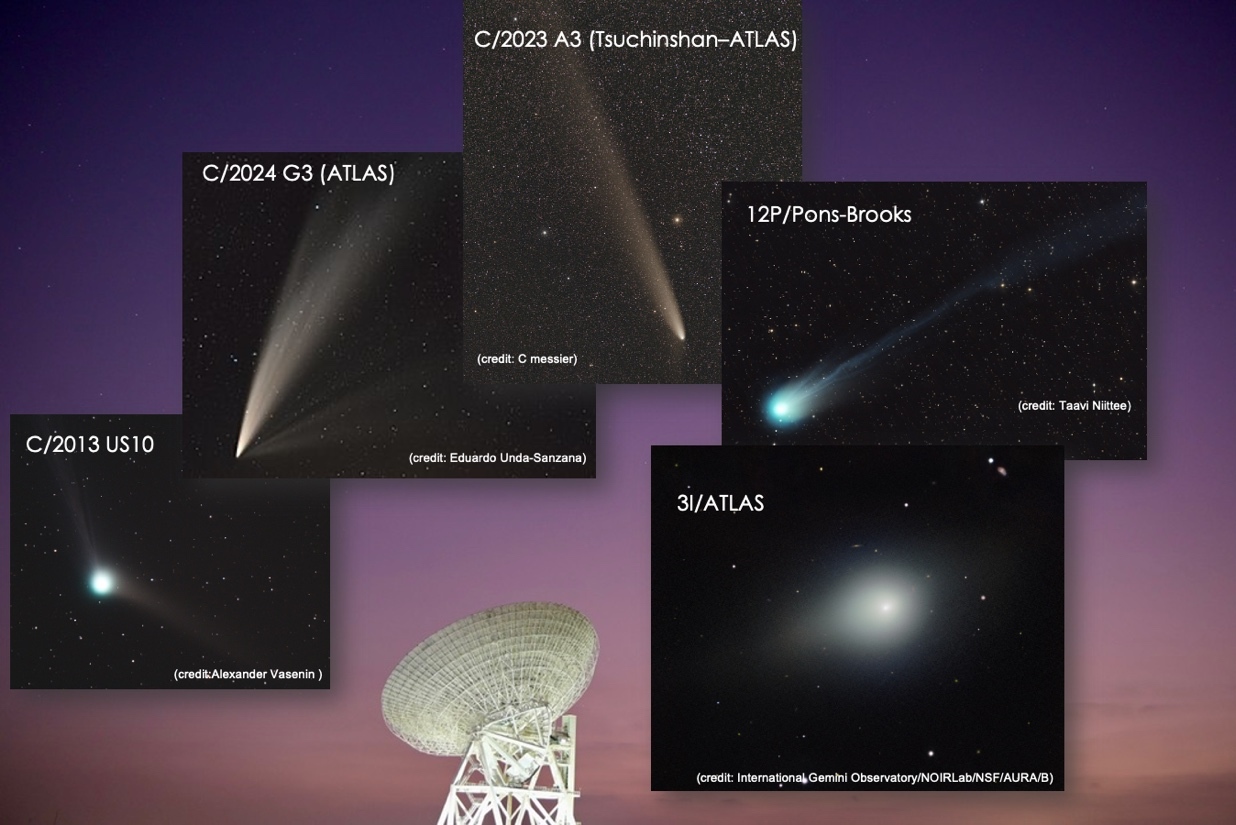
Figure 2. The Tianma Radio Telescope and some of the comets it has observed.
Higher Carbon Monoxide Abundance than Solar System Comets, Suggesting a Colder Formation Environment
In addition to water, the research team utilized the Purple Mountain Observatory's Delingha 13.7-meter millimeter-wave telescope to obtain the CO spectral line at 115 GHz over a heliocentric distance range of approximately 2.33 to 1.75 au. They measured an average carbon monoxide production rate for 3I/ATLAS of about 0.27 tons per second, deriving a CO/H₂O ratio of approximately 28%. This value is notably higher than the typical levels observed for most solar system comets at similar heliocentric distances. Although this ratio is lower than that of the previous interstellar comet 2I/Borisov, it still indicates that 3I/ATLAS possesses a relatively rich reservoir of carbon monoxide volatiles, demonstrating significant compositional diversity among different interstellar comets.
3I/ATLAS also exhibits an enhanced abundance of CO relative to HCN, further supporting the idea that it formed in a planetary system environment colder than our own, capable of preserving more highly volatile materials.
In the future, as more interstellar comets are discovered, astronomers hope to study the physical structures and chemical compositions of these icy minor bodies from beyond the solar system through multi-wavelength observations and data analysis, thereby gaining insights into the evolutionary histories of other stellar systems.
This research was supported by the National Natural Science Foundation of China.
Paper link: https://doi.org/10.3847/2041-8213/ae45a2
Science Contacts:
Li Junchen, jcli@shao.ac.cn
Shi Xian, shi@shao.ac.cn
Download attachments:




