China SKA Science Meeting 2026 Successfully Held in Shanghai
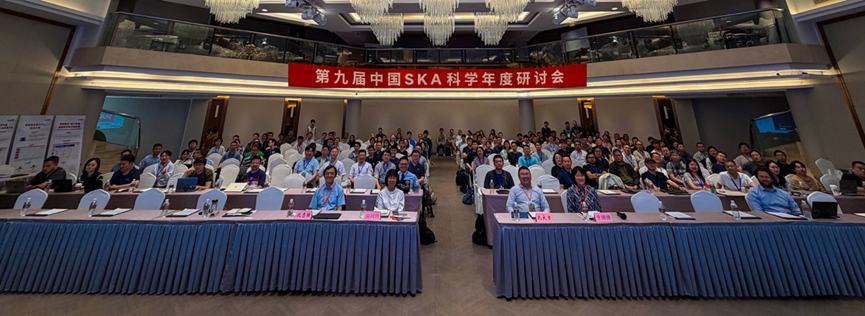
SHANGHAI, May 12–14, 2026 – The China SKA Science Meeting 2026 was successfully held from May 12 to 14, 2026, in Shanghai, bringing together over 200 researchers and young scientists from universities and research institutions across China.
Guided by the International Science and Technology Cooperation Center (ISTCC) of the Ministry of Science and Technology (MOST), and hosted by the Shanghai Astronomical Observatory (SHAO) of the Chinese Academy of Sciences (CAS), the event featured 47 talks, highlighting preparations for early science with the SKA telescopes. Lead authors of the upcoming second SKAO science book were invited to present their latest progress, and SKAO Scientists delivered invited talks on telescope commissioning, science verification, and RFI management, sharing the latest international insights.
The opening ceremony was chaired by Kong Dali, Director of SHAO, who welcomed participants and reaffirmed SHAO’s commitment to supporting the SKA science efforts, accelerating the development of the SKA Regional Centre, expanding talent pools, and strengthening resource integration. Fang Tongzhen, Deputy Director of ISTCC, encouraged in-depth discussions on SKA science preparation, commissioning, and early science participation. Wang Yan, Vice President of CAS Shanghai Branch, emphasized China’s systematic progress in SKA research and expressed full support for the SKA Regional Centre to enhance China’s global role. Mao Yufeng, Deputy Division Director of the Basic Science Research Bureau of CAS, underlined the Academy’s strategic focus on SKA and the importance of fostering young research talent.
During the meeting, Li Shanshan, Division Director of ISTCC, presented an update on China’s engagement with the SKA, covering governance, construction, science preparation, and national participation. Shen Zhiqiang, China’s SKA Chief Scientist, outlined China’s “three-step” development strategy for SKA science and the goals of the second-phase science planning.
Key topics were covered in the 47 talks, such as cosmic reionization, pulsar searches and tests of gravity, neutral hydrogen surveys and cosmology, cosmic magnetism, interstellar medium, transients, AGN and black holes, HI galaxy dynamics and evolution, cradles of life, and ultra-high-energy cosmic ray detection. Participants engaged in intensive discussions on SKA science preparation, observation strategies, data processing, international collaboration, and workforce development.
Download attachments:




