The observational high energy astrophysics group and their collaborators have discovered highly relativistic jets in microquasars
Recently, the observational high energy astrophysics group led by Prof. Wenfei Yu and their collaborators in the MeerKAT Large Survey Program ThunderKAT/XKAT have made prominent progress in radio interferometric observations of microquasars and the physics of relativistic jets from black holes.
About some thirty years ago, discovery of superluminal, relativistic jets in the well-known black hole X-ray binary GRS 1915+105 demonstrated that there exist microquasars in the Universe, in comparison with quasars which have been seen with relativistic jets but reside at cosmological distance. This opened the window of the investigation of black hole jets by observing X-ray binaries (containing either accreting black holes or neutron stars) in our local Universe. However, observations in the past few decades have shown that these microquasars can only produce jets with the estimated Lorentz factor reaching up to around 2.4.This has led to the long-term conception that “Relativistic jets in microquasars are in a less relativistic regime than those in the extragalactic active galactic nucleus (AGN).”
The research team performed follow-up observations with the MeerKAT radio telescope in South Africa of the black hole X-ray binary 4U 1543-47 in 2021 when the black hole transient turned into an X-ray outburst during 2021-2023 period and found its compact jets and episodic jets. Coordinated with space multi-wavelength observations and X-ray all-sky monitoring observations, the team were able to continue to monitor the evolution of both compact jets and episodic jets with high spatial resolution radio interferometric observations for up to about 20 months. The investigations of these observations have achieved the following major discoveries: (1) the Lorentz factor of the episodic jets has been constrained to approximately 8 or above, significantly larger than those estimated from previous observations of microquasar jets in the past few decades[1]; (2) the compact jets show peculiar radio-bright behaviors with large flux variations, corresponding to a variable Lorentz factor range in 1-2[2]; (3) both episodic jets and compact jets are constrained to small jet inclination angles, less than about 21°[1] and 20°[2],respectively, indicating both episodic jets and compact jets were pointing at the earth observers with small angles; (4) at least two episodic jet ejections have been confirmed to have occurred during the single X-ray outburst, with jet position angles consistent within the uncertainties and on the order of one degree. These studies demonstrate that the relativistic jets in Galactic microquasars are in a similarly relativistic regime as those of the relativistic jets in AGN which contain accreting supermassive black holes. Since the accretion time scale scales with the black hole mass, we are able to observe complete cycles of accretion-jet ejection in microquasars to probe physics of relativistic jets from black holes, unlike those cases for relativistic jets from supermassive black holes.
These discoveries not only change the conception regarding microquasar jets that established in the past few decades, but also demonstrate that the Galactic microquasars are astrophysical laboratories of extremely relativistic jets launched from accreting black holes. The observational studies constitute the first detection the episodic jets in the black hole transient 4U 1543-47. In addition, the observations have set a few records of measurements in microquasar jets. For example, the episodic jets have the largest proper motion, the longest projection distance from the origin, and the lowest jet inclination constraints ever detected or measured in a microquasar. The team is able to constrain the jet inclination to a small value around 21°, and relativistic jets with small inclination angles have the advantage to achieve higher lower limit of the jet Lorentz factor. Therefore, the studies imply that substantial microquasar jets are this relativistic[1]. The report of these discoveries has been listed as the editor’s highlight of recent research advances by Nature Communications. “Rigorous observations and data reduction, critical thinking in the analysis, high-level observation and archival platform by the world-leading collaboration, have helped the team make the discovery of the most extreme relativistic jets ever seen in Galactic microquasars, which changes the conception that established in the past few decades with observations to a single microquasar”, says Dr. Xian Zhang, who has made critical detection of the ejection blobs and performed systematic measurements of the relativistic jets. “Our investigations not only prove that the Galactic microquasars are the closest astrophysical laboratories of extreme physics of relativistic jets, but also reveal the clues to observational signatures for future discovery of microblazars – accreting stellar-mass black hole or neutron star systems with their relativistic jets nearly pointed at the earth.”, says Prof. Wenfei Yu, the principal scientist of the observational high energy astrophysics group, who proposed the three rules (“the forward rule”, “the no acceleration rule” and “the least ejection rule”) that is critical to discriminate distinct jet ejections and to constrain the Lorentz factors. These studies constitute a systematic investigation of the most relativistic episodic jets and compact jets in microquasars.
The research team includes Dr. Xian Zhang (first author), a previous Ph.D candidate of Shanghai Astronomical Observatory and a current scientist at GuiZhou University, Prof. Wenfei Yu (the second author and the corresponding author), and 16 other senior or junior colleagues across Europe, Australia and North America in the MeerKAT/ThunderKAT/XKAT collaboration, including world-leading experts at Oxford University in the UK, Curtin University in Australia, INAF in Italy, CNRS in France, University of Amsterdam in the Netherlands, and the University of Cape Town in the South Africa. The study by the observational high energy astrophysics group at SHAO has been supported by the NSFC grants 12373050 and U1838203.
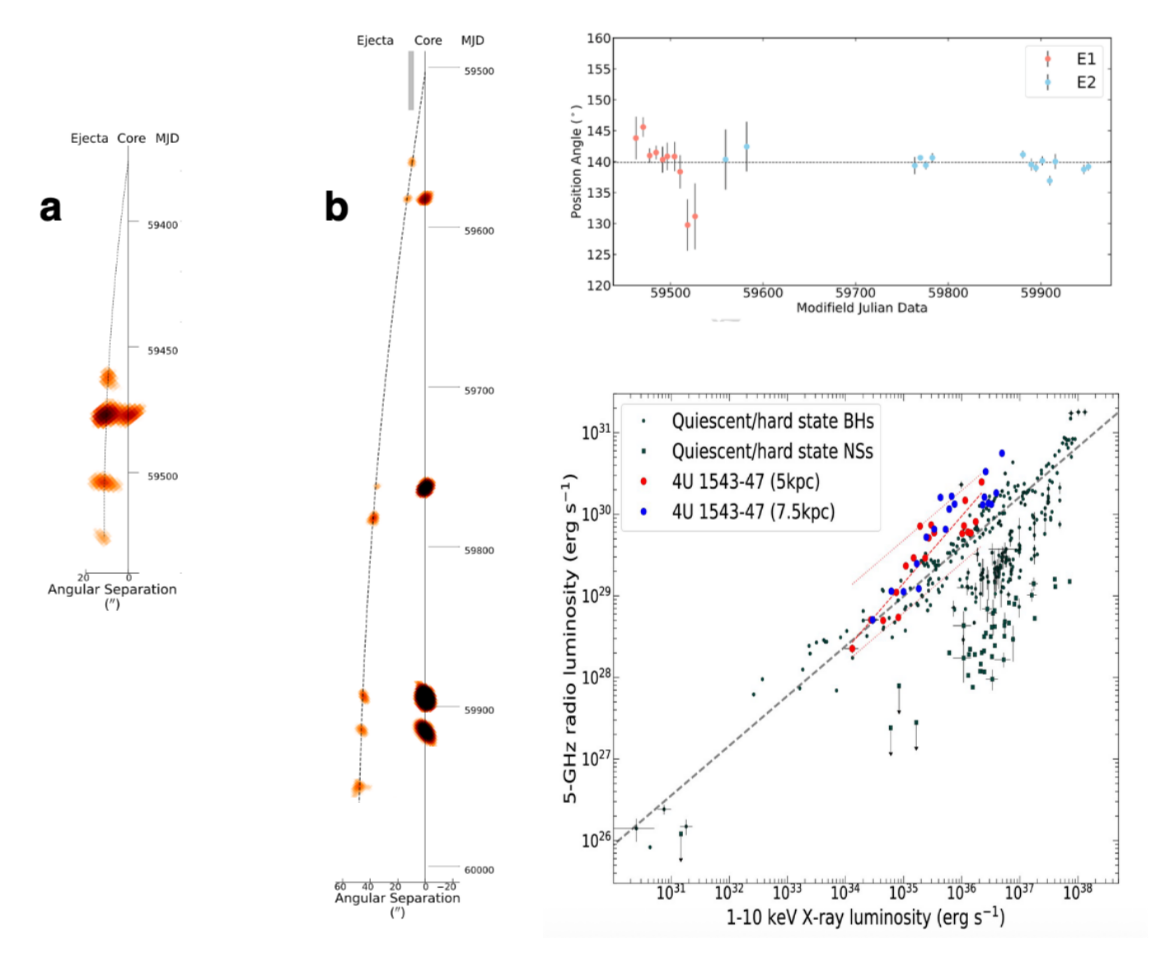
Figure: The superluminal, relativistic jets and the corresponding ejecta (Left), the measurements of the position angles of two ejections (E1 and E1, Top-right), and the radio-bright behavior in the correlation between the radio luminosity and the X-ray luminosity as compared with measurements of other X-ray binaries (Bottom-right). The figure on the left is made of actual detection images of individual observations by the MeerKAT radio telescope with shifts representing the time span[1] . The angular separation indicates the projected angular distances of the ejection blobs from the radio core (where the black hole binary resides). By tracing the proper motion of the ejection blobs, the team puts strong constraints on the Lorentz factor of the superluminal jets. The ejection blobs reached beyond 1 pc (projected distance), the largest ever observed in microquasars to date. The figure on the top-right shows the consistency between the position angles of the two ejections[1]. The figure on the bottom-right shows the peculiar radio-bright behavior in relation to the X-ray luminosity due to accretion, which exceeds the conventional radio vs X-ray luminosity correlation established in other X-ray binaries. This agrees with the expectation for the compact jets with variable Lorentz factors and small inclination angles[2].
DOI:
[2] “Peculiar radio-bright behaviour of the Galactic black hole transient 4U 1543−47 in the 2021–2023 outburst”
https://doi.org/10.1093/mnrasl/slaf008
Contacts:
YU Wenfei, wenfei@shao.ac.cn
ZHANG Xian, zhangxian@gzu.edu.cn
Download attachments:




