Catching a Stellar Growth Spurt: Discover Brightness Variations in Massive Protoclusters
Researchers from Shanghai Astronomical Observatory have carried out the first statistical search for millimeter continuum variability in massive protoclusters using multi-epoch observations from the Atacama Large Millimeter/submillimeter Array (ALMA). By analyzing 383 condensations in 22 massive star-forming regions, the team identified five variable sources and established the first statistical constraints on millimeter variability in these environments. The results highlight the unique capability of high-resolution interferometric observations for studying protostellar variability and open new opportunities for time-domain studies of massive star formation. The study was published in The Astrophysical Journal.
Variability at millimeter and submillimeter wavelengths is thought to trace changes in the mass accretion process of young stars. However, systematic searches have so far been largely limited to nearby low-mass star-forming regions, while evidence in high-mass protostars remains scarce. To address this gap, the research team analyzed multi-epoch observations from the ALMA-QUARKS and MaMMOtH surveys, spanning timescales from several hours to more than two years. Through careful image alignment and flux calibration, they achieved high-precision measurements of continuum emission and carried out a statistical study of millimeter variability in massive protoclusters.
The most striking case was found in the massive star-forming region I13111–6228. When the researchers compared ALMA observations obtained in 2023 and 2024, they detected a strong brightening signal in the difference image. Further analysis revealed that the source is associated with a hypercompact H II region. Over the course of only about one year, its 1.3 mm continuum peak intensity increased by approximately 68%, far exceeding the expected observational uncertainties.
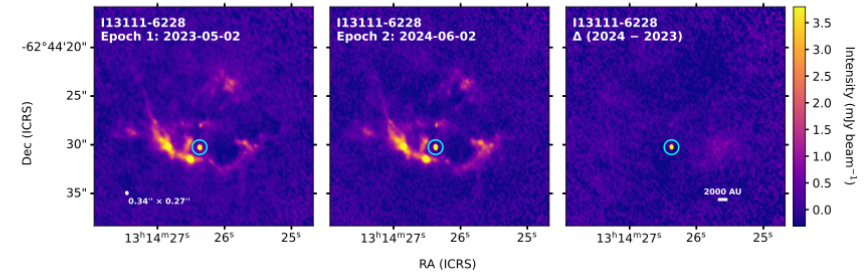
Figure1. 1.3 mm continuum images of I13111−6228 observed with ALMA in 2023 and 2024, along with their difference image.
The study extends millimeter variability research beyond nearby low-mass star-forming regions and into the regime of massive protoclusters, demonstrating the unique capability of high-resolution interferometric observations for investigating variability in complex star-forming environments. Future observations with larger samples and longer temporal baselines will help reveal how frequently such variability occurs and what physical processes drive it.
This work was supported by the National Key Research and Development Program of China, the National Natural Science Foundation of China, and several international collaborative research programs.
DOI: https://iopscience.iop.org/article/10.3847/1538-4357/ae5c08
Science Contacts:
Yuhan Yang, yangyuhan@shao.ac.cn
TieLiu, liutie@shao.ac.cn
Download attachments:




