Shanghai Astronomical Observatory Makes Breakthrough in the Galaxy Cluster "Cooling Flow Problem"
Recently, the Shanghai Astronomical Observatory (SHAO) of the Chinese Academy of Sciences has made new progress in the study of gas evolution in galaxy clusters.
Galaxy clusters are the largest gravitationally bound systems in the universe, filled with high-temperature gas. Theoretically, this gas would continuously radiate energy and gradually cool, accumulating cold gas and triggering star formation in a process known as a "cooling flow". However, observations reveal that the actual cold gas mass and star formation rate (SFR) are significantly lower than theoretical predictions. This discrepancy is referred to as the "cooling flow problem".
It is now widely believed that the activity of supermassive black holes at the centers of galaxy clusters, specifically, active galactic nucleus (AGN) feedback, plays a crucial role. As the black hole accretes matter, it releases energy that is injected into the surrounding medium in the form of radiation, jets, and winds, thereby affecting the thermal state of the gas.
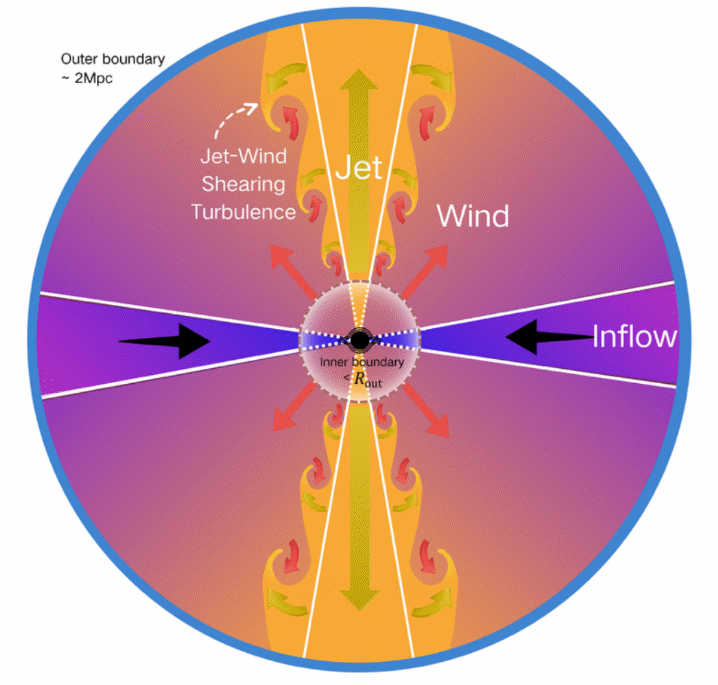
Figure 1: The interaction between the jet and wind from the black hole at the center of the galaxy cluster drives strong turbulence. The dissipation of this turbulence transfers the energy of the jet and wind to the surrounding gas, thereby successfully suppressing the cooling flow in the galaxy cluster. Credit: He et al., Sci. Adv., aed6394 (2026).
This study utilized MACER (https://macer-project.github.io), a numerical simulation framework specifically designed to investigate galaxy-scale AGN feedback, to perform hydrodynamic simulations of a Perseus-like cluster system. Compared to previous models, MACER possesses a more solid physical foundation: the black hole accretion rate is determined more accurately, and the parameter values for jets and winds are based on theoretical studies and observational constraints of small-scale accretion and jet formation. In contrast, traditional AGN feedback models are more phenomenological and feature numerous free parameters. Furthermore, some of their parameter values deviate from theoretical or observational constraints, and they frequently neglect AGN winds, a vital feedback component.
The simulation results demonstrate that when both jets and winds are considered simultaneously, the shear between them triggers strong turbulence in the cluster core, enhancing the efficiency of transferring AGN energy into the thermal energy of the surrounding gas. Under this mechanism, the model not only effectively suppresses excessive gas cooling but also successfully reproduces key observational properties, including cold gas mass, star formation rate, black hole mass evolution (see Figure 2) and gas thermodynamic profiles (see Figure 3), achieving high overall consistency with observations.
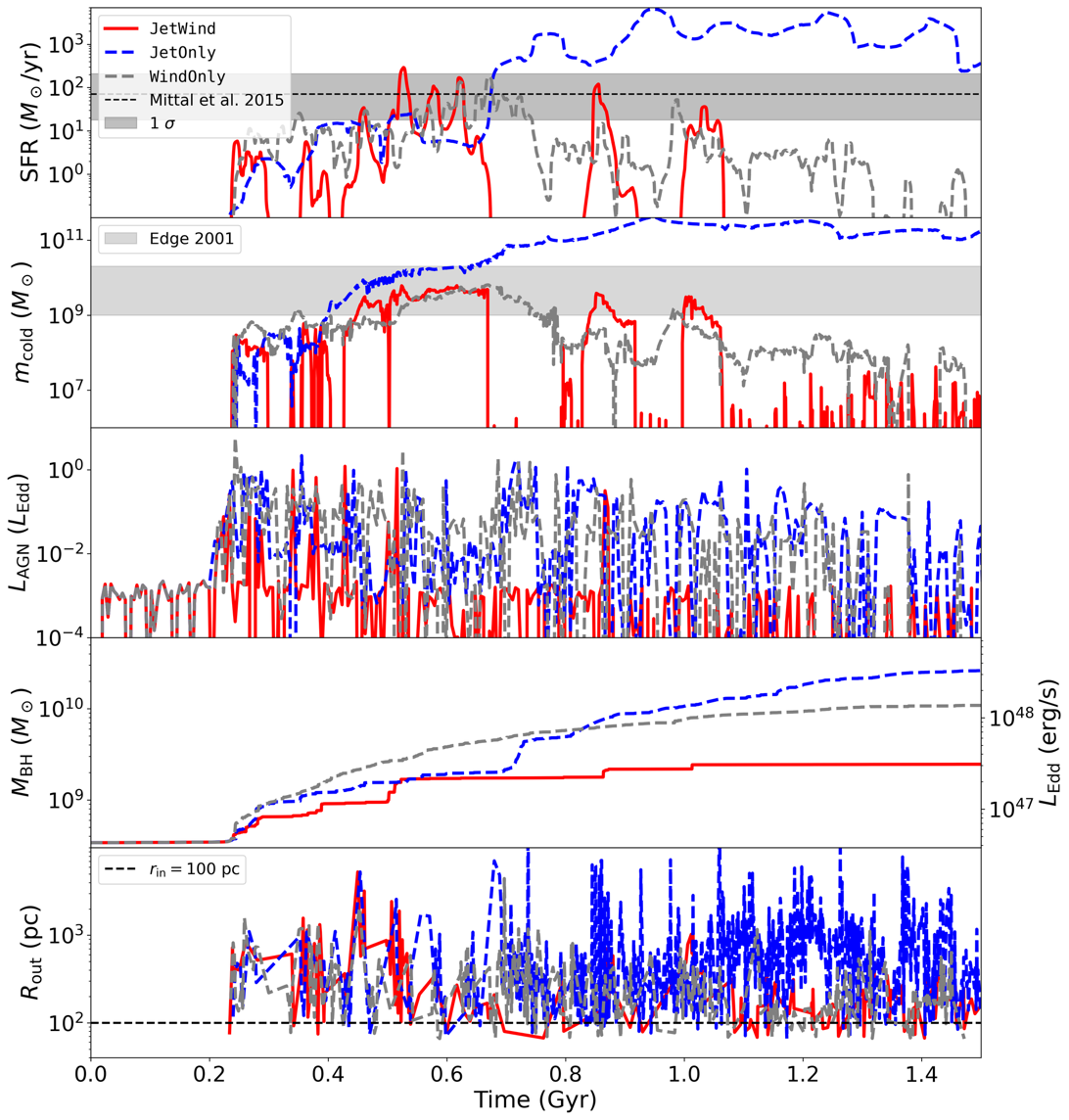
Figure 2: Time evolution of key quantities in the three models. Results are shown for the JetWind (solid red), JetOnly (dashed blue), and WindOnly (dashed gray) models. Top: Star formation rate (SFR). The black dashed line and gray-shaded region mark the SFR of NGC 1275 (the Perseus brightest cluster galaxy, BCG) and its 68% confidence interval, respectively. Second: Cold gas mass. The gray band denotes the molecular gas mass observed in Perseus. The observational values for SFR and cold gas mass represent upper limits for Perseus-like clusters. Third: AGN bolometric luminosity normalized by the Eddington luminosity. Fourth: Black hole mass and Eddington luminosities. Bottom: Evolution of the mass flux-weighted outer boundary of the accretion flow. Only the JetWind model successfully reproduces the observed ranges of cold gas mass, star formation rate, and black hole mass. Credit: He et al., Sci. Adv., aed6394 (2026).
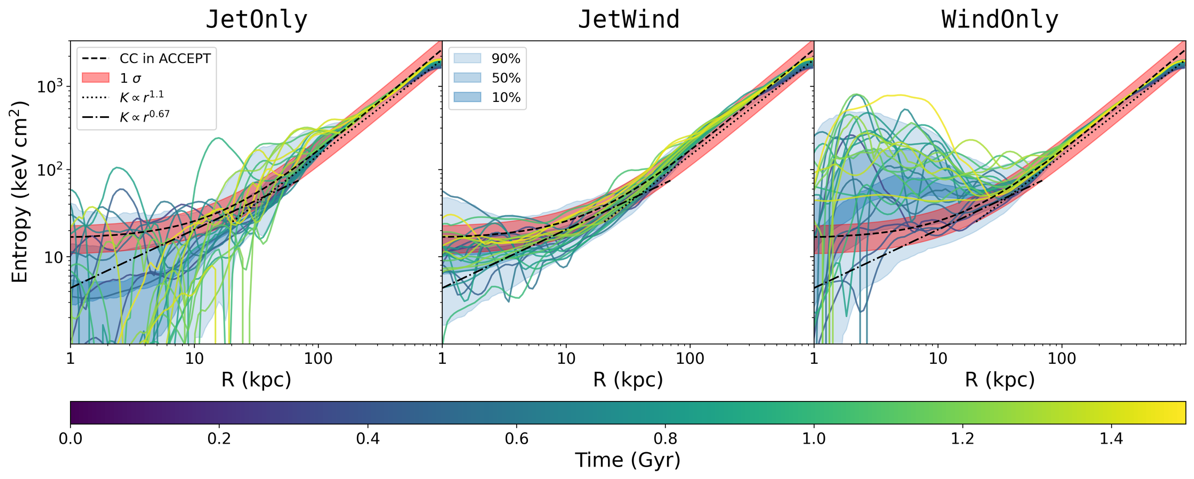
Figure 3: Radial profiles of the entropy of the intracluster medium (ICM), color-coded by time. The shaded regions denote the 10th to 90th percentile distribution of the simulated profiles. Dashed black lines and red bands indicate the median and one standard deviation observed profiles from the ACCEPT cluster sample, respectively. The dot-dashed and dotted lines represent different power-law fits for the cluster outskirts and core, respectively. Similar to previous results, only the JetWind model reproduces the observed entropy profiles throughout most of its evolution. Credit: He et al., Sci. Adv., aed6394 (2026).
These findings provide new insights into understanding the thermodynamic evolution of gas and AGN feedback mechanisms in galaxy clusters, offering a valuable reference for related numerical simulation studies.
The first author of this study is Aoyun He, a first-year doctoral student at the Shanghai Astronomical Observatory, Chinese Academy of Sciences, which is the primary affiliation of the paper. The corresponding authors are Professor Feng Yuan and Professor Suoqing Ji from Fudan University. Collaborators include Ph.D. student Minhang Guo from the Shanghai Astronomical Observatory, Professor Yuan Li from the University of Massachusetts Amherst, Professor Haiguang Xu's research group from Shanghai Jiao Tong University, and Professor Ming Sun from the University of Alabama in Huntsville. This research was supported by the National Natural Science Foundation of China and other programs.
DOI: https://doi.org/10.1126/sciadv.aed6394
Scientific Contacts:
Aoyun He: heaoyun@shao.ac.cn
Feng Yuan: fyuan@fudan.edu.cn
Suoqing Ji: sqji@fudan.edu.cn
Download attachments:




