Gaia’s ‘Excess Noise’ Helps Constrain the Masses of Hidden Binary Companions
The astrometry team at the Shanghai Astronomical Observatory (SHAO), Chinese Academy of Sciences, has developed a new method to use Gaia DR3 astrometric “excess noise” to constrain the orbital inclinations of binary systems and, in turn, improve mass estimates for unseen companions. The study was published in the international journal Astronomy & Astrophysics.
Binary systems are vital for understanding stellar physics, including stellar evolution and the nature of compact objects. While astronomers often use radial velocity measurements to identify companions, determining the orbital inclination remains a challenge. Without a precise inclination, the mass of a dark companion can remain ambiguous, as different combinations of velocity and inclination can yield the same observational data.
To address this, the SHAO team exploited the high-precision measurements of the Gaia satellite. When a star is part of a binary system, it creates a subtle "wobble" due to the gravitational pull of its companion. If this orbital motion cannot be fully explained by standard single-star models, it manifests in the Gaia catalog as "astrometric excess noise". By building a sophisticated simulation framework, the SHAO team calculated expected excess noise values for various orbital inclinations and compared them with observed values from the Gaia DR3 catalog, thereby isolating the most likely orbital inclination range (Figure 1).
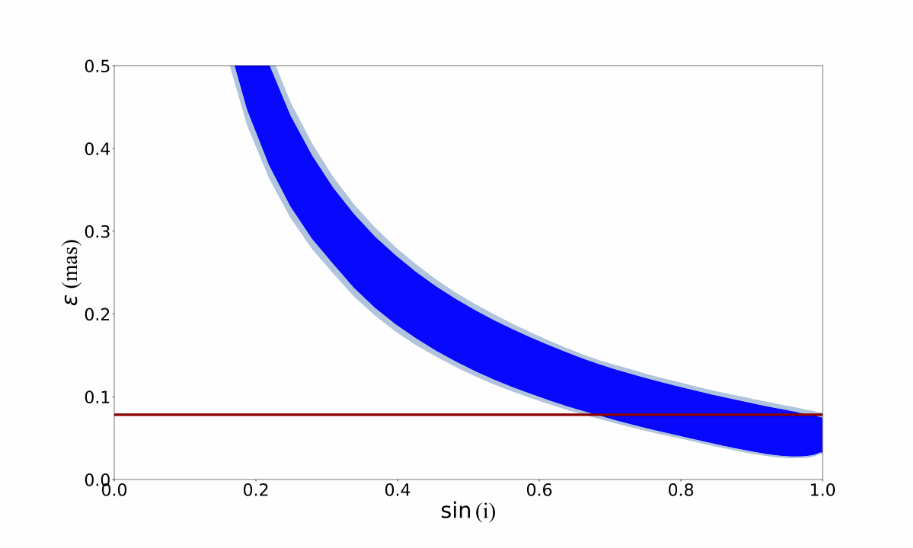
Figure 1: Schematic representation of constraining binary orbital inclination using Gaia DR3 astrometric excess noise. The blue region represents the simulated range of excess noise corresponding to different orbital inclinations, while the red line indicates the excess noise provided by the Gaia DR3 catalog. By comparing simulated values with observations, one can pinpoint the orbital inclination range that matches Gaia data, allowing for more precise mass constraints on invisible binary companions.
The team validated this method using 221 binary systems with established orbital solutions. The results demonstrated that for 83.7% of the samples, the Gaia DR3 orbital inclination fell within the range estimated by their new method. For systems with more pronounced astrometric signals, this accuracy increased to approximately 92.1%. Furthermore, the method was successfully applied to candidate systems harboring dark companions—such as Gaia BH1, Gaia BH2, and LB-1—effectively narrowing the uncertainty in both orbital inclination and companion mass.
"Gaia catalog excess noise was traditionally viewed as a measure of astrometric solution quality," said lead and corresponding author Dr. Shilong Liao. "Our work demonstrates that in binary systems, it also serves as a crucial clue for revealing orbital motion".
"This method fully exploits the potential of the existing data in the Gaia DR3 catalog," added co-corresponding author Dr. Zhaoxiang Qi. "Looking ahead, the release of more abundant epoch astrometric data in Gaia DR4 is expected to further enhance the precision of determining binary orbits and the masses of dark companions".
The research team also included doctoral students Ye Ding and Shangyu Wen, and postdoctoral researcher Qiqi Wu. The project received support from the National Key R&D Program of China, the Youth Innovation Promotion Association CAS, and other funding initiatives.
DOI:https://doi.org/10.1051/0004-6361/202452921
Scientific Contacts: Shilong Liao shilongliao@shao.ac.cn
Download attachments:




