Shanghai Astronomical Observatory Conducts a Bibliometric Study of Hubble Space Telescope Scientific Publications
A research team led by Zhenya Zheng of the Shanghai Astronomical Observatory, Chinese Academy of Sciences, has completed a bibliometric study of more than three decades of scientific publications from the Hubble Space Telescope (HST), identifying the factors that have kept the observatory at the frontier of astronomy, as well as the experience that next-generation space facilities such as the Chinese Space-station Survey Telescope (CSST) can draw on.
The study has been published online in the journal Astronomical Techniques and Instruments.
HST's scientific publications follow a classic life-cycle pattern in which instrument iteration is the strongest driver. Publication output evolved in three phases: rapid growth from 1990 to 1999 (an average annual growth rate of 47.85%), steady growth from 2000 to 2012 (peaking at 939 papers in 2012), and a gradual decline since 2013. After each new instrument is installed, publication output typically peaks about seven years later, and the high-yield plateau above 80 percent of the peak lasts 3.2 years on average. Instruments still operating on orbit—ACS, WFC3 and COS—continue to show rising output, while decommissioned instruments keep producing papers through continued mining of archival data, a "long-tail effect" that extends their scientific value far beyond their operational lifetimes.
A total of 101 countries and territories have participated in HST research, with the United States in a commanding lead (67.66 percent of all publications). U.S.-led papers have become markedly more global over time: the share of internationally collaborative publications rose from 35.71 percent in 2005 to 72.35 percent in 2024, and the average number of partner countries per paper increased from 1.64 to 3.76. China-U.S. collaboration grew exponentially over three decades, from fewer than 0.5 papers per year in the early 1990s to an average of 21.67 papers per year in recent years, making China an increasingly important astronomy partner of the United States.
More than 71 percent of HST papers are concentrated in nine core astronomy journals, seven of which rank in the first quartile (Q1) of the Journal Citation Reports, with an average impact factor of about 5.6—well above the disciplinary median of 1.9. HST papers received an average of 52.1 citations, about 1.3 times the disciplinary average of 40.03, reflecting stronger academic recognition.
The team further analyzed the 20 most-cited HST papers overall (TOP20) and the 20 most-cited papers published in Nature and Science (NS TOP20), finding that the former are cited roughly an order of magnitude more than the latter. The TOP20 papers concentrate on galaxies and cosmology—notably precision measurements of cosmological models, Hubble constant measurements, and galaxy–black hole co-evolution—while nearly half of the NS TOP20 papers involve solar system bodies and exoplanets, showing that headline discoveries attract equally broad attention. The two groups show a highly similar methodological structure, with discovery-driven, precision-measurement-driven and joint-observation studies each accounting for a certain share, but their emphases differ: the TOP20 papers benefit from the long-term accumulation of key programs and subsequent mining of data products, including a foundational paper for the 2011 Nobel Prize in Physics, whereas the discovery-type results in the NS TOP20 are more often driven by transient astronomical events. Multi-instrument joint observations and precision-measurement-driven constraints on theoretical models constitute the core paradigm of HST’s high-impact research, with long-term data accumulation and serendipitous discoveries jointly forming its complete impact landscape.
The study distills HST's success into four pillars: instrument iteration and on-orbit upgrading; complementary multi-instrument capabilities and synergistic observations; international cooperation and competitive proposal selection; and long-term data archiving with open access. As a future observatory planned to co-orbit with the Chinese Space Station and equipped for on-orbit servicing, CSST can draw directly on these insights when planning its instrument iteration schedule, functional configuration, international cooperation architecture and data policies.
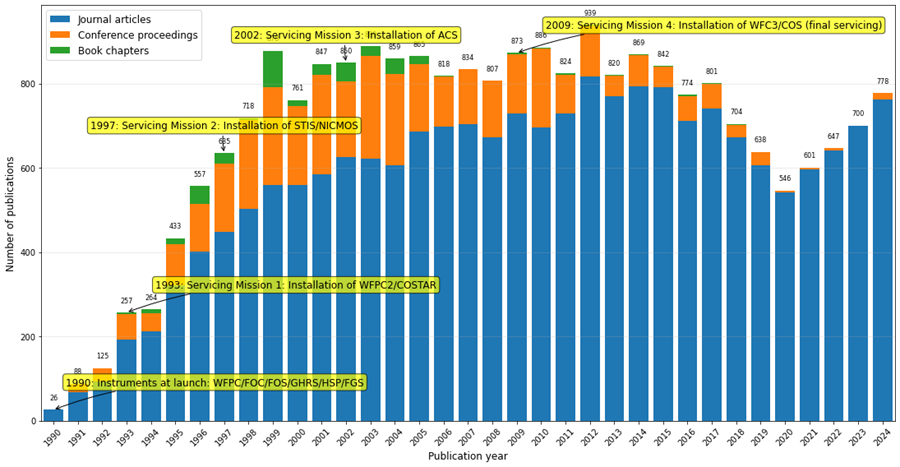
Fig. 1: Annual publication trends for HST from 1990–2024.
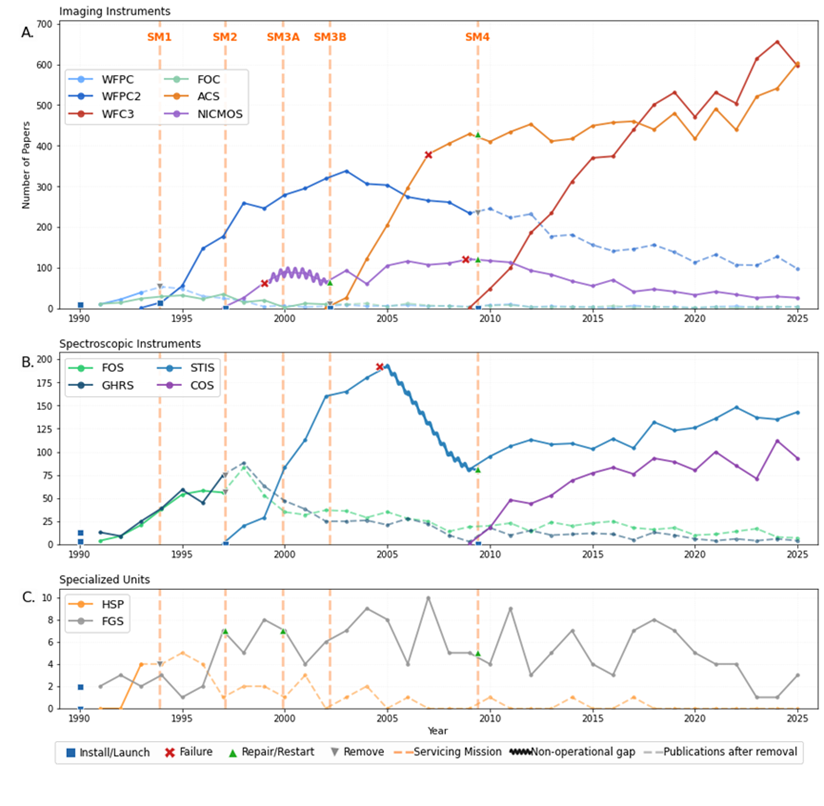
Fig. 2: Publication distribution across the twelve instruments. (A) Publication distribution across the six imaging instruments. (B) Publication distribution across the four spectrographs. (C) Publication distribution across the two specialized units.
This work is supported by the China Manned Space Program and Shanghai Leading Talent Program of Eastern Talent Plan.
DOI: https://doi.org/10.3724/ati2026033
Scientific Contact: Zhenya Zheng, zhengzy@shao.ac.cn
Download attachments:




