A Standardized Gaia–VLBI Workflow for Compact Symmetric Object Identification,Revealing Early Evolutionary Pathways of Radio Galaxies
Recently, an international team led by Shanghai Astronomical Observatory, Chinese Academy of Sciences (CAS), has developed a quantifiable, verifiable, and scalable standardized workflow for identifying Compact Symmetric Objects (CSOs), derived from milliarcsecond-level alignment between optical and radio positions by combining the high-precision astrometry of Gaia with Very Long Baseline Interferometry (VLBI) radio imaging. This achievement expands the catalog of high-quality CSO samples and provides new insights into their physical nature, jet–interstellar medium coupling, and feedback processes during the early stages of radio galaxy formation. These results were published on December 5, 2025, in the international astronomic research journal “Astronomy & Astrophysics”.
CSOs are considered as bilaterally symmetric radio galaxies smaller than one kiloparsec (kpc). They record the initial dynamical phase of jet formation and serve as a crucial bridge linking the nuclear (<1 pc) region to the interstellar (ISM) and circumgalactic (CGM) environments of the host galaxy. A precise definition and reliable census of CSOs are key to addressing fundamental astrophysical questions like: How are relativistic jets collimated and coupled with the surrounding multiphase gas? How do young radio galaxies evolve from parsec-scale radio structures to megaparsec-scale giants across nearly six orders of magnitude? How does jet-driven energy and momentum feedback regulate star formation and shape the co-evolution of supermassive black holes and their host galaxies?
Traditionally, CSO identification has relied mainly on radio morphology and spectra. However, their true cores are often faint or invisible in VLBI images due to free–free absorption (FFA) or synchrotron self-absorption (SSA). This has led to frequent misclassification as “core + one-sided jet” sources, further complicated by projection and Doppler boosting effects. To overcome these challenges, the team proposed the “Gaia–VLBI core anchoring” method, which uses the microarcsecond-precision optical positions from the European Space Agency’s Gaia satellite to accurately pinpoint the optical nucleus within VLBI radio images — even when the radio core itself is undetectable. This optical–radio co-location technique has been established as a first-principle criterion for identifying CSOs. Four complementary observational indicators — radio morphology, spectral index, flux variability, and hotspot expansion velocity — are used as cross-validation, forming a universal and reproducible chain of evidence.
Building on this workflow, the team constructed a multi-parameter diagnostic framework linking radio power (P), linear size (D), expansion velocity (v), and kinematic age (t) — the so-called P–D–v–t correlation — providing simultaneous dynamical and energetic constraints. The results reveal two principal evolutionary branches in the early growth of radio galaxies: 1. High-power, rapidly expanding “freely growing” CSOs, some of which may evolve into large-scale FR II radio galaxies; 2. Low-power, slowly advancing CSOs, whose jets are significantly confined by the pressure gradients and clumpy structures of the host’s multiphase medium, remaining trapped within sub-kiloparsec scales due to environmental resistance. In addition, the study identifies a severely frustrated subclass of extremely low-power CSOs that are fully confined within their host galaxies and thus unable to enter the normal evolutionary sequence. This work highlights the diversity and complexity of CSO populations in terms of energy injection, environmental coupling, and evolutionary pathways, providing crucial constraints for understanding the origin and early evolution of radio galaxies.
The standardized verification workflow established in this study demonstrates remarkable scalability. It can be directly applied to existing large VLBI archives, enabling systematic identification of Compact Symmetric Objects across vast datasets. More importantly, this framework provides an efficient and reliable tool for future VLBI surveys in the era of the Square Kilometre Array (SKA), as well as for China’s upcoming radio telescopes such as FAST and QTT. By facilitating large-scale CSO census and dynamical evolution studies, it opens a pathway to systematically trace the complete life cycle of radio galaxies.
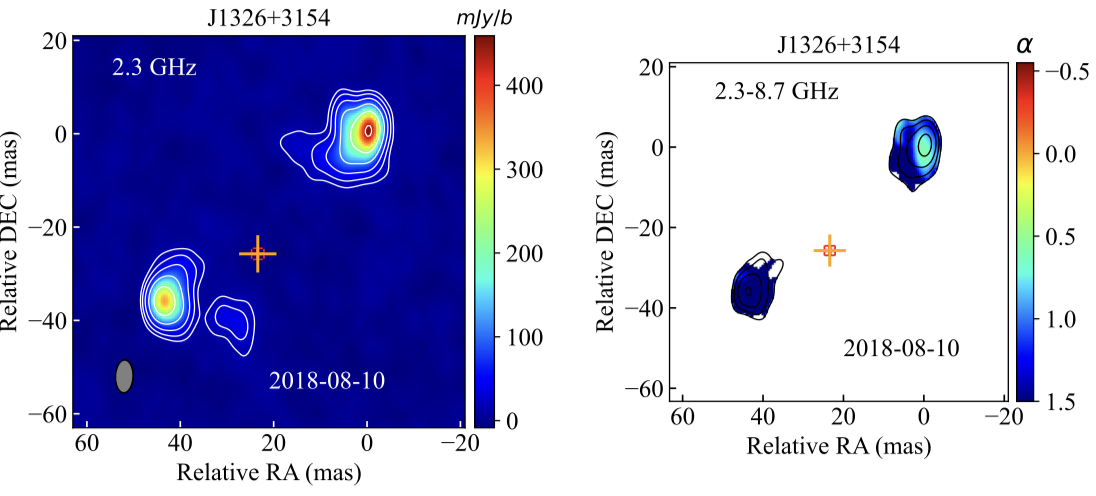
Figure 1.Left: The 2.3‑GHz VLBI image of CSO J1326+3154 shows two radio components straddling the optical core (orange cross, from Gaia). Right: The 2.3/8.7‑GHz spectral‑index map shows both radio components are steep‑spectrum, consistent with the CSO definition.
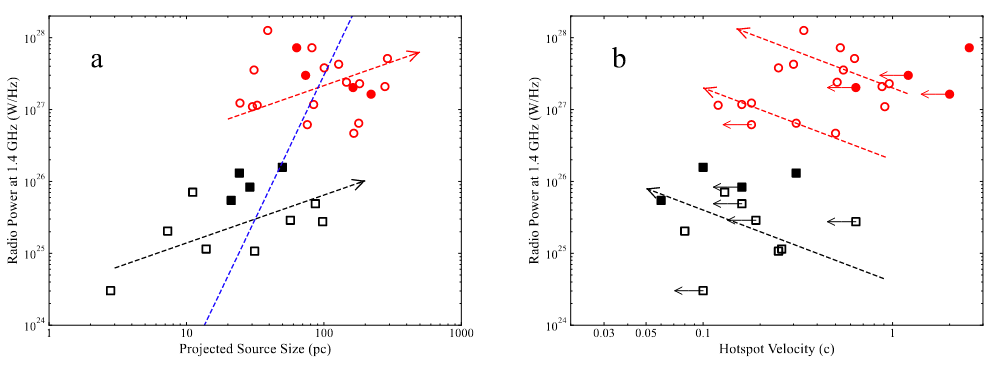
Figure 2. Schematic diagrams of the power–size (left) and power–expansion velocity (right) relations for the CSO sample (see the full figure in the main text of the published paper). The red points and dashed line represent the evolutionary track of high-power CSOs, while the black squares and dashed line correspond to the low-power CSO evolutionary branch. The plots clearly exhibit a distinct double-track evolutionary pattern.
Acknowledgements. This work is supported by the National Key R&D Program of China (SKA), the National Natural Science Foundation of China, the Shanghai Leading Talents (Eastern Scholar) Program, the Tianchi Program of the Xinjiang Uygur Autonomous Region, and the China Postdoctoral Science Foundation. Data processing was carried out at the China node of the SKA Regional Centre.
Paper link:
An Tao, Zhang Yingkang, Frey Sandor, Baan Williem, Wang Ailing. “Identifying compact symmetric objects with high-precision VLBI and Gaia astrometry”, 2025, A&A, 704, A93 https://www.aanda.org/articles/aa/full_html/2025/12/aa54322-25/aa54322-25.html
Related publication: Tao An, Baan Willem. A. Baan, "The Dynamic Evolution of Young Extragalactic Radio Sources", 2012, ApJ, 760, 77 https://iopscience.iop.org/article/10.1088/0004-637X/760/1/77
Scientific contact:
Tao An: antao@shao.ac.cn;
Yingkang Zhang: ykzhang@shao.ac.cn
Download attachments:




