Scientists successfully "dissect" the internal structure of barred spiral galaxies, revealing the secrets of galaxy evolution
Recently, an international team of astronomers developed a novel galaxy "dissection" technique that enables precise analysis of the distinct components within barred spiral galaxies. The findings, published in the academic journal 《Astronomy & Astrophysics》, open a new window into understanding the formation and evolution of galaxies in the universe.
Barred spiral galaxies are a common type of galaxy characterized by a central bar-like structure—with our own Milky Way as a prime example. However, due to observational limitations, scientists have struggled to comprehensively study their internal structures. The central regions of barred galaxies could comprise multiple structures with diverse physical origins, which is hard to separate through traditional methods.
This new method works like a "CT scan" for galaxies. By analyzing the motion and chemical composition of stars, the team successfully decomposed barred spirals into four main components: the central bar (often exhibiting a "peanut-shaped" morphology), the bulge region, the rotating thin disk, and the diffuse stellar halo.
The research team employed supercomputers to model 12 sets of mock observational data of galaxies from different viewing angles. The results demonstrated that their approach accurately measures the mass distribution of each component with errors below 15%. Additionally, they reconstructed the "age records" and chemical compositions of stars in different regions, providing crucial clues about galaxy evolution.
"It's like studying Earth's history through fossils," explained Ling Zhu, a co-author of this study. "Stars in different regions preserve information about the galaxy's formation at different epochs. The bar is typically younger, while the bulge and halo consist of much older stars."
This structural decomposition of barred spirals is a key point in the team's ongoing work on dynamical modeling, successfully separating the classical bulge and bar structures— a challenge in previous studies.
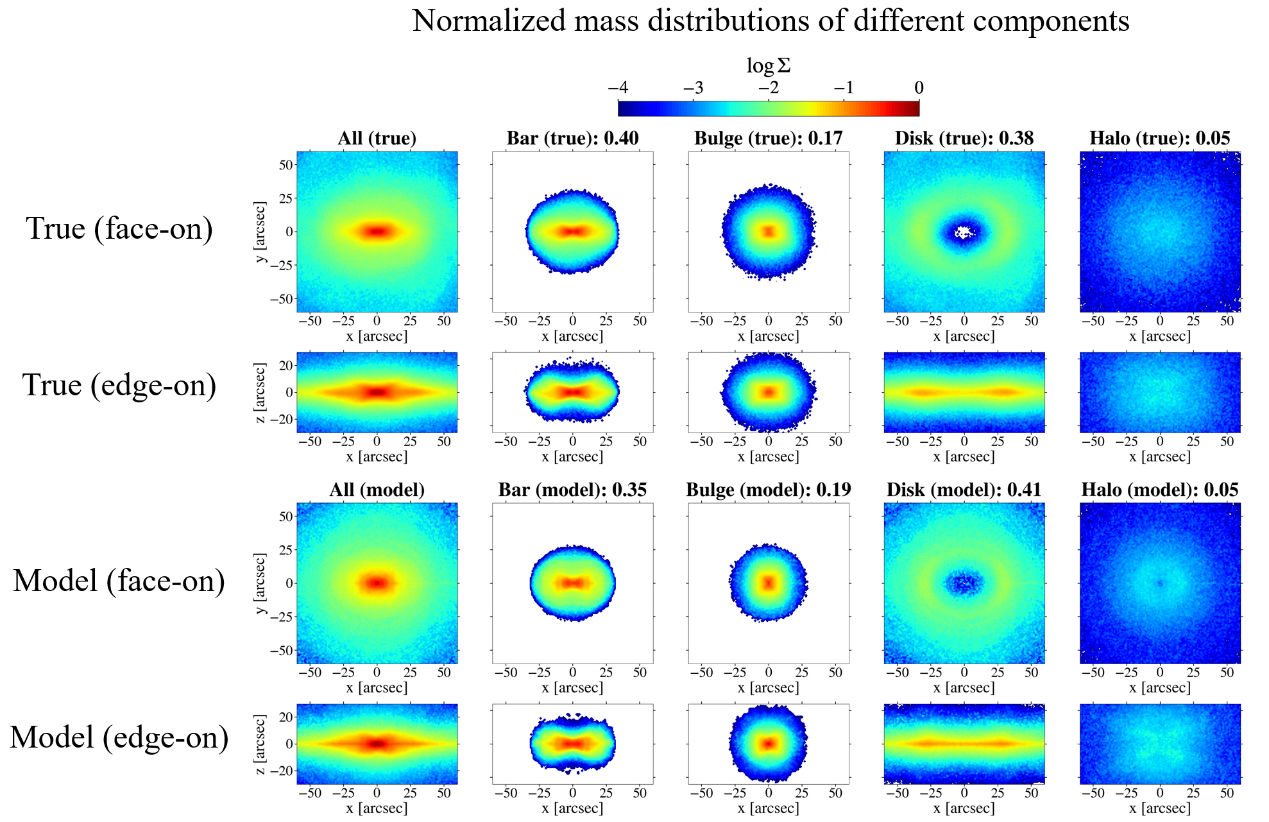
This figure compares spatial distributions of stellar mass for decomposed structures in an example model compared with their true counterparts. The top two rows display the true mass surface densities of the galaxy projected onto the internal x-y (face-on) and x-z (edge-on) planes, while the bottom two rows show the model-predicted results, with the central mass density normalized to unity. From left to right, the panels show the mass surface densities of the entire galaxy, the bar, the bulge, the disk, and the stellar halo. The mass fractions of all components are calculated within the 60×60×30 arcsec^3 volume (aligned with the axis ranges in the panels), with their values shown in the text.
This research will help astronomers delve deeper into the evolutionary history of barred spiral galaxies like our own Milky Way. In the future, the team plans to apply this method to real observational data, particularly targeting galaxy samples from the European Southern Observatory's GECKOS survey.
This study was conducted collaboratively by researchers from Westlake University, the Shanghai Astronomical Observatory of the Chinese Academy of Sciences, and other institutions.
Paper link: https://doi.org/10.1051/0004-6361/202557236
Scientific contacts:
Ling Zhu (lzhu@shao.ac.cn),
Yunpeng Jin(jinyunpeng@westlake.edu.cn)
Download attachments:




