New Study Reveals the Accretion and Migration Processes of Giant Planet Formation
Recently, a research team led by the Shanghai Astronomical Observatory of the Chinese Academy of Sciences, in collaboration with Princeton University, the Institute of Science Tokyo, and the University of California, Santa Cruz, has made significant progress in the study of planetary accretion and migration. The related work, titled “Concurrent Accretion and Migration of Giant Planets in their Natal Disks with Consistent Accretion Torque (II): Parameter Survey and Condition for Outward Migration,” has been published in the international astronomy journal The Astrophysical Journal, providing new insights into the formation of giant planets.
To date, more than 6,000 exoplanets have been discovered through surveys such as Kepler and TESS. Since the discovery of the first exoplanet orbiting a Sun-like star, theories have suggested that these planets did not form at their current distances from their host stars, but instead underwent significant orbital “migration.” Planetary migration is considered a key mechanism for explaining the formation of populations such as hot Jupiters and super-Earths. Low-mass planets weakly perturb the disk and undergo Type I migration, while massive planets open gaps in the disk, slow their migration, and undergo Type II migration. However, classical theories generally predict that, regardless of whether migration is Type I or Type II, planets should migrate significantly inward toward the host star over the million-year lifetime of protoplanetary disks. This prediction is in strong tension with the observed orbital distribution of wide-orbit giant planets, constituting a long-standing challenge in planet formation theory.
The research team find that traditional theories overlook a key aspect of giant planet migration: accretion. During the early formation stages of giant planets, gas accretion is unavoidable; therefore, accretion and migration are intrinsically coupled processes. Previous studies have often treated planetary accretion and migration in isolation, causing this effect to be neglected for a long time. We show that treating accretion and migration concurrently is the key to resolving this problem. In 2024, using three-dimensional hydrodynamical simulations, we first found that accreting giant planets can exhibit outward migration. This outward migration arises from the additional torque exerted on the planet by the circumplanetary disk formed through accretion, which alters the planet’s orbital evolution. In the present work, we conducted a systematic exploration of parameter space and identified the key parameter governing outward migration: the planet’s gap-opening capability. This capability depends on factors such as planet mass, the viscosity of the accretion disk, and the disk aspect ratio (or temperature). We find that if the planet’s gap-opening capability is weak—meaning its ability to capture surrounding gas is limited—the accretion effect is weak and the migration reverts to Type I inward migration. If the gap-opening capability is very strong, the planet clears most of the surrounding gas, again weakening the accretion effect, and migration returns to Type II inward migration. In the intermediate regime, the accretion effect is strongest, leading to outward migration or a significant suppression of inward migration (Figure 1).
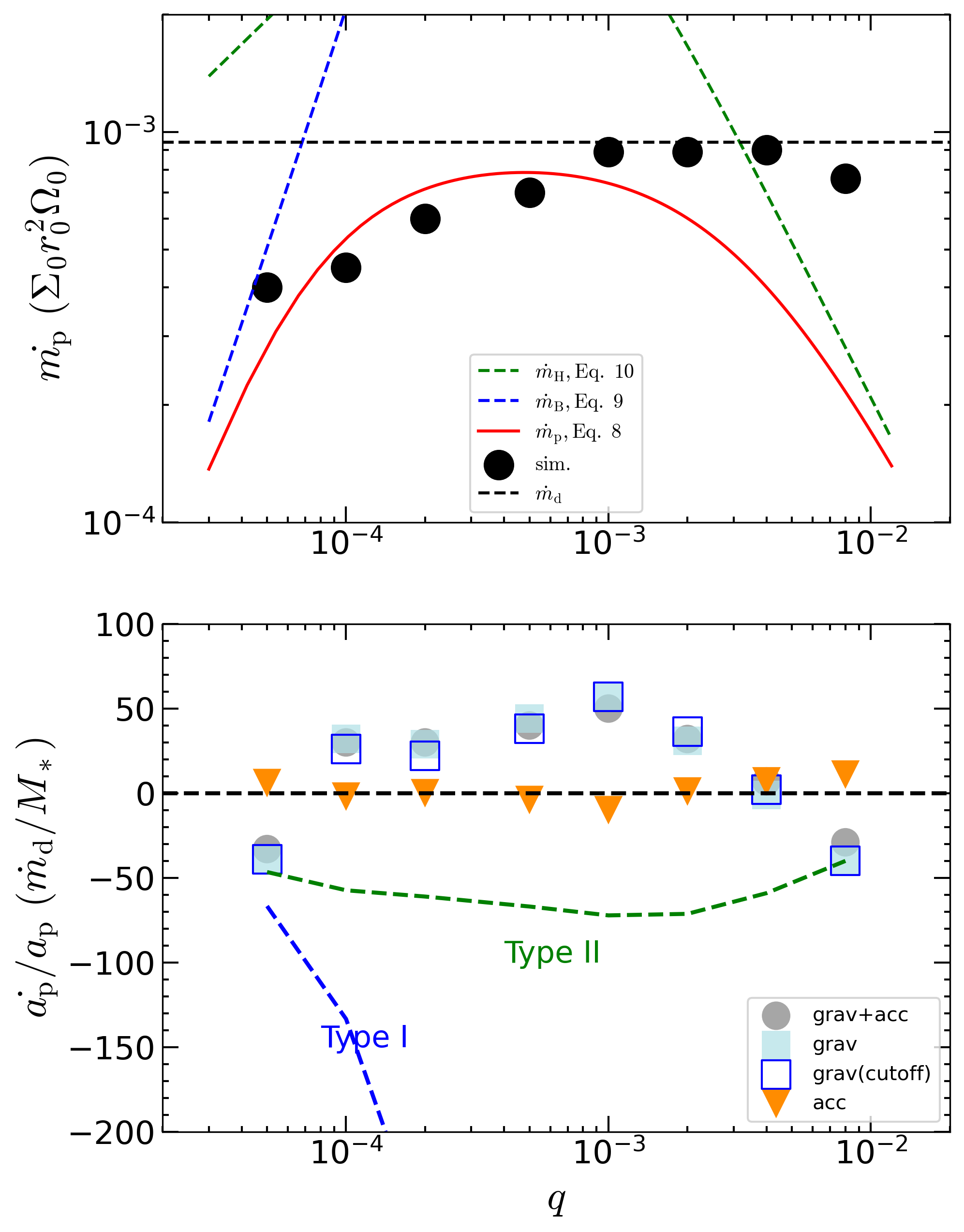
Figure 1. Planetary accretion rate (top panel) and migration rate (bottom panel) as functions of the planet-to-star mass ratio q. When the planet lies in an intermediate mass range, accretion is most efficient and migration becomes outward.
In another paper published simultaneously (Ida et al. 2026), based on the numerical simulation results described above and our previous simulations of planetary accretion rates, The research team derived a new migration formula that describes the coupled mass growth and migration of accreting planets. This provides a solid foundation for future population synthesis models.
With the launch of the ET mission led by the Shanghai Astronomical Observatory, The research team expect to detect more wide-orbit giant planets, which will help us better understand the formation mechanisms of giant planets.
The first author of this work is Junpeng Pan, a graduate student at the Shanghai Astronomical Observatory, and the corresponding author is Ya-Ping Li. This research was supported by the National Natural Science Foundation of China and the Shanghai Natural Science Foundation.
Paper link: https://iopscience.iop.org/article/10.3847/1538-4357/ae261a
Related papers:
Scientific Contact: Ya-Ping Li, liyp@shao.ac.cn
Download attachments:




