ALMA Observations Reveal: The Interplay Between Magnetic Fields and Gravity-A New Perspective on Star Formation in the Central Molecular Zone
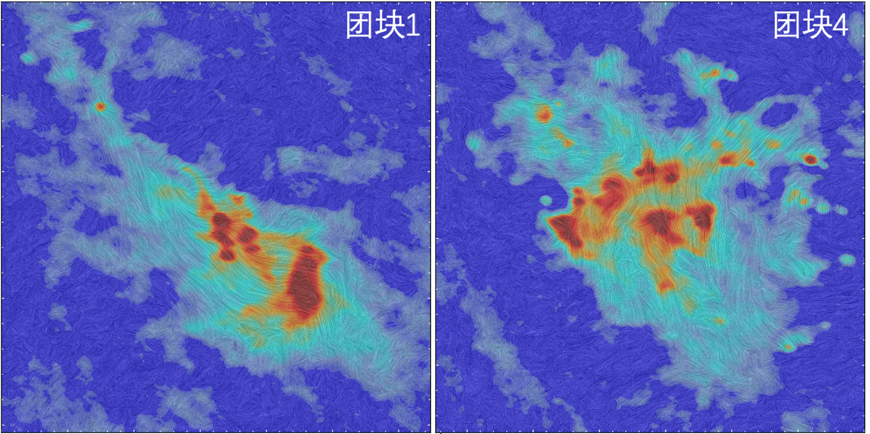
Figure. ALMA 870𝞵m continuum image, the white thin lines denote the inferred magnetic field orientation.
A recent study using the Atacama Large Millimeter/submillimeter Array (ALMA) has provided new insights into the magnetic field structures within two massive clumps in the 20 km/s cloud of the Central Molecular Zone (CMZ) of the Milky Way. By combining high-resolution polarization observations from ALMA with previous data from the James Clerk Maxwell Telescope (JCMT) this work maps the magnetic field strength and orientation across different scales. The findings reveal the complicated interplay between magnetic fields, gravity, and turbulence, which collectively shape the star formation processes in these dense regions. The results have been published in the Astrophysical Journal (ApJ).
Located approximately 26,000 light-years from Earth, the CMZ is one of the most central regions of the Milky Way. The study targets on two massive clumps within the 20 km/s molecular cloud in the CMZ, referred to as Clump 1 and Clump 4. Using ALMA’s high-resolution polarization observations, the researchers found that the magnetic field strengths in these regions range from 0.3 to 3.1 milligauss (mG). When combined with JCMT polarization observations, the study reveals that at larger cloud scales (~2 light-years), the magnetic field dominates the dynamics, while at smaller scales, such as cores (0.03–0.3 light-year) and condensations (less than 0.03 light-year), gravity begins to take over. This transition highlights the complex balance of forces at play in star-forming regions.
Another key significance of this research is its quantitative analysis of magnetic tension and gravitational forces between the cores, in addition to comparing the orientations of magnetic fields and gravity. The results indicate that while magnetic fields resist gravitational collapse, their strength is insufficient to completely prevent gas from collapsing into dense cores. This suggests that star formation may occur in these regions, driven by the combined effects of gravity, turbulence, and magnetic fields.
These findings significantly enhance our understanding of the physical processes involved in star formation, particularly in the extreme environment of the CMZ. By revealing the complex interactions between magnetic fields, gravity, and turbulence, this study paves the way for future exploration of molecular cloud dynamics and the mysteries of stellar birth.
Paper link: https://doi.org/10.3847/1538-4357/ae3a9b
Contact: Liu Yuhua, liuyuhua@shao.ac.cn
Download attachments:




