Progress in Asteroid Spectral Research
Recently, significant findings in asteroid spectral research, led by the Shanghai Astronomical Observatory of the Chinese Academy of Sciences in collaboration with multiple institutions including the Macau University of Science and Technology and the University of Winnipeg in Canada, were published online in the international astronomy journal The Astrophysical Journal Supplement Series. This study not only deepens our understanding of the surface composition of S-type asteroids but also provides critical scientific support for China's asteroid exploration missions.
Asteroids in our solar system preserve primordial information from the time of its formation 4.6 billion years ago. Traditionally, astronomers classify asteroids into three major types—S, C, and X—based on the relationship between the intensity of reflected sunlight and wavelength. Among these, S-type asteroids are predominantly found in the inner region of the main asteroid belt and are the most common type among near-Earth asteroids. Their main components are silicate minerals such as olivine and pyroxene, making them similar to ordinary chondrites found on Earth.
Scientists typically need to compare asteroid spectra with laboratory data from meteorites to infer their mineral composition. However, the challenge lies in the significant differences between space observation conditions and laboratory environments, making direct comparison complex. Through a series of experimental analyses on ordinary chondrite samples, the research team systematically investigated the spectral response mechanisms of S-type asteroids in the visible and near-infrared (VNIR) wavelength range.
The study found that both high phase angle observation conditions and fine-grained surface materials significantly increase the spectral slope, an effect similar to space weathering. In other words, an asteroid's surface state and viewing geometry can "distort" its spectral features, which must be corrected to accurately interpret its composition.
More notably, the research revealed a "antagonistic" effect of thermal metamorphism and shock metamorphism on spectra: stronger thermal metamorphism leads to more pronounced absorption features, while higher degrees of shock metamorphism result in weaker absorption features. This discovery provides a new clue for scientists to reconstruct the thermal evolution history of asteroids.
Furthermore, the study clarified a long-standing question: although S-type asteroids contain small amounts of iron-nickel metal (typically less than 10%), the presence of this metal has a negligible effect on their spectral shape.
Based on these findings, the research team further analyzed the target bodies of several asteroid exploration missions. The results indicate that the target of NASA's OSIRIS-APEX mission, 99942 Apophis, and the target of China's Tianwen-2 mission, 469219 Kamo'oalewa, are both S-type near-Earth asteroids with compositions similar to LL ordinary chondrites. Meanwhile, 4179 Toutatis, flown by and observed during the Chang'e-2 mission, has a composition closer to L ordinary chondrites. This series of comparisons not only validates the reliability of the spectral analysis method but also provides important scientific groundwork for future asteroid sample-return missions.
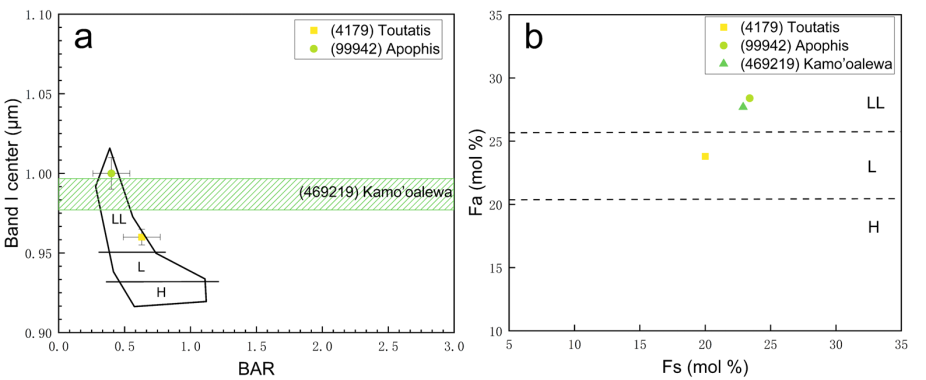
Figure 1: Mineralogical analysis of multiple asteroid mission targets based on spectral observation data. (a) Comparison of spectral parameters; (b) Spectral-derived mineralogical analysis.
This research not only advances the development of remote sensing for asteroid composition but also demonstrates the important role of international cooperation in deep space exploration. As missions like Tianwen-2 progress, humanity's understanding of asteroids will deepen further.
This research was supported by the National Natural Science Foundation of China, the China Postdoctoral Science Foundation.
Paper link: https://doi.org/10.3847/1538-4365/ae3fa4
Scientific contact: Wang Pengyue, Email: pywang@shao.ac.cn
Download attachments:




