China-Uzbekistan Cooperation Achieves High-Precision Digitization of Uzbekistan’s Century-Old Astronomical Plates
Recently, the research on astronomical plate digitization and astrometric analysis, carried out by the Shanghai Astronomical Observatory (SHAO) of the Chinese Academy of Sciences in cooperation with the Ulugh Beg Astronomical Institute (UBAI) of the Academy of Sciences of Uzbekistan, has been published in the Monthly Notices of the Royal Astronomical Society (MNRAS).
Astronomical plates serve as crucial observational carriers in early astronomy, preserving valuable century-long astronomical data. However, their scientific value has not been fully exploited due to issues such as physical vulnerability and difficulties in data extraction. As one of the oldest astronomical research institutions in Central Asia, UBAI has maintained continuous observations since 1895 until the early 21st century, accumulating more than 15,000 observational plates covering various celestial bodies—an extremely precious scientific resource.
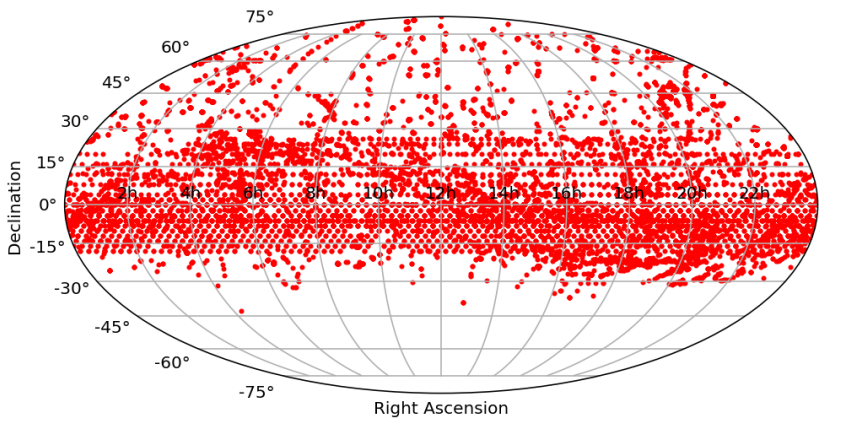
Fig 1. Distribution of the sky areas pointed to by the UBAI astronomical plates
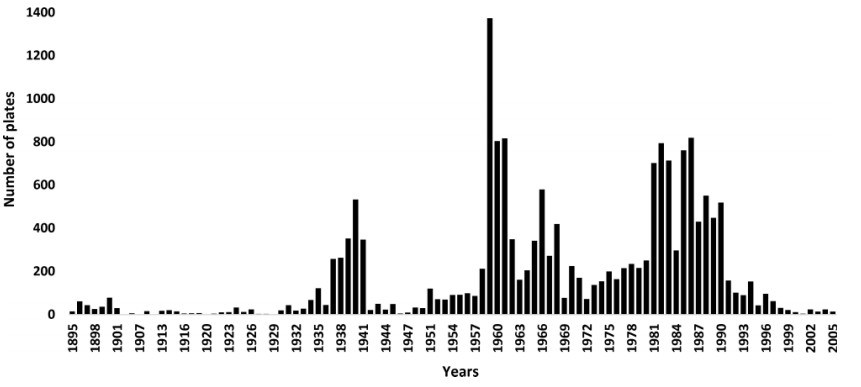
Fig 2. Distribution of the number of UBAI astronomical plates over the years of observation
Following the establishment of cooperation between China and Uzbekistan in 2018, all UBAI plates have been digitized using high-precision astronomical plate scanners independently developed by SHAO. The scanned plate images are stored in the standard FITS format, fully retaining the metadata and original observational information. Based on the imaging characteristics of different plates, the research team first conducted astrometric calibration on single-exposure plates.
Building on previous work, the team introduced point spread function (PSF) fitting and secondary matching with the Gaia DR3 catalog, optimized the plate parameter model, and effectively suppressed systematic errors and local distortions in plate imaging. In total, 2,330 plates have been processed with an astrometric accuracy better than 0.3 arcseconds.
This work not only preserves precious astronomical heritage but also provides a feasible technical solution and practical model for the preservation and scientific utilization of historical astronomical plates worldwide.
DOI: https://doi.org/10.1093/mnras/stag335
Scientific contacts:
Zhengjun Shang, zjshang@shao.ac.cn
Meiting Yang, ymt@shao.ac.cn
Download attachments:




