TMRT reports first confirmation that magnetars' radio-active phase evolves reproducibly
Recently, the Tianma Radio Telescope (TMRT) team at the Shanghai Astronomical Observatory (SHAO) of the Chinese Academy of Sciences, leveraging the telescope’s unique "dual-band simultaneous observation" capability, conducted simultaneous observations of the magnetar XTE J1810−197 at 2.25 GHz and 8.60 GHz over a span of more than 2,100 days. The team precisely characterized the evolution of the magnetar’s radiation and rotation during its latest radio-active phase, and found striking similarities with its previous radio-active phase, thereby conclusively answering the question: "Can the evolutionary patterns of a magnetar’s radio-active phase be reproduced?" The relevant findings were recently published in the international academic journal SCIENCE CHINA Physics, Mechanics & Astronomy (Volume 69, 2026).
Magnetars are a class of special pulsars with extremely strong magnetic fields, typically ranging from 10^13 to 10^15 Gauss—more than a billion times stronger than the highest magnetic fields ever produced in terrestrial laboratories. Magnetars often exhibit brief but intense high-energy outbursts, releasing energies that sometimes exceed the loss of their rotational energy, suggesting that magnetic energy is their primary power source. Currently, a total of about 30 magnetars and candidates are known across the sky, mainly manifesting as soft gamma-ray repeaters and anomalous X-ray pulsars. In addition, magnetars are also considered the "engines" behind various short-duration violent burst phenomena, including fast radio bursts. Among the known magnetars and candidates, only six have been detected to emit radio pulse radiation—an extremely rare occurrence. Although magnetar research holds great physical significance, our understanding remains limited, partly due to the scarcity of samples and observational data, and partly due to their inherently "changeable" nature.
The Tianma Radio Telescope (TMRT) team at SHAO has consistently regarded magnetars as important research targets. During the telescope’s commissioning phase, they achieved high-sensitivity observations of radio outbursts from a magnetar near the supermassive black hole at the Galactic center, and have since made several significant advances based on these observations. This study focuses on the first magnetar ever detected in radio—XTE J1810−197. After its first detection of radio pulse radiation in 2004, the source remained active until late 2008, when it entered a radio-quiet phase. Following a decade of quiescence, it became radio-active again in late 2018. The TMRT team promptly organized efforts and fully utilized the telescope’s "dual-band simultaneous observation" capability, conducting monitoring of this magnetar simultaneously at 2.25 GHz and 8.60 GHz. Over a period of more than 2,100 days, the team completed 296 observations, covering nearly the entire duration of this active episode, from onset to quiescence.
Based on high-quality observational data, the team first precisely characterized the evolution of the magnetar’s rotation and radiation during this active period (Figure 1). Compared with single-frequency observations, the "dual-band simultaneous" feature not only reveals the evolution of radiation over time but also discerns, with great sensitivity, the frequency-dependent behavior of radiation. For highly variable objects like magnetars, simultaneous dual- or multi-frequency observations are essential for disentangling true frequency-dependent radiation properties; otherwise, temporal evolution can be mistakenly attributed to frequency dependence, leading to a "fixed-time-snapshot" misinterpretation.
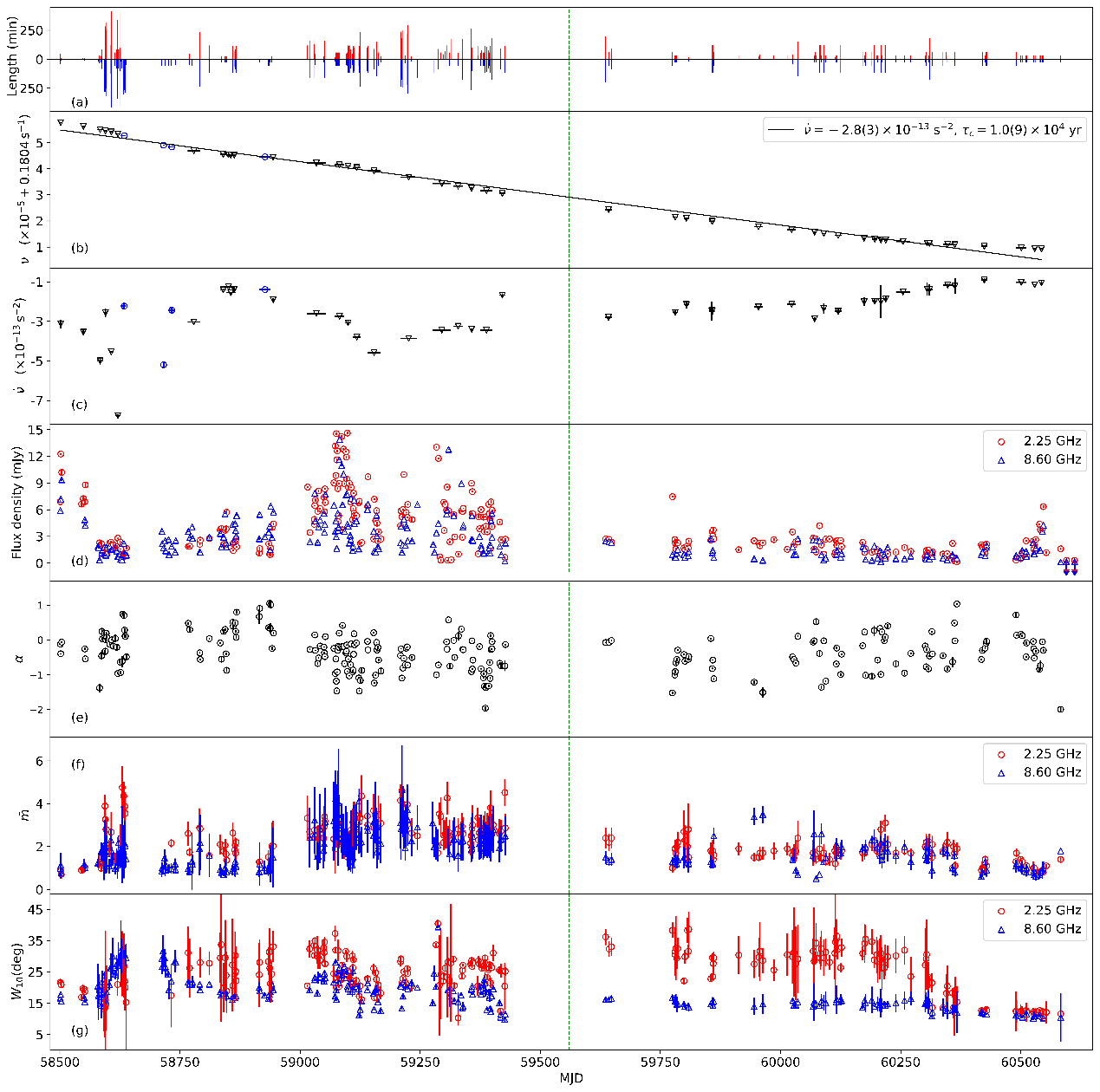
Figure 1: Temporal evolution of the rotation and radiation parameters of XTE J1810−197: (a) duration of dual-frequency observations; (b) rotation frequency; (c) first derivative of rotation frequency; (d) dual-frequency flux density; (e) spectral index; (f) phase modulation index of the intermediate component; (g) width of the intermediate component at 10% of peak intensity.
Based on the above analysis, the team has for the first time conclusively answered whether the evolutionary patterns of a magnetar’s radio-active phase can be reproduced. As shown in Figure 2, by comparing the evolution of the first derivative of rotation frequency during the latest radio-active phase with that during the historical active episode in 2003, the team demonstrates that XTE J1810−197 exhibits highly consistent evolutionary characteristics across the two episodes: from intense fluctuations in the early active phase, to a "decline–rebound" in the middle phase, and to a stable plateau in the late phase—both the timescales and amplitudes are remarkably similar. Further analysis indicates that this "reproducibility" is reflected not only in the amplitude and timescale of changes in the first derivative of rotation frequency but also in the overall evolutionary trend of radio emission behavior. To explain the reproducibility of these patterns, the team used a twisted magnetosphere model to fit the measured values (indicated by the blue solid line in Figure 2) and found that this theoretical model can account for the magnetar’s spin-down evolution and radiation characteristics to a certain extent. This study not only deepens our understanding of the radio emission mechanism of magnetars but also provides key observational evidence for exploring plasma physics processes under extreme magnetic fields, and offers a new basis for predicting magnetar radio activity.
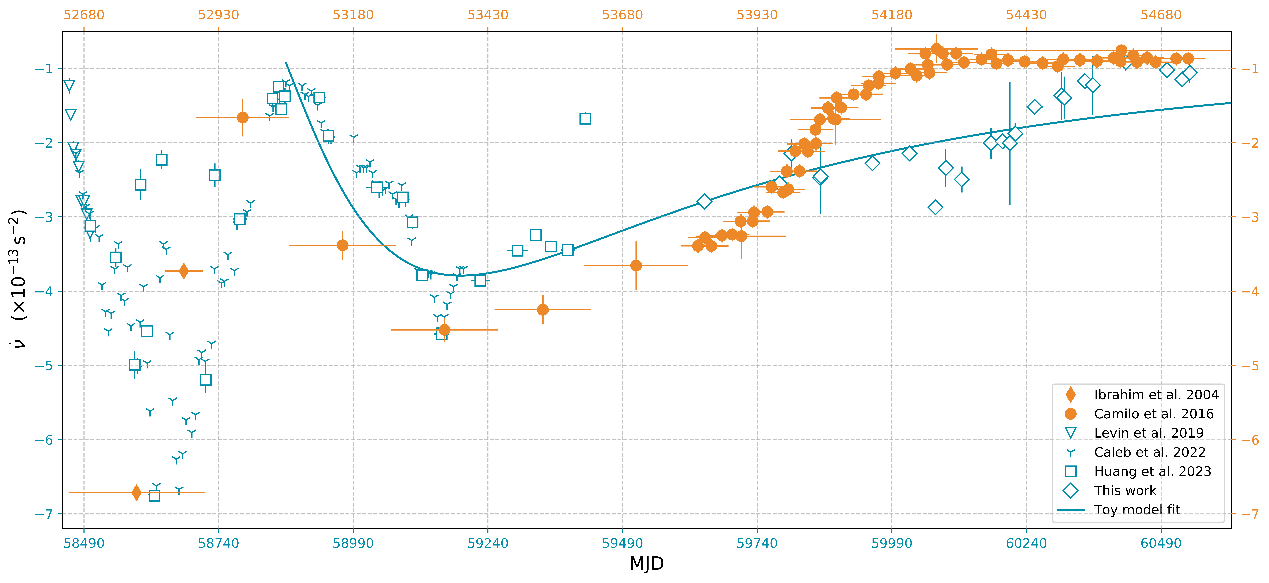
Figure 2: Comparison of the evolution of the first derivative of rotation frequency of XTE J1810−197 during its 2003 (orange) and 2018 (blue) radio active episodes, with the blue solid line representing the fit to the 2018 data using a twisted magnetosphere model.
In addition to the Shanghai Astronomical Observatory, this research was completed in collaboration with Hubei University of Education, Guangzhou University, the Institute of High Energy Physics (Chinese Academy of Sciences), and the Xinjiang Astronomical Observatory. The project received substantial support from the Ministry of Science and Technology’s Square Kilometre Array (SKA) Special Project, the National Key Research and Development Program of China, the National Key Laboratory of Radio Astronomy and Technology, and other related programs. The dedicated support of the Tianma Telescope operations team played a decisive role in achieving the research objectives.
Link to paper: https://doi.org/10.1007/s11433-025-2902-8
Scientific contacts:
Zhen Yan, yanzhen@shao.ac.cn
Zhiqiang Shen, zshen@shao.ac.cn
Download attachments:




