Astronomers Capture a Black Hole’s “Dinner Plate” Being Warped
A research team led by the Shanghai Astronomical Observatory (SHAO) of the Chinese Academy of Sciences has conducted high-resolution observations on the microquasar GRS 1915+105 with the East Asian VLBI Network (EAVN). The findings were published online on March 25, 2026, in The Astrophysical Journal Letters.
They found a large misalignment between the continuous jet and the discrete ejecta. Moreover, the velocity of the discrete ejecta was much lower than the previously reported near-light-speed value — only about 0.35 c (c is the speed of light) (Figure 1). This source was previously well-known for its superluminal jet phenomenon. Given that the microquasar is currently in an X-ray obscured phase, the research team proposes, through numerical simulations and theoretical analysis, that the black hole’s accretion disk (i.e., its “dinner plate”) may have been tilted by the tidal torque of a massive perturber. The discrete ejecta are launched along the normal direction of the warped disk, resulting in a change of direction. Meanwhile, the inner disk, closer to the black hole, is rapidly realigned with the black hole’s spin axis due to effects such as the Bardeen–Petterson effect, thereby keeping the continuous jet aligned with the long-term projected direction on the sky (position angle ~147°).
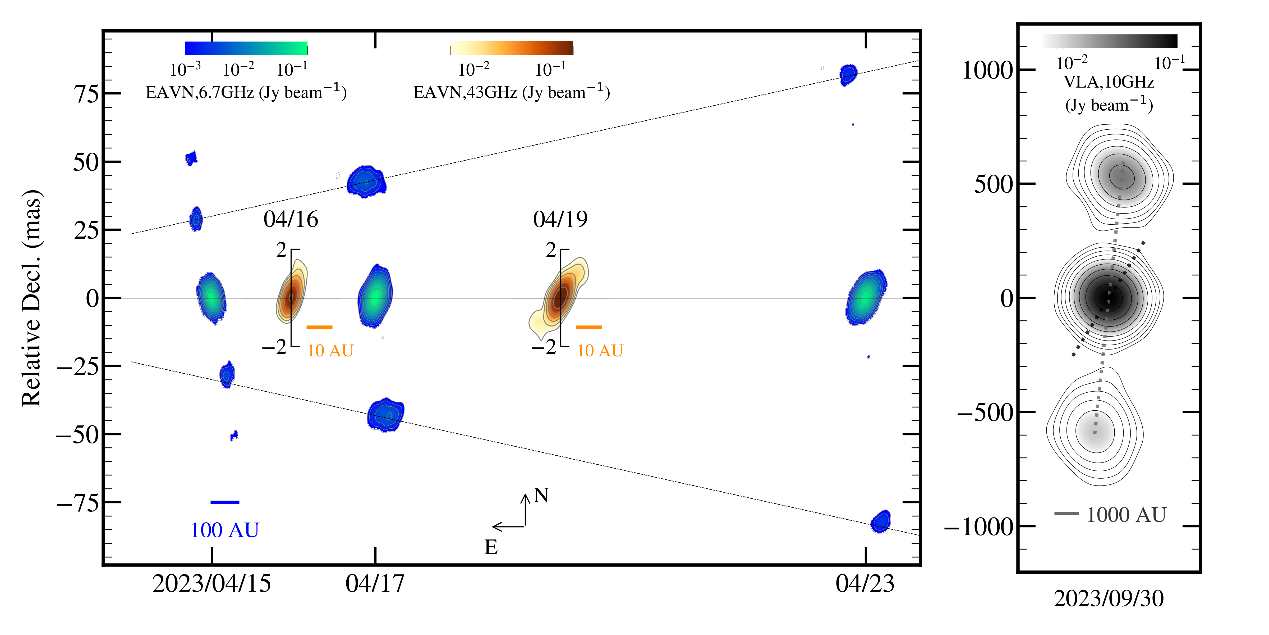
Figure 1: The continuous jet and discrete ejecta of the microquasar GRS 1915+105 appear at different position angles (Jiang et al. 2026).
A microquasar is a binary system consisting of a stellar-mass black hole or neutron star and a normal companion star. GRS 1915+105 is one of the most famous black-hole microquasars. Since its discovery in 1992, its jet direction has retained stable at a position angle of around 147°. During a radio outburst of this source in April 2023, the researchers resolved two-sided discrete ejecta from its 6.7 GHz images obtained with the EAVN, while detecting the central continuous jet in 43 GHz images. The results show that the continuous jet remains consistent with the long-term direction (~147°), whereas the discrete ejecta appear at a position angle of approximately 188° — a deviation of more than 40° from the continuous jet. A similar deviation in position angle was observed during a consecutive outburst in late September 2023.
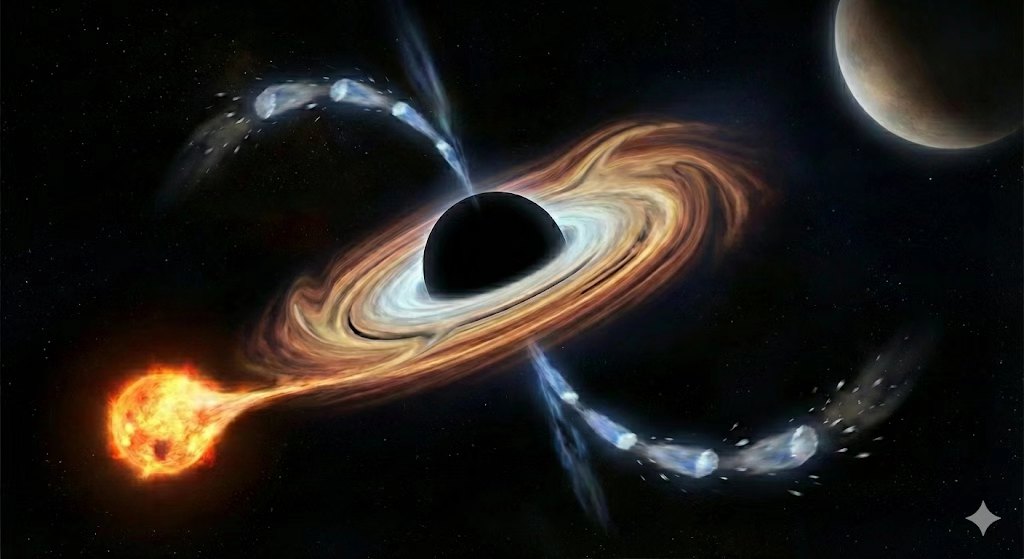
Figure 2: Schematic diagram of the warped accretion disk and jets in the microquasar GRS 1915+105 (generated by nano banana).
Such a significant and repeatable misalignment in position angle, together with the observed X-ray obscuration, points to a warped accretion disk. Numerical simulations show that a massive perturber at a close flyby-orbit of the microquasar system would be sufficient to tilt the black hole’s accretion disk, causing the disk’s normal axis to deviate significantly from the black hole’s spin axis. Existing magnetohydrodynamic simulations suggest that such a misalignment can easily trigger warping or even tearing of the accretion disk. When these warped disk patches propagate inward, they may launch discrete ejecta along their local spin axes. In contrast, the inner disk, being closer to the black hole, realigns with the black hole’s spin axis due to the Bardeen–Petterson effect or magneto-spin alignment (Figure 2).
This study not only reveals the unique physical processes occurring in GRS 1915+105 during its obscured phase, providing important clues for understanding jet formation mechanisms in black hole accretion systems under different states, but also offers new observational evidence to distinguish between continuous jets and discrete ejecta. Furthermore, it provides new insights into explaining transient phenomena in X-ray binaries, changing-look active galactic nuclei, and other astrophysical sources.
The work was carried out primarily in collaboration between the Shanghai Astronomical Observatory and the Xinjiang Astronomical Observatory, and was supported by the National Natural Science Foundation of China, the National Key R&D Program of China, and other funding agencies.
Paper link: https://iopscience.iop.org/article/10.3847/2041-8213/ae5186
Science Contacts:
Wu Jiang: jiangwu@shao.ac.cn
Zhen Yan: zyan@shao.ac.cn
Zhiqiang Shen: zshen@shao.ac.cn
Download attachments:




