Workshop on the Formation of Exo-terrestrial Planets Held in Shanghai
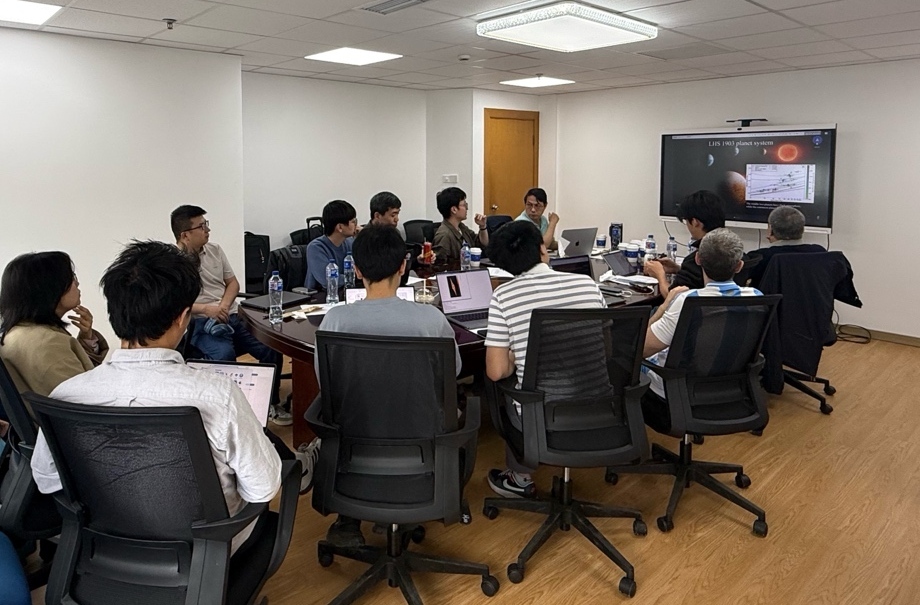
On April 17, 2026, the Workshop on the Formation of Exo-terrestrial Planets, hosted by the Shanghai Astronomical Observatory (SHAO) of the Chinese Academy of Sciences, was held in Shanghai. The meeting was chaired by Professor Jian Ge.
The workshop was conducted in a hybrid format and brought together more than 20 experts and scholars from 12 research institutions in China and abroad. Participating institutions included the University of California, Santa Cruz, the Max Planck Institute for Astronomy, the University of Southern Queensland, the University of Hong Kong, the University of Toronto, Indiana University as well as SHAO, Westlake University, Purple Mountain Observatory, Tsinghua University, Zhejiang University, and Sun Yat-sen University.
The workshop focused on the formation and evolution of exo-terrestrial planets, an important frontier area in exoplanet research. Discussions covered the latest progress in the field, major scientific questions, possible formation mechanisms, and key evolutionary processes. Through invited presentations and focused discussions, participants exchanged views on recent advances and held in-depth discussions on several key issues.
The workshop brought together experts and young scholars in the field, helping to further refine the major scientific questions related to the formation and evolution of exo-terrestrial planets and to identify several priority directions for future research. The meeting will help promote closer collaboration, coordinated research efforts, and international cooperation on these key scientific questions, thereby supporting the core scientific goals of the Earth 2.0 mission.
Participants noted that research on the formation and evolution of exo-terrestrial planets is an important component of the scientific framework of the ET mission and a major frontier direction in future international exoplanet research. The workshop provided a high-level platform for academic exchange, deepened scientific consensus, and helped integrate research efforts. It is expected to play a positive role in advancing China’s frontier exploration in this area and enhancing the scientific research and output of the ET mission.
Download attachments:




