Tianma Telescope Team Achieves Major Progress in Interstellar Scintillation Study of Magnetar XTE J1810-197
Recently, the Tianma Telescope team from the Shanghai Astronomical Observatory (SHAO) of the Chinese Academy of Sciences has achieved significant progress in the study of interstellar scintillation properties of the magnetar XTE J1810-197. Their key advancements include: explaining why previous low-frequency observations failed to characterize its diffractive interstellar scintillation timescale, pinpointing the location of its interstellar scattering screen, and setting a new record for the highest-frequency detection of a "scintillation arc." These findings have been published in the international journal Chinese Physics Letters.
Magnetars are a special class of neutron stars distinguished by their extraordinarily strong magnetic fields (10^13–10^15 Gauss). They differ from ordinary pulsars in several respects, including possessing stronger magnetic fields, being younger, having longer spin periods, exhibiting more frequent high-energy (X-ray and gamma-ray) activity, showing a lower proportion of radio emission, and displaying highly variable radiation properties. To date, astronomers have discovered just over 30 magnetars (including candidates), but only six have been detected in radio pulsations.
For many years, the Tianma Telescope has targeted magnetars as key observational objects, producing a series of influential results regarding their emission, rotation, and frequency characteristics. Recently, the team turned its focus to interstellar scintillation—analogous to stars "twinkling" in the radio band (see Figure 1). This phenomenon serves as a powerful tool to probe the distribution, turbulence, and scattering properties of interstellar plasma along the signal's path. Leveraging the Tianma Telescope's advantages of high sensitivity at high frequencies and multi-frequency observing capabilities, the team analyzed six years of monitoring data on magnetar XTE J1810-197, conducting an in-depth investigation of its interstellar scintillation at 7.00 GHz, 8.60 GHz, and 14.0 GHz.
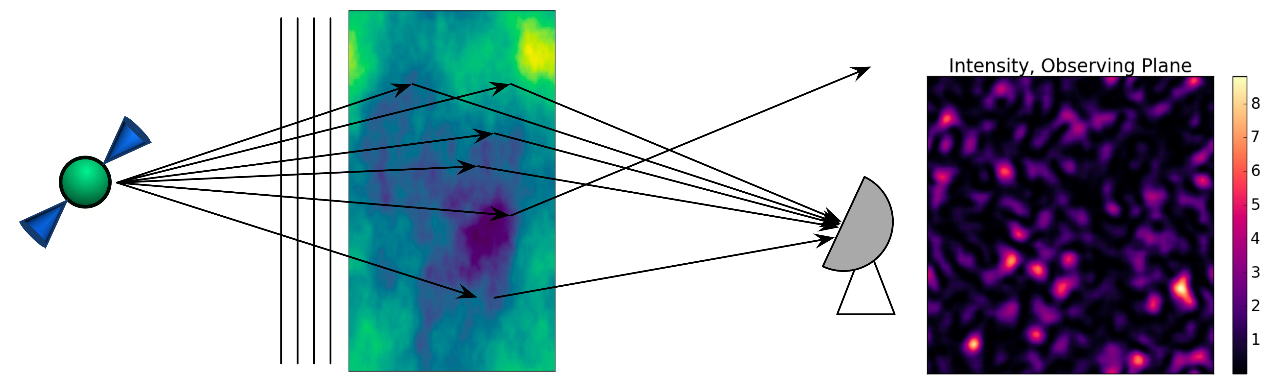
Figure 1 – Schematic diagram of the magnetar interstellar scintillation principle (Image Credit: Jeffrey Hazboun).
To address the masking effect of the magnetar's intrinsic, highly variable emission on the scintillation signal, the team applied a singular value decomposition (SVD) algorithm. This effectively corrected for intrinsic variability in the majority of the observational data, allowing the interstellar scintillation to be visualized as two-dimensional dynamic spectra. Subsequently, they performed two-dimensional autocorrelation analysis to fit the parameters of the scintillation fringes, and employed Fourier analysis (i.e., secondary spectroscopy) to detect scintillation arcs, further constraining the properties of the interstellar plasma (see Figure 2). In observations at frequencies as high as 14.0 GHz, the team clearly detected diffractive interstellar scintillation from the target magnetar, effectively resolving the debate over whether a strong-to-weak scattering transition occurs at these frequencies. Through the above analyses, they not only obtained key parameters—such as scintillation timescale, characteristic bandwidth, and drift rate—but also achieved three major breakthroughs.
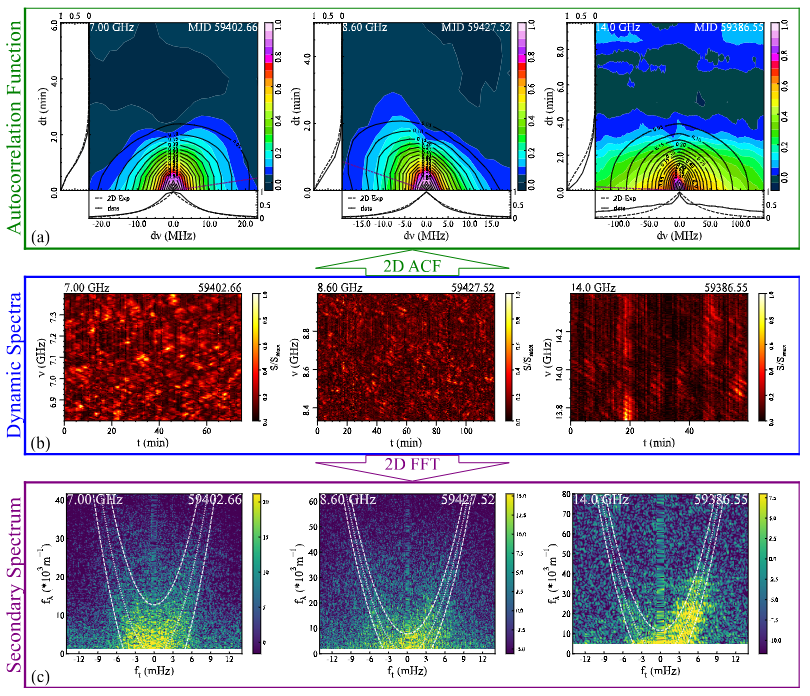
Figure 2 – Results for the magnetar at 7.00, 8.60, and 14.0 GHz: two-dimensional dynamic spectra of interstellar scintillation (middle panels), autocorrelation analysis (top panels), and secondary spectra (bottom panels).
【1】 Explaining why previous low-frequency observations failed to measure the diffractive scintillation timescale.
In 2024, an international team using the upgraded Giant Metrewave Radio Telescope (uGMRT) observed the magnetar XTE J1810-197 in the 575–725 MHz band. While they obtained some results, they were unable to measure the target's diffractive scintillation timescale. Based on the high-frequency observations from the Tianma team, a model was used to deduce that at 575–725 MHz, the diffractive scintillation timescale of this magnetar is less than 4 seconds—shorter than its spin period (5.54 seconds). This finding explains why the previous international team could not detect coherence between pulse signals in that band: the timescale was simply too short to permit reliable fitting.
【2】 Locating the interstellar scattering screen of the magnetar.
Using a kinematic model, the team placed the dominant scattering screen in the Sagittarius Arm at a distance of approximately 1.6 kiloparsecs (kpc) from Earth. The position of this scattering screen coincides with that of the HII region JCMTSE J180921.2–201932. This HII region is an active massive star-forming area, where localized ionization caused by stellar winds from newborn stars leads to enhanced turbulence in the interstellar medium. The result shows that the scattering screen lies far from the magnetar, ruling out the previous international team's hypothesis that some of the scintillation-related spectral features were linked to the magnetar's 2018 outburst.
【3】 Setting a new record for the highest-frequency detection of a scintillation arc in secondary spectra.
As shown in the bottom panels of Figure 2, the study clearly detected parabolic "scintillation arcs" in the secondary spectra of magnetar XTE J1810-197 at 7.00, 8.60, and 14.0 GHz. The detection of a scintillation arc at 14.0 GHz surpasses the previous international record for the highest frequency at which a scintillation arc has been detected—a record previously set by the same Tianma team at 8.60 GHz. In addition, the team found that these scintillation arcs exhibit a pronounced asymmetry. To explore the underlying physical mechanism, they analyzed the relationship between an asymmetry parameter (logarithmic asymmetry ratio) and the dispersion gradient. Their results confirm that the two evolve synchronously and exhibit a strong linear correlation (see Figure 3), providing the first direct observational evidence supporting the theory that dispersion gradients cause arc asymmetry.
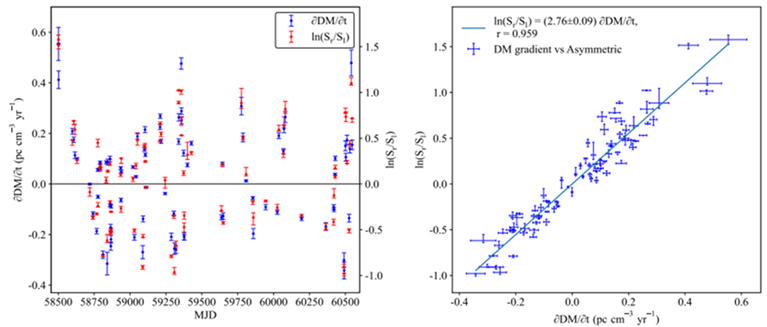
Figure 3 – Relationship between arc asymmetry and dispersion gradient: their evolution over time (left) and correlation analysis (right).
Furthermore, using six years of flux density monitoring data, the team successfully measured the refractive interstellar scintillation timescale of the magnetar, thereby completing the physical picture of interstellar medium scattering toward this source. This research was accomplished through the close collaboration of members of the Tianma Telescope team at Shanghai Astronomical Observatory, with valuable input from several domestic colleagues.
This work received support from the Ministry of Science and Technology's Square Kilometre Array (SKA) Special Project, the National Key Research and Development Program of China, and the Key Laboratory of Radio Astronomy and Technology. The dedicated support of the Tianma Telescope operations team played a decisive role in achieving these research goals.
Paper link: https://cpl.iphy.ac.cn/article/doi/10.1088/0256-307X/43/4/041101
Science contacts:
Zhen Yan, yanzhen@shao.ac.cn
Zhi-Qiang Shen, zshen@shao.ac.cn
Download attachments:




