Researchers Use Counterjet to Reveal Clumpy Gas Near 3C 84 Black Hole
Researchers from the Shanghai Astronomical Observatory, Chinese Academy of Sciences, have utilized the extremely faint counterjet in the nearby radio galaxy 3C 84 as a tomographic probe, discovering that the dense ionized gas surrounding the central supermassive black hole is lumpy and inhomogeneous, the team successfully used this hard-to-see jet as a moving backlight to illuminate the black hole's hidden environment. The study was published in The Astrophysical Journal.

Figure 1 Artist's impression: The clumpy ionized gas surrounding the central black hole in 3C 84 obscures the northern counterjet. The southern jet is brighter, while the northern counterjet serves as a backlight to probe the circumnuclear absorbing medium.
First, the research team found compelling evidence of an external free-free absorption screen by conducting a dual-frequency spectral index analysis. While the approaching southern jet hotspot maintained an optically thin synchrotron spectrum, the northern counterjet components, identified as N1 and N2, exhibited strongly inverted radio spectra between 15 and 43 GHz. The team estimated that the free-free absorption optical depth at 15 GHz decreased from approximately 3.0 to 1.9 in N1, and from 3.7 to 2.4 in N2, yielding an electron number density of 104 to 105 cm-3 under a reasonable absorption path length, consistent with typical active galactic nuclei (AGN) values.
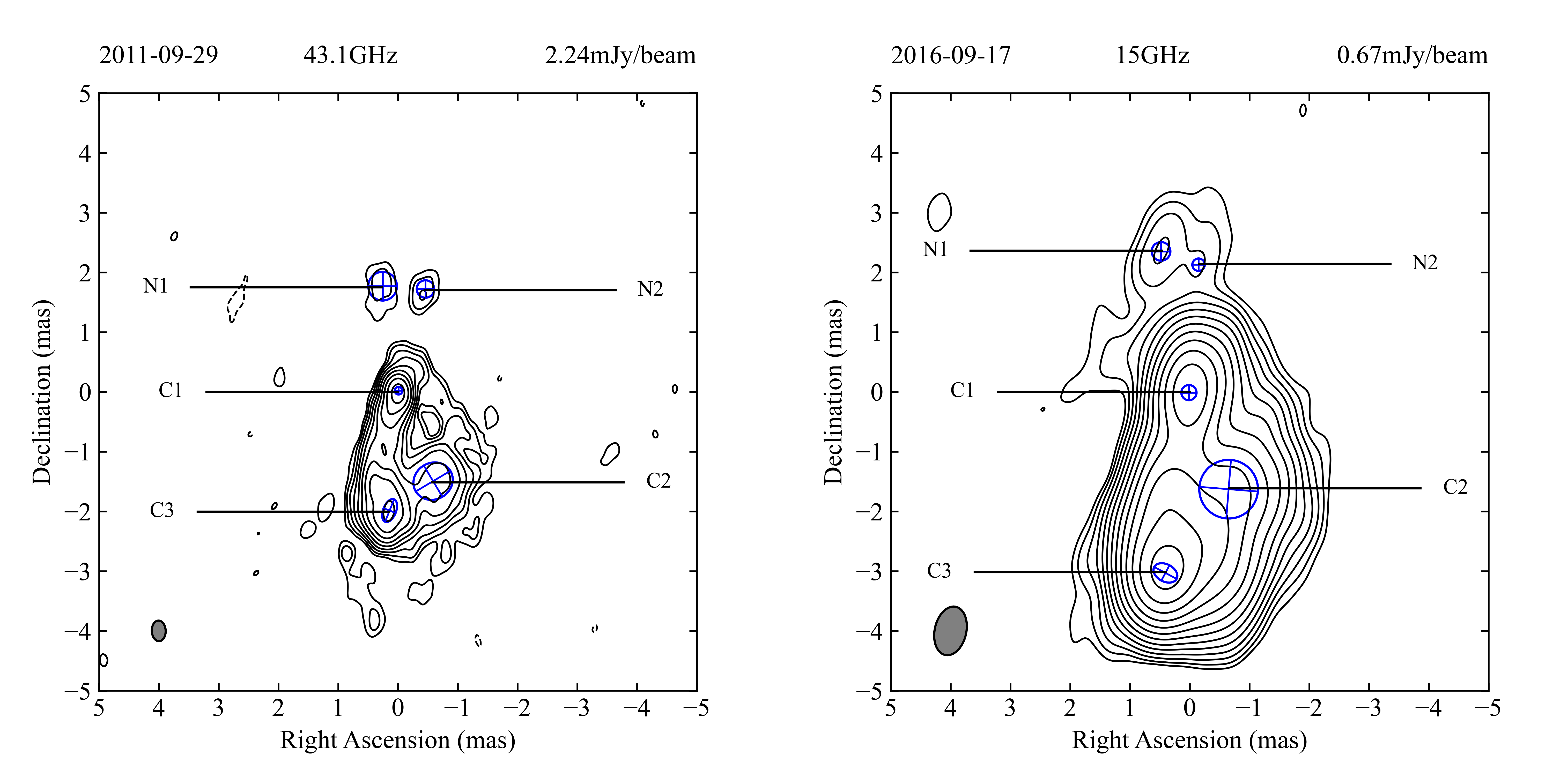
Figure 2 Parsec-scale VLBA images of the 3C 84 jet (Left: 43 GHz; Right: 15 GHz). Southern C2/C3 are the brighter approaching jet, while northern N1/N2 are the faint counterjet. Blue circles mark the analyzed components. (Credit: Liu et al. 2026, ApJ Figure 1)
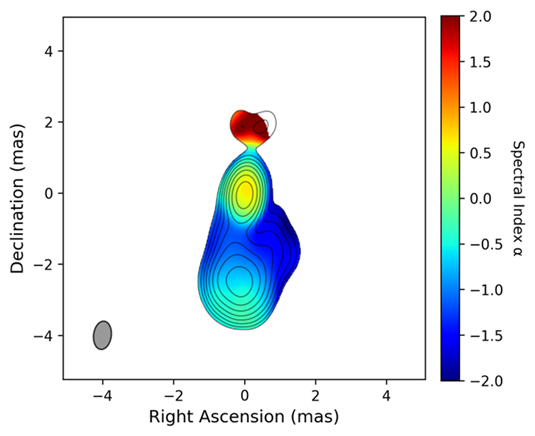
Figure 3 Spectral index map of 3C 84 between 15 and 43 GHz (July 2014). The counterjet's strongly inverted spectrum is crucial evidence of external free-free absorption. (Credit: Liu et al. 2026, ApJ Figure. 5)
Second, the time-domain evolution of the counterjet components demonstrated that the absorbing material is not a smooth, uniform mist, but rather a highly structured medium. The observation showed that as N1's spectrum transitioned from strongly to moderately inverted, it was accompanied by a rapid flux density increase at 43 GHz, whereas N2 exhibited stronger overall absorption and a weaker, delayed brightening. These distinct behaviors indicate that as the compact bright spots moved outward, they sequentially crossed different lines of sight, revealing that the obscuring structure, likely a dusty torus or its driven outflows, is clumpy or filamentary in both radial and transverse directions.
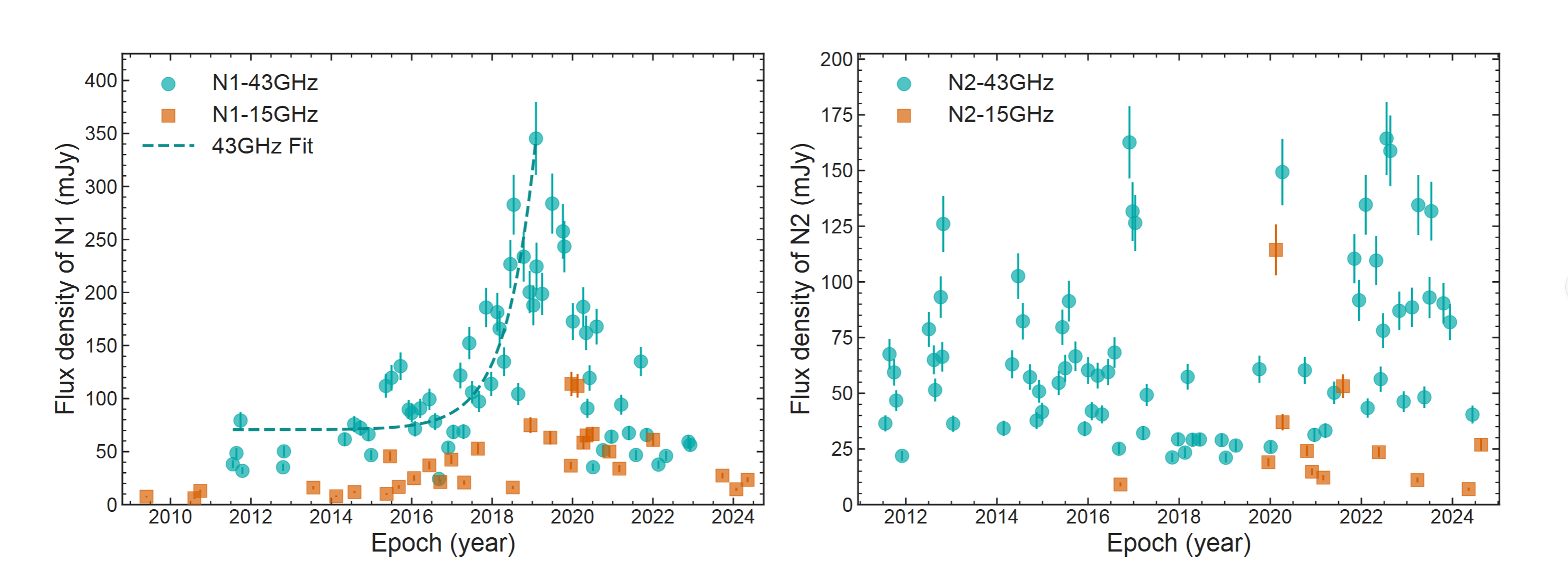
Figure 4 Flux density evolution of counterjet components N1 and N2 at 15 and 43 GHz. N1 brightens rapidly as absorption decreases, while N2 shows a delayed, weaker brightening. (Credit: Liu et al. 2026, ApJ Figure. 4)
Furthermore, kinematic measurements of the jet features provided geometric constraints on the parsec-scale structure of 3C 84. Assuming intrinsic symmetry of the two-sided jet, the researchers determined a viewing angle of approximately 20 degrees and an apparent pattern speed of 0.45 to 0.52 times the speed of light for the radio knots. The study also noted a potential slow modulation of 7-11 years in the transverse position of the counterjet, though currently treated as a candidate signal rather than a confirmed periodicity. Ultimately, this research establishes 3C 84 as a vital benchmark for studying the interaction between jets and clumpy circumnuclear gas in AGN.
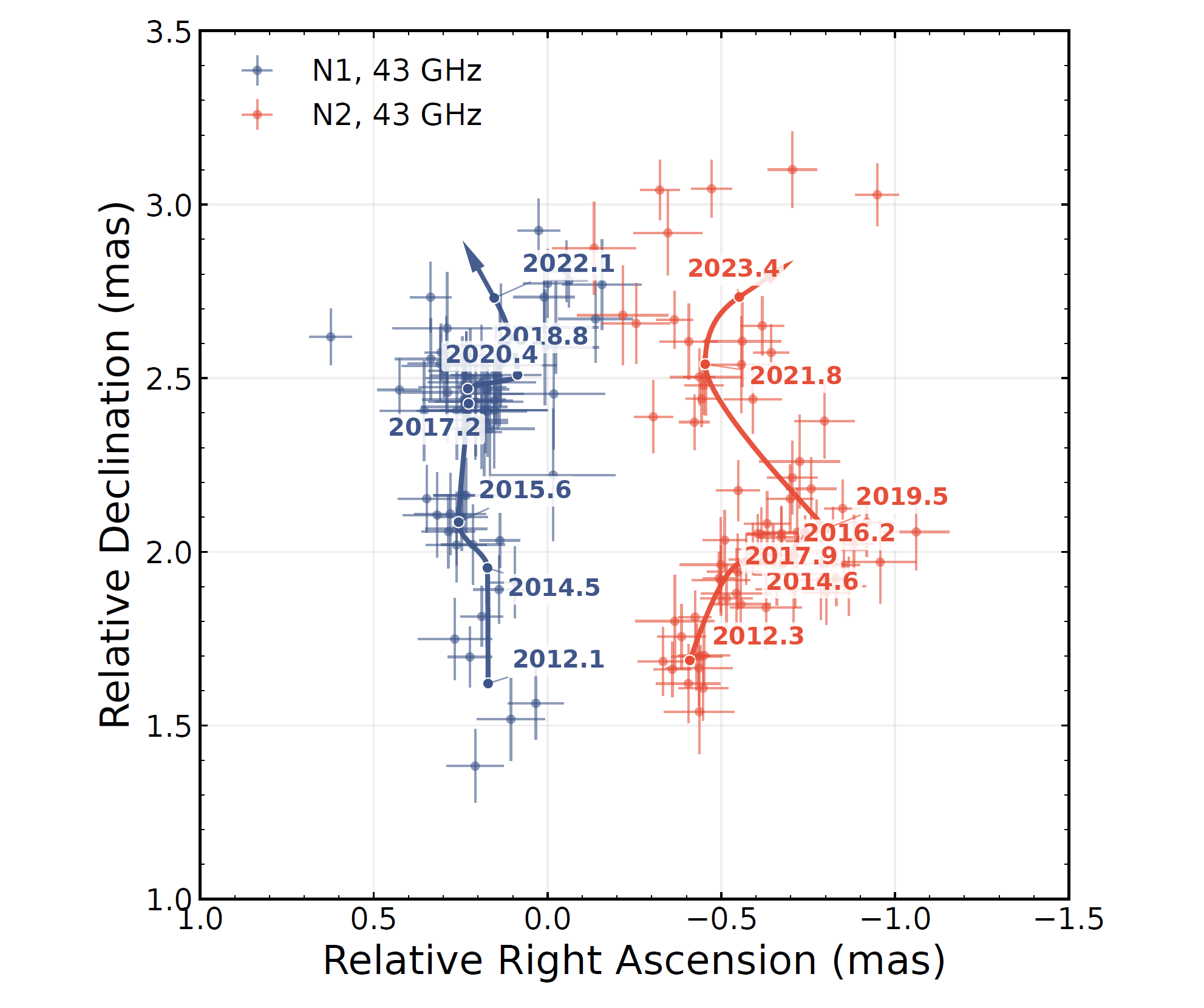
Figure 5 2D projected trajectories of N1 and N2 at 43 GHz, illustrating how they cross the absorbing medium along different lines of sight with periodic modulation. (Credit: Liu et al. 2026, ApJ Figure. 8)
The first author of this paper is Chuanzeng Liu, a Ph.D. student jointly affiliated with ShanghaiTech University and the Shanghai Astronomical Observatory (SHAO). His supervisors are Prof. Xiaoyu Hong and Prof. Tao An. This research was supported by the National SKA Program of China (Grant No. 2022SKA0120102) and the Shanghai Oriental Talents Program. The study also made use of the computing resources from the China SKA Regional Centre prototype, along with public data from the MOJAVE project and the VLBA-BU Blazar Monitoring Program.
DOI: https://doi.org/10.3847/1538-4357/ae624a
Scientific Contacts:
LIU Chuanzeng: liuchuanzeng@shao.ac.cn
HONG Xiaoyu: xhong@shao.ac.cn
AN Tao: antao@shao.ac.cn
Download attachments:




