Quantitative Study of Surface Composition of Metallic Asteroids Based on Reflectance Spectra
A recent study led by the Shanghai Astronomical Observatory, in collaboration with Macau University of Science and Technology, University of Winnipeg, and other international institutions, has been published online in the journal The Astrophysical Journal Supplement Series. The research advances our understanding of the surface composition of metallic asteroids and provides important scientific support for current and future asteroid exploration missions.
Traditionally, asteroids are classified into three major types based on the relationship between the intensity and wavelength of reflected sunlight: S-type , C-type , and M-type. The largest M-type asteroid in the main asteroid belt, 16 Psyche, is the target of NASA’s Psyche Mission, launched in 2023. Due to its unusually metal-rich nature, Psyche offers a unique opportunity to investigate the internal structure and evolutionary history of differentiated bodies in the early Solar System.
Psyche is also considered a potentially valuable target for future space resource utilization. It is thought to contain enormous quantities of iron, nickel, and platinum-group metals, with estimated reserves far exceeding those currently accessible on Earth.
To determine asteroid surface compositions, scientists typically compare asteroid spectra with laboratory measurements of meteorites, minerals, and metallic materials. However, differences between laboratory conditions and the space environment make such comparisons extremely complicated.
In this study, the research team conducted a systematic spectralinvestigation of Psyche,mesosiderites, HED meteorites, and mixtures of metal and silicates in the visible and near-infrared wavelength band (0.3–2.5 μm). The results show that the spectra of the 10:90 orthopyroxene+metal powder was similar to that of Psyche, this does not necessarily mean that there is only a small amount(~10%) of pyroxene on the surface of Psyche. Taking into account the density of Psyche, there might be a large amount of low-iron pyroxene on its surface.
The researchers also found that some forms of some mesosiderites match some aspects of Psyche. Since some spectral metrics and Fs content of HED meteorites are similar, the possibility of Vesta being a mesosiderite parent body cannot be ruled out either. However, the higher metal content of mesosiderites favors them over HED meteorites being linked to Psyche.
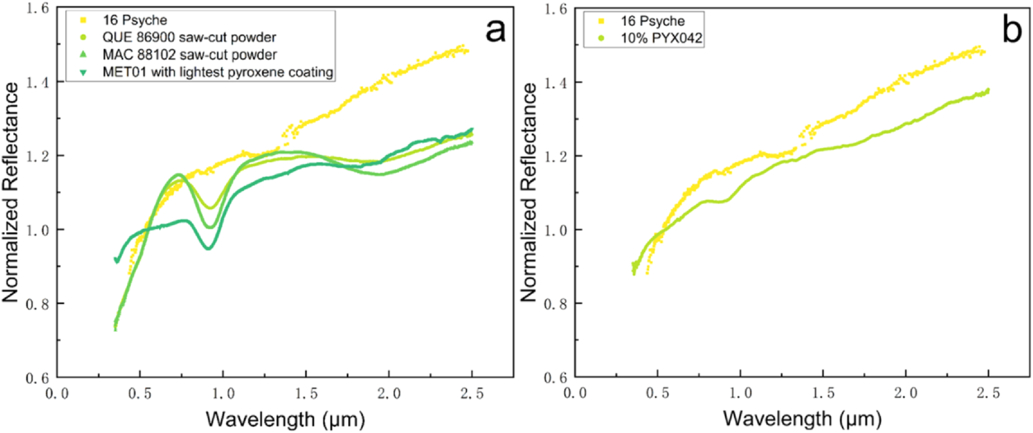
Figure. Reflectance spectra of Psyche, mesosiderites powder, pyroxene powder on metal slab and pyroxene + metal powder.
DOI:https://doi.org/10.3847/1538-4365/ae644a
Science Contacts:WANG Pengyue,pywang@shao.ac.cn
Download attachments:




