Researchers at Shanghai Astronomical Observatory Led the Discovery of the Most Distant Lyman Continuum Emitting Galaxy Known to Date
Recently, a research team led by the “Early Universe and High-redshift Galaxies” group at the Shanghai Astronomical Observatory of the Chinese Academy of Sciences, in collaboration with researchers from the European Southern Observatory (ESO) and Arizona State University, has made new progress in the study of high-redshift Lyman continuum emitting galaxies. Using data from the Hubble Space Telescope (HST), the James Webb Space Telescope (JWST), and the MUSE integral field spectrograph on ESO’s Very Large Telescope (VLT), the team discovered and systematically studied a Lyman continuum emitting galaxy, designated LCEz4-M1, at a redshift of z=4.444 in the Hubble Ultra Deep Field. This object is the highest-redshift, and therefore the most distant, Lyman continuum emitting galaxy known to date, and it holds significant implications for understanding the early universe and cosmic reionization. The findings have been published in The Astrophysical Journal Letters[1].
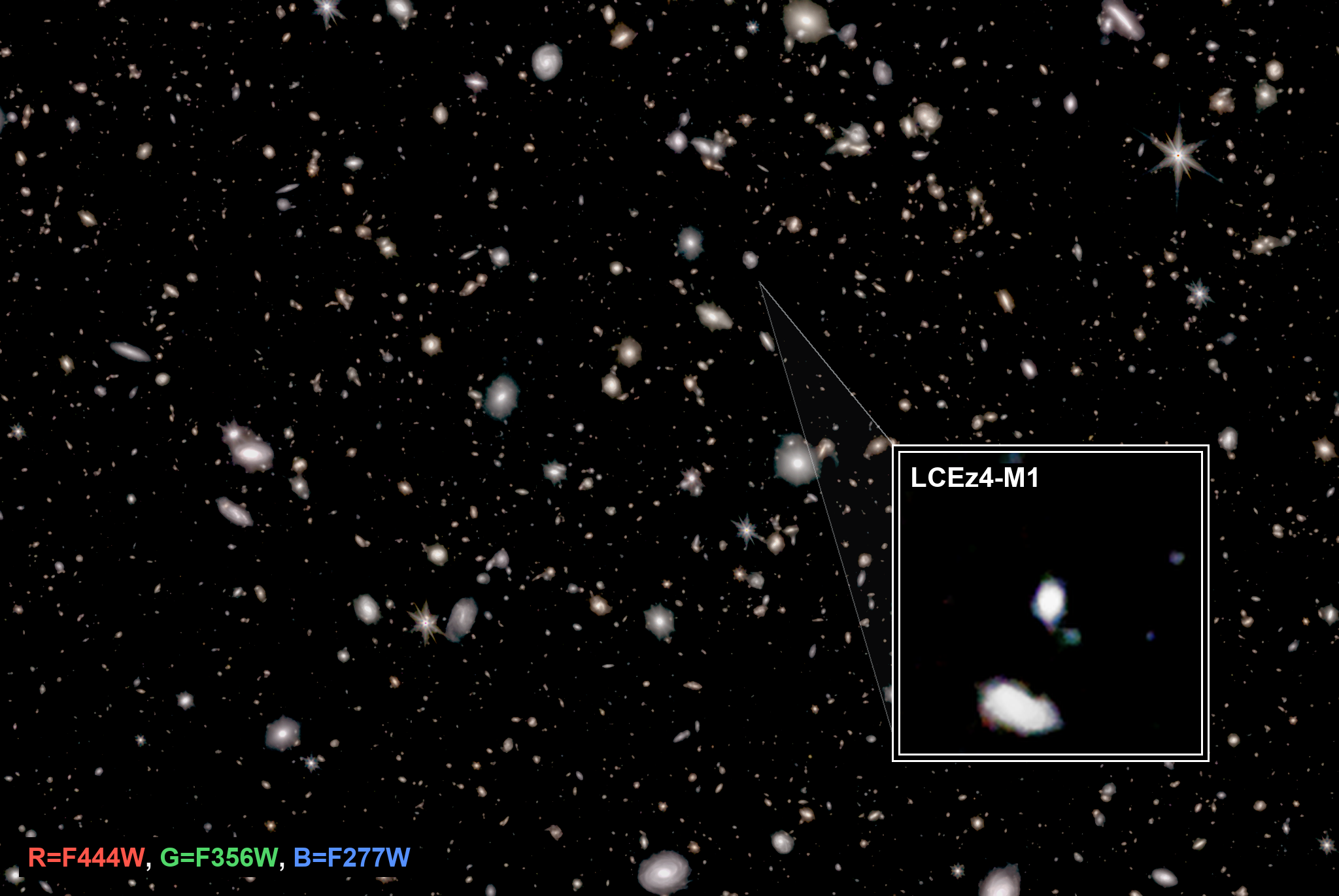
Figure 1: The highest-redshift Lyman continuum galaxy candidate known to date, LCEz4-M1. Background image: JWST.
Lyman continuum (LyC) radiation refers to high-energy ultraviolet light with wavelengths shorter than 912 angstroms, capable of ionizing neutral hydrogen gas in the universe. Whether early galaxies could produce and release enough LyC photons is one of the central questions in understanding cosmic reionization. However, in the high-redshift universe, the intergalactic medium strongly absorbs LyC photons, making such radiation extremely difficult to observe directly. As a result, detections of LyC-emitting galaxies at redshifts greater than 4 are exceedingly rare.
LCEz4-M1 existed only about 420 million years after the end of cosmic reionization, making it the highest-redshift — and thus most distant — Lyman continuum emitting galaxy currently known. Its discovery provides critical observational clues for studying how early galaxies emitted ionizing photons and the role such galaxies played in the ionization history of the universe.
The galaxy resides in the Hubble Ultra Deep Field, one of the deepest and most data-rich regions of the sky across multiple wavelengths. The team first confirmed its redshift of z=4.444 using the Lyman-alpha emission line in VLT/MUSE spectra. They then detected LyC signals from the direction of the galaxy in both HST/ACS F435W imaging and VLT/MUSE spectral data. Because these two datasets come from different telescopes and independent observing techniques, they provide mutually corroborating evidence, significantly strengthening the credibility of the candidate. Further analysis ruled out the possibility that the LyC signal arises from foreground source contamination or random noise.
Based on the two independent measurements from HST and MUSE, and adopting conservative assumptions for the intergalactic medium transmission, the team estimated that the galaxy has a relatively high LyC escape fraction. This suggests that a substantial number of ionizing photons may have escaped from the galaxy into intergalactic space. The finding carries important implications for understanding how galaxies transformed their cosmic environment during the cosmic dawn and the epoch of reionization.
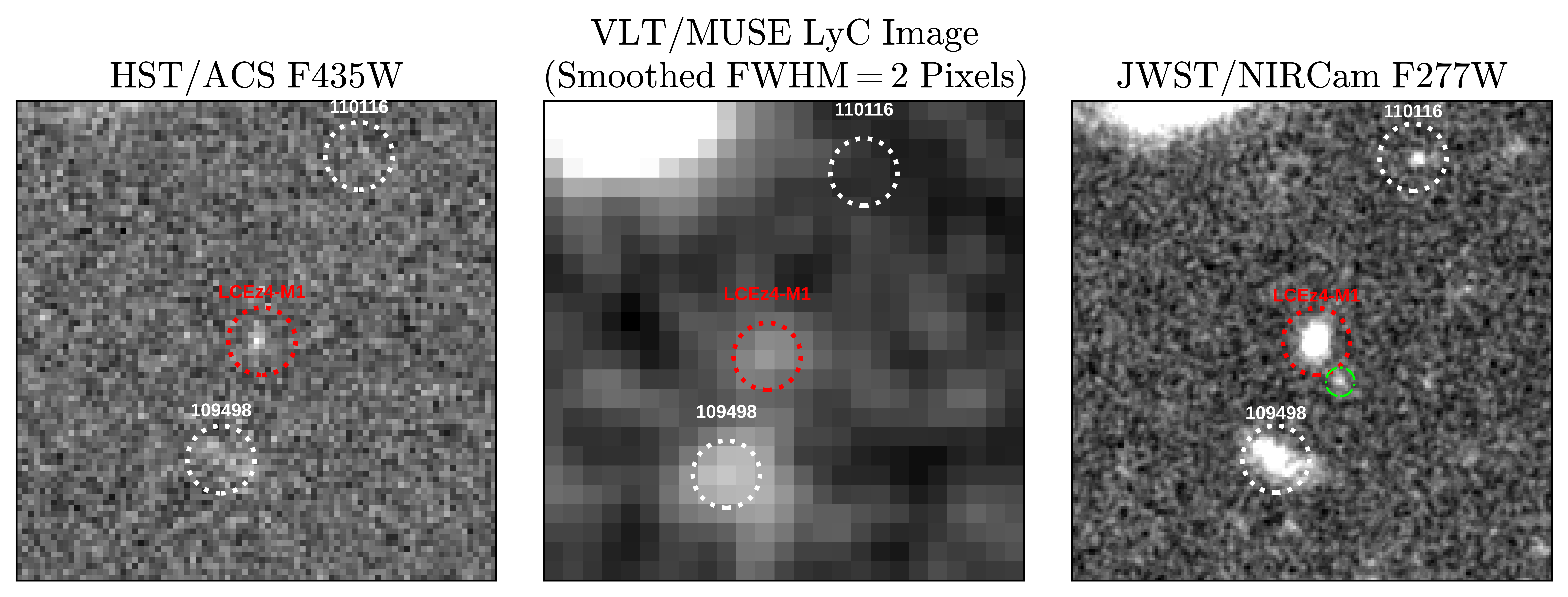
Figure 2: Left: HST/ACS F435W image; middle: VLT/MUSE LyC image; right: JWST/NIRCam F277W image. The red dashed circles mark the position of LCEz4-M1. Both the independent HST and MUSE datasets detect a LyC signal at this location, and the JWST/NIRCam image shows that it coincides with the main body of the galaxy, supporting that the signal originates from the high-redshift galaxy LCEz4-M1 at z=4.444.
This study extends a series of recent works by the Shanghai Astronomical Observatory team on high-redshift LyC-emitting galaxies [2]. Looking ahead, with the release of deeper JWST observations and the development of space facilities such as the Chinese Space-station Survey Telescope (CSST), astronomers expect to advance the study of high-redshift LyC galaxies from a handful of individual cases to statistical investigations of larger samples. This will provide a new observational foundation for understanding the formation and evolution of the first generations of galaxies in the early universe, the cosmic reionization process by which galaxies ionized the entire universe, and the co-evolution of galaxies and the intergalactic medium.
Paper links:
ApJL Link:https://iopscience.iop.org/article/10.3847/2041-8213/ae75e1
Arxiv Link:https://arxiv.org/abs/2603.01487
A series of recent works by the Shanghai Astronomical Observatory team on high-redshift LyC-emitting galaxies:
上海天文台团队揭示高红移莱曼连续辐射星系的特性--上海天文台
上海天文台科研团队牵头公布哈勃空间望远镜最深窄带巡天数据--上海天文台
Scientific contacts:
Zhen-Ya Zheng, zhengzy@shao.ac.cn
Shuairu Zhu, shuairuz@shao.ac.cn
Download attachments:




