Gas Moves Chaotically on Small Scales in Massive Star-Forming Regions

An international research team led by Chinese scholars, in collaboration with scientists from Finland, the United States, Spain, Chile, Germany, South Korea and other countries, has completed a landmark study using data from the ALMA-ATOMS survey. The findings challenge the long-standing canonical paradigm in astronomy that gravity dominates the small-scale structural evolution of molecular clouds. The research reveals that turbulence may act as the primary driver governing gas kinematics and structural evolution even within sub-parsec supercritical gas filaments adjacent to nascent stars, delivering critical observational evidence for deciphering the dynamical mechanisms at the initial stage of star formation. The corresponding paper has been published in SCIENCE CHINA Physics, Mechanics & Astronomy.
Stars are born within dense gas filamentary structures embedded in molecular clouds. The fragmentation, collapse, and mass accretion of such filaments constitute a core research frontier in contemporary astrophysics. Two dominant theoretical frameworks have long prevailed in the field: one posits that supersonic turbulence shapes and fragments filamentary structures, while the other prioritizes gravitational forces as the key regulator. Previous observational efforts have largely focused on large-scale filaments spanning 1-10 parsecs and their bulk motions. Systematic statistical dynamical investigations targeting sub-parsec regions (<1 parsec)—the core cradle of star birth—remain scarce, leaving the two competing theoretical models inadequately constrained by observational data.
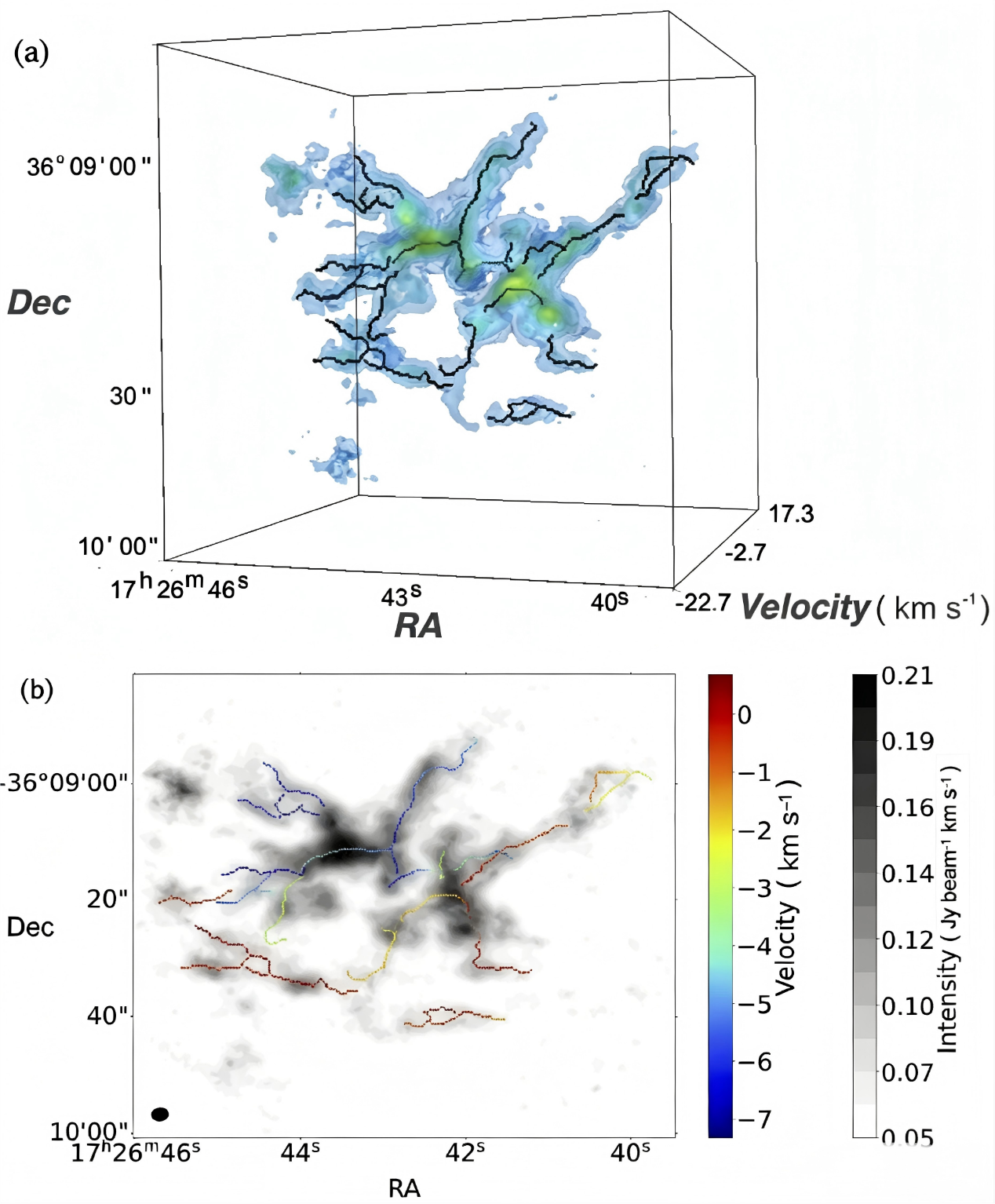
To fill this research gap, the team analyzed high-sensitivity H¹³CO⁺ J=1–0 molecular line data from the Atacama Large Millimeter/submillimeter Array (ALMA) ATOMS survey across 146 active massive star-forming regions in the Milky Way. The optically thin H¹³CO⁺ J=1–0 line enables precise tracing of dense gas kinematics. Employing the CRISPy algorithm, researchers identified 837 kinematically coherent gas filaments within position-position-velocity (PPV) 3D space, among which 214 exhibit an aspect ratio greater than 5. The filament lengths range from 0.02 pc to 1.6 pc, with a median length of 0.23 pc. Statistical analysis shows that 98% of the sample (823 filaments) possess line densities exceeding the critical threshold, classifying them as gravitationally bound supercritical filaments. Conventional theories predict such structures should undergo ordered gravitational contraction and fragmentation to spawn stars.
The team pioneered a vector field decomposition technique to resolve pixel-by-pixel distributions of internal velocity gradients, intensity gradients, and gravitational fields within filaments. All gradients were decomposed into two orthogonal components parallel and perpendicular to the filament major axis, disentangling radial motions along filaments from transverse cross-filament motions. Observational measurements demonstrate that the magnitudes of parallel and local perpendicular velocity gradients inside filaments are nearly equivalent, indicating gas undergoes substantial transverse motions alongside radial streaming along filaments.
Further orientation analysis yielded paradigm-shifting results. The team quantified the angular distributions of velocity gradients, density intensity gradients, and gravitational fields relative to filament major axes: density and gravitational gradients exhibit strong preferential alignment perpendicular to filament axes, whereas velocity gradients display fully random spatial orientations with no correlation to filament axes or local gravitational fields. Chaotic gas motions persist even in sub-0.1 pc scales, domains widely presumed to be gravitationally dominated. Correlation tests confirm no significant coupling between velocity gradients and gas surface density or local gravitational acceleration, ruling out local gravity as the dominant driver of gas dynamics.
Professor Zhang Chao from Taiyuan Normal University, the paper’s first author, commented: “We initially set out to characterize ordered, regular gas accretion flows within dense filamentary structures via velocity gradient analysis, yet were astonished to discover highly chaotic gas motions inside these high-density filaments.”
The team compared observational results against numerical simulations of randomly driven supersonic magnetohydrodynamic (MHD) turbulence. Synthetic observables generated by simulations closely reproduce key observational signatures including velocity gradient distributions and kinematic modes, robustly demonstrating that unordered internal gas motions arise from isotropic turbulence. Minor discrepancies persist between simulations and observations: simulated transverse velocity gradients marginally exceed radial counterparts, and velocity gradients strengthen with rising gas surface density—a trend absent in observational datasets. Researchers attribute these disparities to the extreme turbulence intensity of the observed active massive star-forming regions, far exceeding that of low-mass star-forming regions targeted in simulations, alongside divergent magnetic field configurations and gas density regimes between simulation and observed fields. These mismatches outline clear directions for refined numerical modeling in future work.
Dr. Liu Tie, Principal Investigator of the ATOMS project and corresponding author based at the Shanghai Astronomical Observatory, stated: “This work overturns the traditional view that gravity governs small-scale molecular cloud structure formation, offering a novel framework to reconcile longstanding tensions between turbulent and gravitational models of star formation. Moving forward, our team will integrate high-precision numerical simulations and multi-wavelength observations to further unravel coupled interactions among turbulence, gravity, and magnetic fields, gradually unveiling the full evolutionary sequence of star formation.”
Two companion perspective articles published alongside the paper commend the study’s surprise findings. Professor Philippe André, a leading authority on molecular cloud filamentary structures at Paris-Saclay University, remarked: “This is a startling new result since HFS clumps are strongly self-gravitating systems in which gravity has often been considered to be the main dynamical player, akin to the case of clusters of galaxies at the nodes of the cosmic web. If confirmed, such a conclusion would have profound implications as it would significantly reshape our – admittedly limited– understanding of the initial formation phase(s) of star clusters and massive stars.” Distinguished theoretical astrophysicist Professor Mark R. Krumholz from the Australian National University noted: “This finding also eases a major tension that had arisen between the picture of star formation painted by high-resolution observations of particular star-forming clouds and the statistical properties of star formation that we can measure on extragalactic scales. …Thus the present observations not only help resolve an outstanding question in Galactic star formation, they help bring extragalactic and Galactic measurements of star formation into harmony.”
This collaborative research was jointly conducted by domestic institutions including Taiyuan Normal University, Shanghai Astronomical Observatory (CAS), National Astronomical Observatories (CAS), Nanjing University, and Yunnan University, alongside more than ten international universities and observatories such as the University of Helsinki, Dartmouth College, Universidad de Chile, and the Max Planck Institute for Astronomy. The project received funding support from multiple national research programs worldwide, including China’s National Key R&D Program, the National Natural Science Foundation of China, the Academy of Finland, and the U.S. National Science Foundation.
DOI:https://doi.org/10.1007/s11433-026-2964-7
https://www.sciengine.com/SCPMA/doi/10.1007/s11433-026-3018-3
LIU Tie liutie@shao.ac.cn
ZHANG Chao zhangchao@tynu.edu.cn
Download attachments:




