Satellite-Ground Laser Time-Frequency Transfer Achieves Picosecond Precision and Sub-Picosecond Stability
Recently, research team from Shanghai Astronomical Observatory (SHAO) of the Chinese Academy of Sciences (CAS) achieved a major breakthrough in satellite-ground laser time-frequency transfer. The team developed a laser time-frequency transfer payload and dedicated ground station for Mengtian Laboratory Module of the Chinese Space Station. The system demonstrated a 1-second Normal Point accuracy of 2–5 picoseconds (ps) for satellite-ground clock difference measurements, a time deviation stability better than 0.7 ps at 50 seconds, and a modified Allan deviation stability of 2×10⁻¹⁴ at 50 seconds—representing the best satellite-ground laser time-frequency transfer performance reported internationally to date. The findings were published on July 16, 2026, in the Journal of Geodesy, a leading international journal in geodesy.
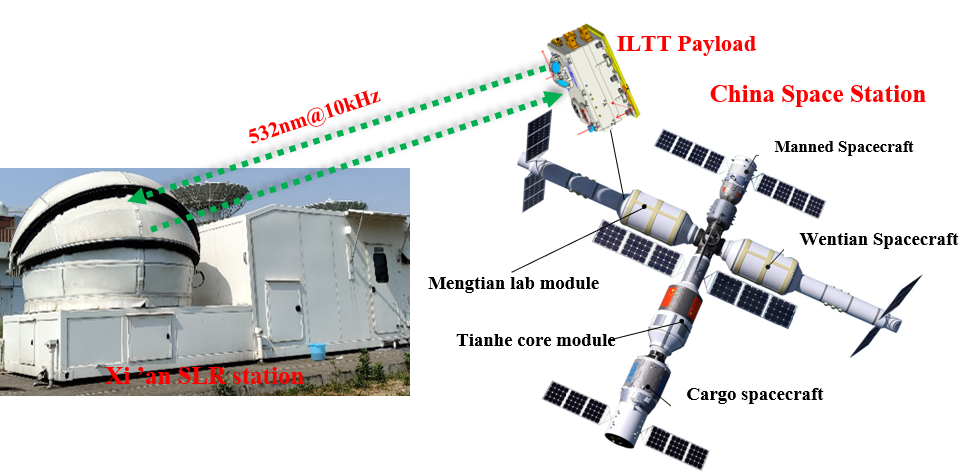
Satellite-ground time-frequency transfer is a critical technique for achieving high-precision time synchronization and frequency comparison, playing an important role in metrology and fundamental scientific research. In recent years, with the rapid advancement of ground-based and space-borne atomic frequency standards, existing time-frequency transfer links face increasing demands for higher precision, stability, and accuracy. The performance of optical clocks, in particular, has reached unprecedented levels of stability and accuracy. Traditional microwave time-frequency transfer techniques are increasingly inadequate due to bandwidth limitations, while fiber-optic time-frequency transfer suffers from inflexibility due to its reliance on terrestrial distribution. Free-space high-precision laser time-frequency transfer has thus emerged as a distinctly advantageous approach.
To meet the requirements of major national aerospace missions, the SHAO team developed the laser time-frequency transfer payload for the Mengtian Laboratory Module. The payload consists primarily of a single-photon detector with its optical system, an event timer, and a laser retroreflector, integrated into a compact design weighing approximately 6.6 kg with power consumption below 25 W. It achieves a single-shot measurement precision of 20 ps and a measurement stability better than 1 ps per day.
To address challenges posed by the space station's low orbital altitude, significant variations in radial distance and elevation angle during observation arcs, and strong background noise affecting single-photon detection, the team overcame key technical hurdles including single-photon detection, picosecond timing, high-repetition-rate measurement, and low timing jitter. They developed an optical system comprising a polytetrafluoroethylene diffuser, partitioned attenuators, and a 4 nm narrow-band filter, which significantly enhanced the payload's detection capability and measurement stability.
In terms of data processing, the team established an analytical calculation model for satellite-ground laser time-frequency transfer at picosecond-level precision within the framework of general relativity. The model systematically accounts for light travel time, atmospheric refraction and turbulence, reference point offsets between the detector and retroreflector, retroreflector center-of-mass offset, and relativistic frequency shifts. In modeling relativistic frequency shifts, the team quantitatively assessed the effects of Earth's higher-order gravitational potential, solid Earth tides, and ocean tides on the accuracy and stability of the time-frequency transfer link, providing a comprehensive theoretical foundation for high-precision satellite-ground laser time-frequency transfer. This effort resulted in a set of engineering-oriented calculation models with well-defined error bounds that can be directly embedded into time-frequency transfer processing software and have been verified through software verification.
During the implementation of the satellite-ground laser time-frequency transfer experiments, the team addressed critical issues including interference from rendezvous and docking retroreflector echoes on the laser time-frequency transfer signals, and the difficulty of accurately directing high-repetition-rate laser pulses into the detection window under fixed gating conditions. These solutions enabled stable coordination between space-borne uplink laser signal detection and ground-based reflected echo reception.
The laser time-frequency transfer link will further support the on-orbit performance evaluation of atomic clocks aboard China's space station, and support picosecond-level remote time synchronization and gravitational redshift tests at the 10⁻⁷ level in fundamental scientific research. Building on this achievement, the technology has been extended to serval National major programs, achieving full coverage of laser time-frequency transfer capabilities from low Earth orbit (space station, 2022) to geostationary orbit (Beidou, 2007) and cislunar space (DRO, 2024).
The first author of the study is GENG Renfang, a postdoctoral fellow at SHAO. The corresponding author is WU Zhibo, a senior engineer at SHAO. Collaborators include GAO Shuai and his research group from the National Time Service Center, and WANG Wenbin, a researcher from the Technology and Engineering Center for Space Utilization, CAS.
DOI:https://doi.org/10.1007/s00190-026-02095-0
Science contacts:
WU Zhibo, wzb@shao.ac.cn
GENG Renfang, grf@shao.ac.cn
Download attachments:




