Predicting a Space Telescope’s View of Galaxies: Generative AI Bridges Ground- and Space-Based Observations
Renhao Ye and Shiyin Shen at the Shanghai Astronomical Observatory of the Chinese Academy of Sciences have recently explored a method for predicting images across telescopes using generative artificial intelligence. Based on real, paired galaxy images from the DESI ground-based survey and the Euclid space telescope, the study established a generative mapping from ground-based, seeing-limited images to high-resolution space-based images. The team also generated E-BGS, a large dataset of predicted images for the sky area expected to be covered by the forthcoming Euclid DR1. This work explores a new approach to mitigating the limitations that ground-based image resolution imposes on galaxy structure measurements and to extending such studies across a wider area of the sky. The results have been published in The Astrophysical Journal Letters.
The structural properties of galaxies—their sizes, shapes, and surface brightness distributions—provide important observational constraints on processes involved in galaxy formation and evolution, including angular momentum evolution, gas cooling, and mergers. Statistically, the combined effects of these physical processes can be reflected in scaling relations such as the stellar mass–size relation. Early-type and late-type galaxies exhibit different mass–size relations, and these relations, together with their changes over cosmic time, provide important clues to the structural evolution of galaxies. Reliably characterizing these relations requires accurate measurements of galaxies spanning different masses and sizes, with careful consideration of measurement biases affecting populations such as compact galaxies and dwarf galaxies.
The DESI Bright Galaxy Survey (BGS), together with photometric data from the Legacy Imaging Surveys, provides an unprecedentedly large sample for studying low-redshift galaxies, with photometric data now available for more than ten million galaxies and spectra for several million galaxies. However, approximately one-quarter of BGS galaxies have r-band half-light radii smaller than the full width at half maximum of the typical point spread function (PSF) in that band, leaving their structures poorly resolved. In this size regime, structural measurements are susceptible to systematic biases that depend on galaxy size, potentially affecting conclusions about the evolution of galaxy populations.
Space telescopes can avoid atmospheric disturbances and obtain higher-resolution images. This study used VIS images from Euclid’s first Quick Data Release (Q1), covering approximately 63.1 square degrees. Compared with the BGS survey footprint of approximately 14,000 square degrees, Euclid’s currently public imaging coverage remains limited, and most BGS galaxies still lack publicly available Euclid VIS images. The team adopted an Image-to-Image Schrödinger Bridge diffusion model, using 82,830 pairs of real images from the overlapping DESI and Euclid Q1 footprints for training and validation. Starting from a ground-based r-band image and using the z-band image as conditioning information, the model iteratively generates a predicted Euclid VIS-band image that shows finer structure than the original ground-based input, as illustrated in Figure 1.
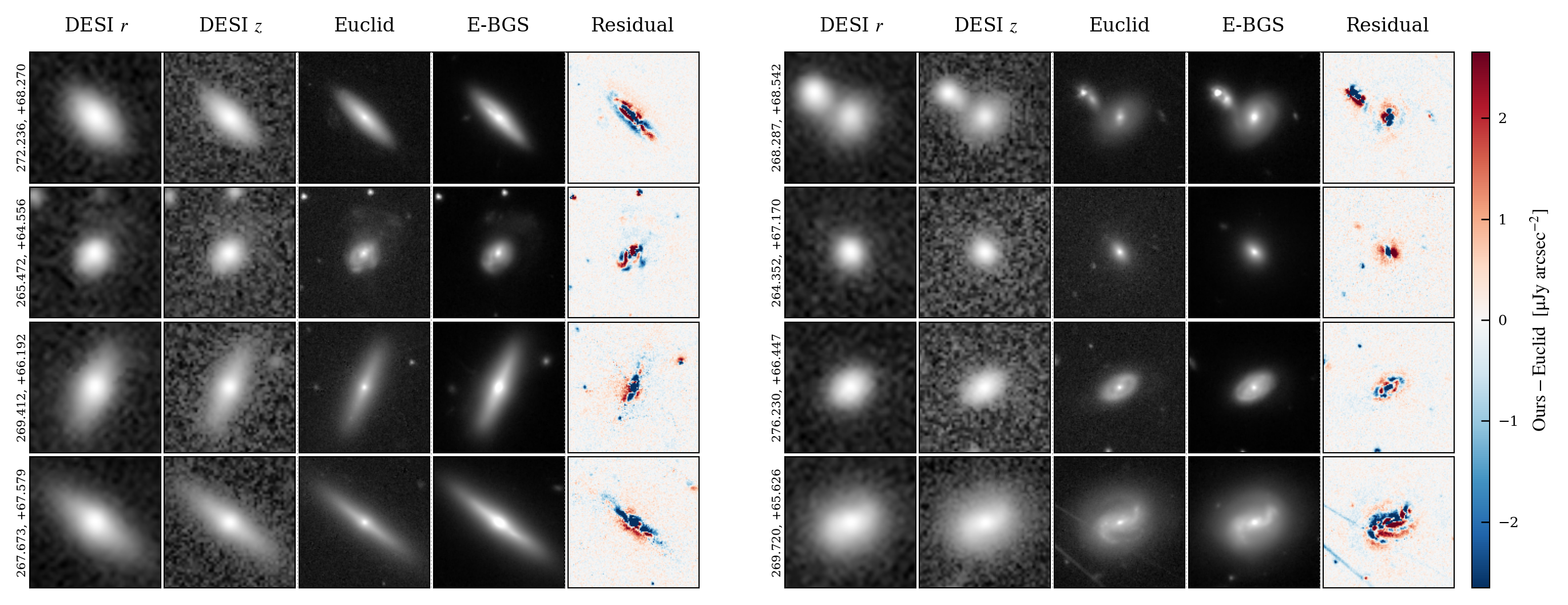
Figure 1. Galaxies randomly selected from the independent test set. From left to right, the columns show the observed DESI images in the r and z bands, the observed Euclid VIS image, the model prediction (E-BGS), and the residual image obtained by subtracting the observed Euclid image from the prediction (Residual).
The team evaluated the method in two respects using a spatially independent test set. In the Fourier domain, using the angular scale at which the median Fourier ring correlation (FRC) falls to 0.5 as a metric, the correlation scale between E-BGS predictions and observed Euclid images is approximately 0.5 arcseconds, compared with 1.9 arcseconds and 1.35 arcseconds for the DESI r- and z-band images, respectively. The correlation between predictions and observations thus extends to scales approximately 1/3.8 and 1/2.7 of the corresponding scales for the ground-based inputs. This indicates that the predicted images remain statistically correlated with the observed Euclid images down to smaller angular scales than the original ground-based inputs do. In terms of structural parameters, the team measured three quantities: the Petrosian radius, the Sérsic effective radius, and the Sérsic index. Under the adopted sample selection criteria and measurement methods, the absolute median biases of all three E-BGS structural parameters relative to Euclid VIS measurements are smaller than those obtained from DESI r-band images. The median bias in Petrosian radius is reduced to 0.006 arcseconds, compared with 0.112 arcseconds for DESI r, and its dependence on galaxy size is substantially weaker. The median bias in Sérsic effective radius is −0.004 arcseconds, closer to zero than the DESI r-band value of −0.041 arcseconds. The median bias in Sérsic index is reduced to +0.093, compared with +0.262 for DESI r. The team found that these improvements are primarily reflected in the median biases of the sample as a whole; the scatter in the residuals did not decrease.
In addition to these evaluations, the team generated predicted Euclid VIS-band images for BGS targets that meet the sample selection criteria within the expected Euclid DR1 footprint and publicly released them as the E-BGS dataset, as illustrated in Figure 2. These targets currently lack publicly available Euclid observations. Once Euclid DR1 provides the corresponding images, the team will conduct an independent test to objectively assess the utility and limitations of generative AI in real research applications.
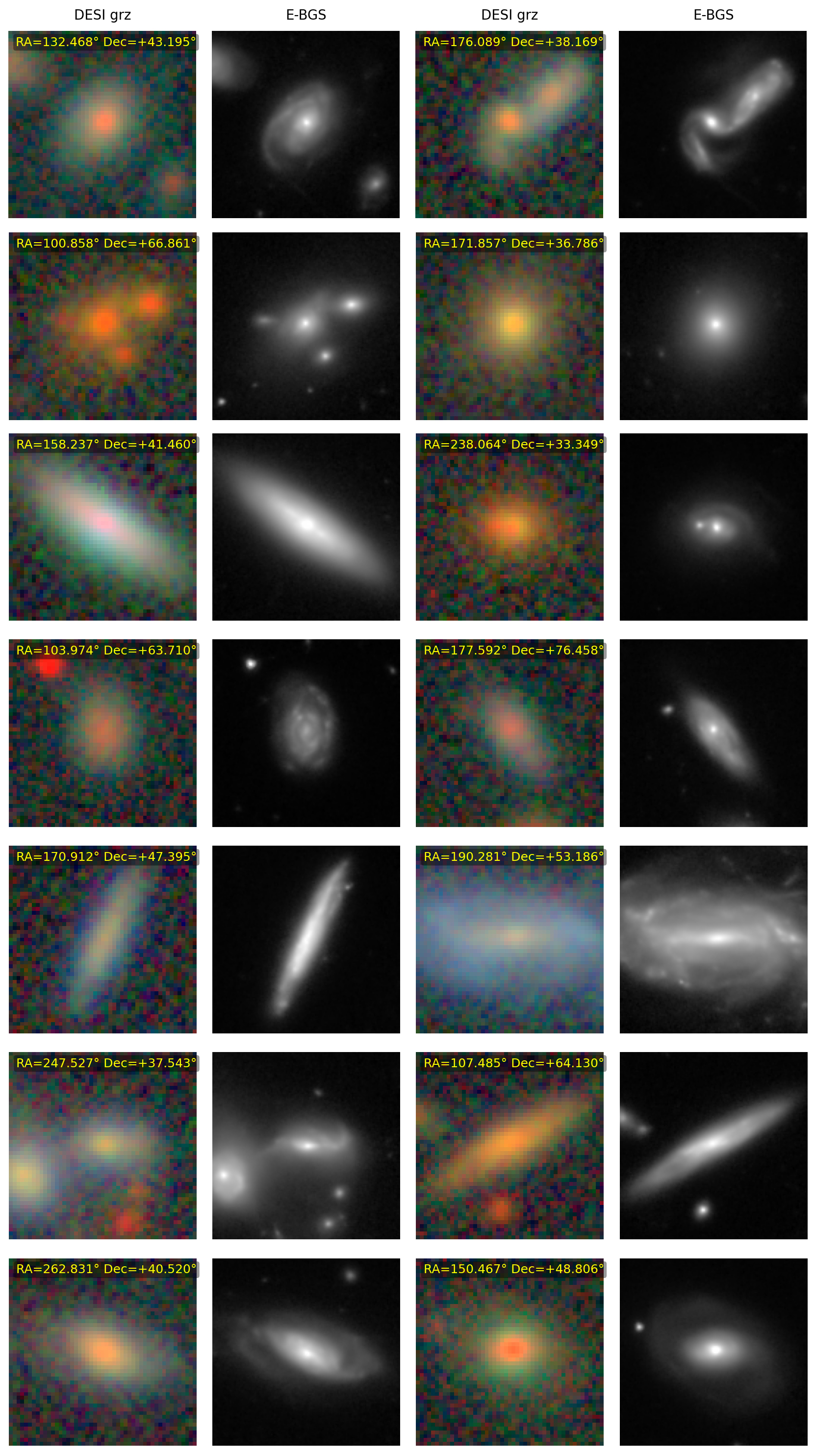
Figure 2. Examples from the E-BGS dataset. In each pair, the left panel shows a three-band composite of ground-based DESI observations, and the right panel shows the AI-generated prediction in the Euclid VIS band. These galaxies do not yet have publicly available Euclid images. The predictions will be compared with subsequently released Euclid observations to assess their reliability.
The team emphasizes that the value of this method lies not only in producing sharper images, but also in exploring the extent to which AI can use existing observational clues to provide reliable information for measuring galaxy structure. They also explicitly acknowledge the limitations of the current method: small-scale features in the predicted images are not guaranteed to correspond individually to observed structures; a reduction in median bias does not imply a corresponding reduction in measurement errors for individual galaxies; and possible conditional biases within different galaxy subpopulations have yet to be ruled out. As more real high-resolution observations become available, such generative methods may be refined through continued validation and help astronomers plan follow-up observations more effectively, directing limited telescope time toward the areas where additional evidence is most needed.
Paper link: https://iopscience.iop.org/article/10.3847/2041-8213/ae9cbf
Science contact:
Ye Renhao, renhaoye@shao.ac.cn
Shen Shiyin, ssy@shao.ac.cn
Download attachments:




