Progress in Lunar-based Extremely Long Baseline Black Hole Shadow Imaging
Recently, a research team from the Shanghai Astronomical Observatory of the Chinese Academy of Sciences has made progress in the study of lunar-based very long baseline interferometry (VLBI) for sub-microarcsecond black hole shadow imaging. The related results have been published in the Monthly Notices of the Royal Astronomical Society. The study focuses on the detectability of black hole shadow candidates observable by lunar-based VLBI and the constraints of lunar-based telescopes.
The Event Horizon Telescope (EHT) forms a VLBI network using ground-based telescopes, but due to the limited physical size of the Earth, its angular resolution at the 1.3 mm observing wavelength reaches only 20 microarcseconds, allowing it to observe only two black hole shadows: M87* and Sgr A*. Against the background of the successful detection of interferometric signals by the Queqiao-2 lunar orbital VLBI experiment and the concept of future International Lunar Research Station, the team assumed a VLBI array composed of a lunar-based telescope and the ground-based EHT with a maximum baseline of 380,000 km, which could improve the resolution to 0.7 microarcseconds. Based on this scenario, the team analyzed M87*, Sgr A*, and 29 other black holes with apparent diameters greater than 0.7 microarcseconds, evaluating the detectability of their black hole shadows.
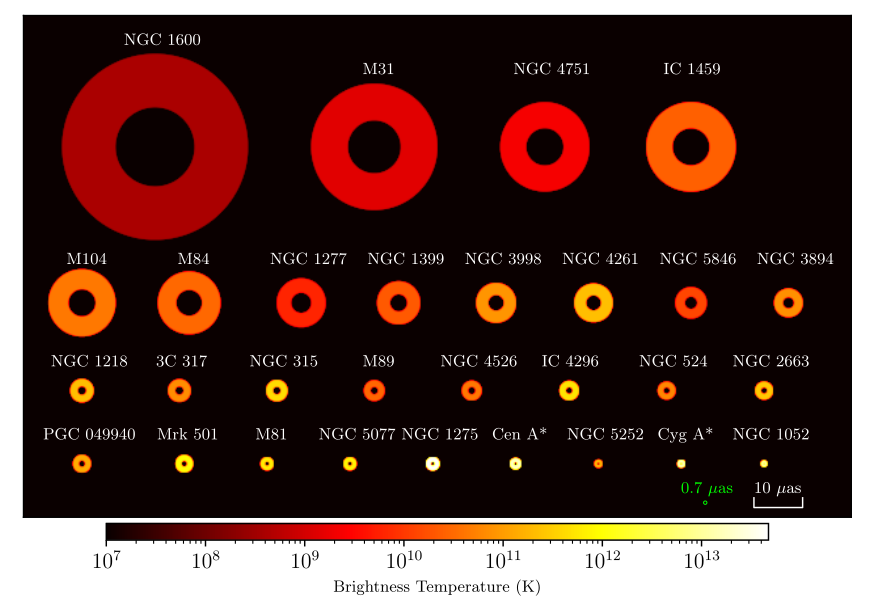
Figure 1. Ring model images of 29 candidate black holes. The ring sizes are estimated from mass and distance, and the brightness is based on single-dish observations.
The study found that 6 of the candidate black holes are highly suitable for Moon-Earth VLBI black hole shadow detection. Their positions in the sky and the geometry relative to the Moon's orbit are appropriate, and the projected Moon–Earth baselines can cover the key feature for detecting black hole shadows: the null of the visibility amplitude. Figure 2 shows the profile of the visibility amplitude with baseline length for these 6 candidate black holes. Their first null (the position where the visibility amplitude first decreases to zero and then rises again as the baseline increases) falls within the projected Moon–Earth baselines (gray area). These six sources are: M104, NGC 524, PGC 049940, NGC 5077, NGC 5252, and NGC 1052.
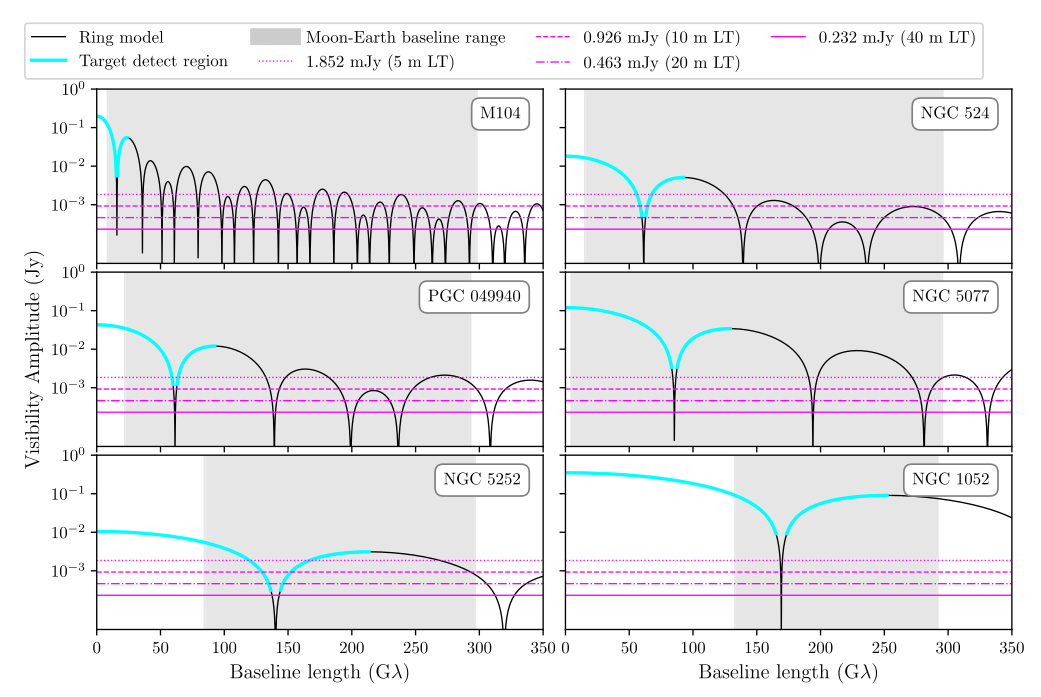
Figure 2. Distribution of visibility amplitude with baseline length for the 6 candidate sources suitable for lunar–Earth VLBI black hole shadow detection.
The study also discusses the impact of factors such as the location of the lunar-based telescope and the antenna aperture. The related results further refine the understanding of the scientific objectives and technical motivations of lunar-based telescopes in the field of black hole imaging, and have certain constructive significance for the future development of lunar-based astronomy.
The first author and corresponding author of the study is Zhao Shan-Shan, assistant researcher at the Shanghai Astronomical Observatory. Collaborators include Prof. Lu Rusen, Senior Engineer Liu Lei, and Prof. Shen Zhiqiang of the Shanghai Astronomical Observatory, as well as Prof. Yosuke Mizuno of the Tsung-Dao Lee Institute, Shanghai Jiao Tong University.
Paper link: https://doi.org/10.1093/mnras/stag1580
Science contact: ZHAO Shan-Shan zhaoss@shao.ac.cn
Download attachments:




