Study reveals deep-interior dynamics behind anomalous deformation of Mercury’s northern plains
Researchers from Shanghai Astronomical Observatory have participated in a study of Mercury’s geology and interior dynamics. The study provides new insights into how processes in Mercury’s deep interior may have influenced its surface over long timescales. It reveals that the relatively young plains near Mercury’s north pole exhibit more pronounced crustal compression and deformation than expected for a relatively young surface. The results suggest that this anomalous deformation may be associated with an upwelling of low-density material from the deep interior, challenging the view that Mercury’s landscape was shaped predominantly by planetary cooling and contraction.
Mapping Mercury’s surface reveals anomalous tectonic deformation
Mercury is the smallest planet in the Solar System and the closest to the Sun. The evolution of Mercury’s landscape shares similarities with other terrestrial planets: as its hot interior slowly cooled over time, the whole planet contracted, causing its rocky outer shell to buckle into long cliffs and ridges.
The study focused on the Northern Smooth Plains, a vast volcanic plain near Mercury’s north pole that covers about 7% of the planet’s surface. Formed roughly 3.7 billion years ago, it is geologically young by Mercury’s standards. Under existing theories, most of the planet’s contraction had already occurred, meaning that this younger surface should have experienced less contractional deformation. The research team mapped cliffs and ridges across Mercury and measured the degree of crustal compression. Surprisingly, the Northern Smooth Plains showed substantial contractional deformation, indicating that cooling-driven contraction alone cannot fully explain the observed deformation.
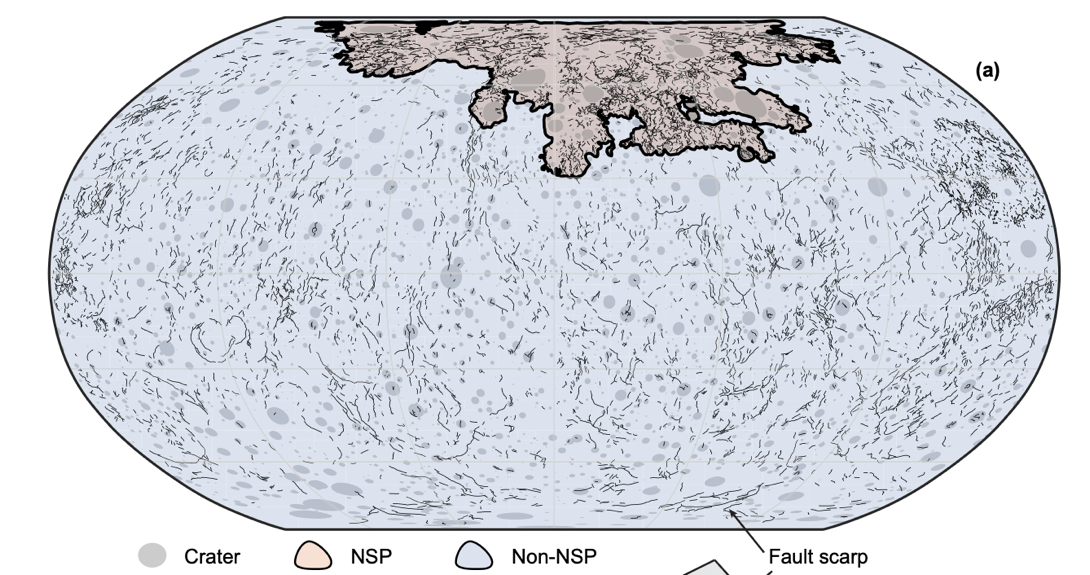
Figure 1. Distribution of contractional tectonic features on Mercury’s surface. The Northern Smooth Plains (red), although relatively young, exhibit substantial contractional deformation and constitute the study region of this work (image source: Xie et al., 2026).
Mantle upwelling identified as another possible driver of surface evolution
To investigate the cause of this anomaly, the team combined measurements of Mercury’s gravity and topography with computer simulations of its interior. The results suggest that regional deep-mantle activity may have contributed to the anomalous deformation.
At the centre of the plain sits a broad, gentle bulge called the Northern Rise. The study suggests that it may be associated with an upwelling of buoyant, low-density material from about 350 km below the surface. Unable to breach the planet’s rigid lithosphere, the rising material spread laterally beneath the surface, forming a deep anomaly roughly 730 km across. This process could have uplifted the centre of the plain and altered the surrounding stress field, enhancing contractional deformation around the margins of the uplift.
As the mantle upwelling waned, the uplift could gradually diminish as the interior structure adjusted. However, the long-wavelength topography and residual stress generated during the earlier stage could continue to influence surface tectonics over very long periods. This suggests that some relatively young cliffs and contractional structures on Mercury may preserve the long-term effects of earlier deep-interior processes rather than indicating strong recent interior activity.
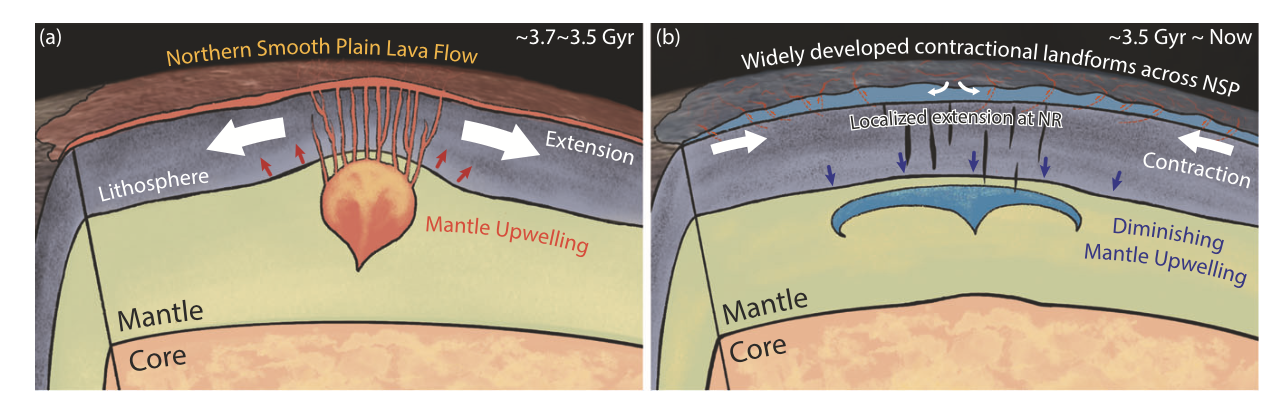
Figure 2. Schematic illustration of how mantle upwelling influenced the tectonic evolution of Mercury’s Northern Smooth Plains. The uplift and stress state generated by an early deep upwelling could continue to influence surrounding tectonic activity after the upwelling weakened (image source: Xie et al., 2026).
Implications for terrestrial planetary science
By integrating surface mapping, gravity and topographic observations, and interior dynamic modelling, this study provides a framework for understanding how regional internal processes can influence the long-term tectonic evolution of Mercury in addition to global thermal contraction. The findings also provide a reference for investigating the relationship between planetary interiors and surface tectonics on other terrestrial planets.
In this study, Associate Researcher Shengxia GONG from SHAO analyzed possible mantle upwelling beneath Mercury’s Northern Smooth Plains using gravity and topography data and performed dynamic loading calculations to constrain parameters for subsequent numerical simulations. Prof. Chengli HUANG participated in evaluating the calculation results.
The study was led by The Chinese University of Hong Kong (CUHK). The first author, Dr. Jingchun XIE, is currently a postdoctoral researcher at CUHK, and the corresponding author is Prof. Yan ZHAN. Jingchun XIE obtained his PhD from SHAO, where he began his research on Mercury, and has since continued to study Mercury’s geology and interior evolution.
DOI: https://doi.org/10.1038/s41467-026-74975-0
Scientific Contact:GONG Shengxia sxgong@shao.ac.cn
Download attachments:




