SKAO Chief Scientist Prof. Naomi McClure-Griffiths Visits Shanghai Astronomical Observatory
On October 8, 2026, Prof. Naomi McClure-Griffiths, Chief Scientist of the Square Kilometre Array Observatory (SKAO), visited the Shanghai Astronomical Observatory (SHAO) of the Chinese Academy of Sciences. During the visit, Prof. McClure-Griffiths exchanged views with SHAO researchers engaged in Square Kilometre Array (SKA)-related work, learning about the research progress and observation preparations of the observatory's teams and delivering a special academic lecture. The visit deepened the SHAO teams' understanding of SKA science planning and construction progress, and provided a useful reference for refining science cases and preparing for observation and data analysis.
SHAO teams presented their research progress and SKA science preparations in areas including active galactic nuclei (AGN), pulsars, the interstellar medium and star formation, cosmic dawn and reionization, and neutral hydrogen (HI) and galaxy evolution. The exchanges also covered technical work on low-frequency observation, very long baseline interferometry (VLBI) and digital receivers.
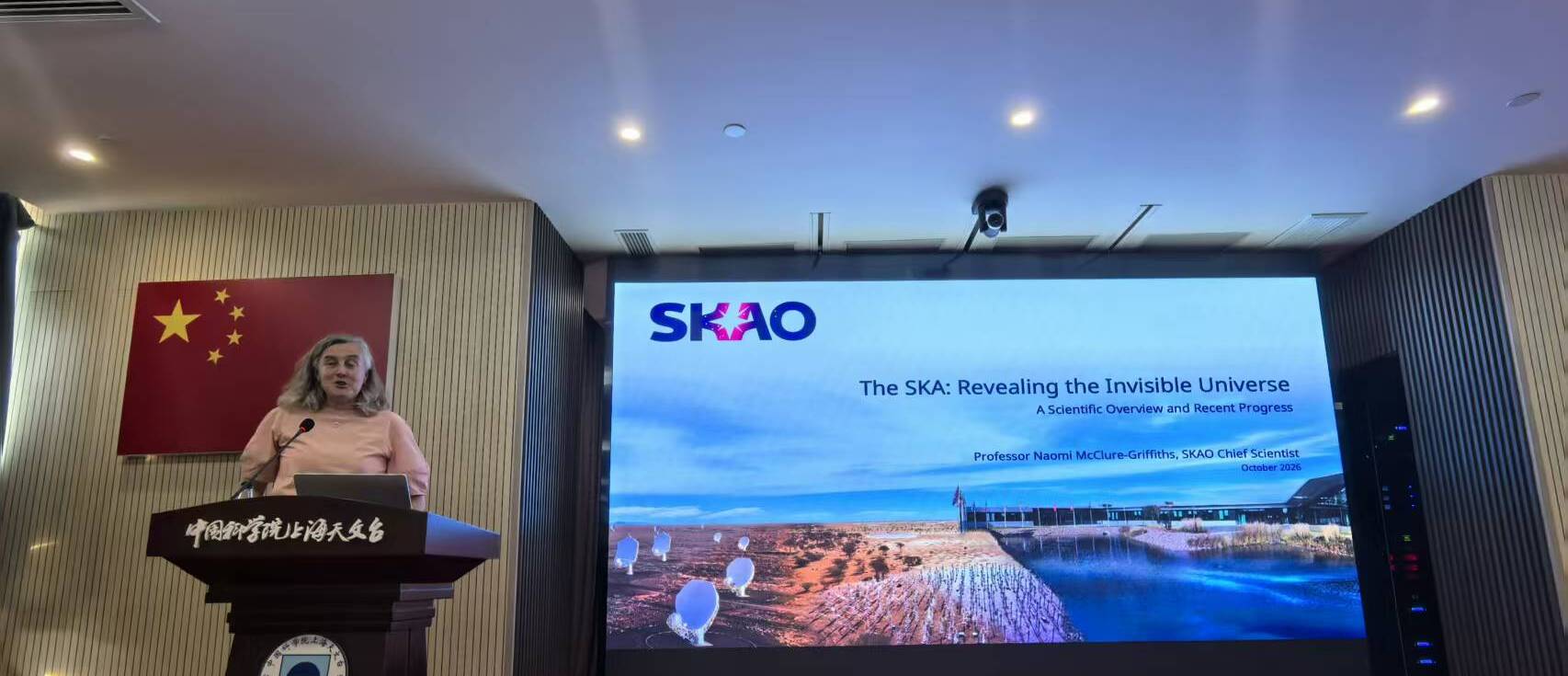
Prof. Naomi McClure-Griffiths delivering an academic lecture at the Shanghai Astronomical Observatory
The AGN team presented studies on radio-quiet active galactic nuclei, the AGN life cycle, high-redshift AGN and intermediate-mass black holes, showcased cases of radio jets and peculiar radio structures, and discussed the application of artificial intelligence tools and synergistic multi-wavelength data analysis. The pulsar exchange focused on the use of SKA pulsar timing arrays to detect nanohertz gravitational waves, as well as the prospects for discovering pulsars at the Galactic center and testing gravity in strong gravitational fields.
The interstellar medium and star formation team presented research on the Galactic center, molecular cloud structure and interstellar magnetic fields. In particular, studies of molecular absorption filaments at the Galactic center examine the connection between cold atomic gas and molecular gas, exploring the possibility of using SKA neutral hydrogen observations and polarization measurements to test the origin of gas structures and the role of magnetic fields.
The cosmic dawn and reionization team presented low-frequency observations based on the Murchison Widefield Array (MWA) and the 21 Centimeter Array (21CMA), covering data processing, foreground modeling and end-to-end simulations, as well as progress on the low-frequency anechoic chamber experiment (LACE). Technical exchanges involved the MWA Phase 3 digital receiver, the 21CMA digital multi-beam upgrade and validation, and research plans for low-frequency VLBI with SKA-Low. The neutral hydrogen and galaxy evolution team presented work on simulating 21-centimeter radiation from galaxies, galaxy groups and galaxy clusters using semi-analytic models.
Prof. McClure-Griffiths delivered an academic lecture entitled “The SKA: Revealing the Invisible Universe.” Starting from scientific questions ranging from the formation of the first stars in the universe to tests of gravitational theories, the lecture presented the observing capabilities of SKA-Mid and SKA-Low, and showcased the extensive planning of the international astronomical community for SKA science, drawing on the science monograph Advancing Astrophysics with the SKA II. The lecture also covered the construction and commissioning progress of the SKA telescopes in South Africa and Australia, including milestone achievements such as the first interference fringes obtained by SKA-Mid and the first imaging by SKA-Low, the current state of array construction, early science operations plans, and the planning of science-ready data products.
Prof. McClure-Griffiths' research focuses on the structure of the Milky Way and interstellar gas, and she is well known for achievements including the discovery of a new spiral arm of our Galaxy. She received her PhD from the University of Minnesota in 2001 and has since conducted research in Australia for many years, leading large-scale survey projects using ASKAP. She served as the inaugural chair of the SKAO Science and Engineering Advisory Committee. As the first Chief Scientist of SKAO, she is committed to advancing science planning, fostering international collaboration, and aligning science goals with telescope construction and operations.
The visit provided an opportunity for SHAO to showcase its SKA-related research and technical development. The discussions, which centered on existing achievements and future SKA observing capabilities, will help the relevant teams further refine their science cases and advance their preparation for observation and data analysis, laying a solid foundation for deeper engagement in SKA science and international cooperation.
Download attachments:




