2026 J-PAS XXII Collaboration Meeting Successfully Held in Shanghai
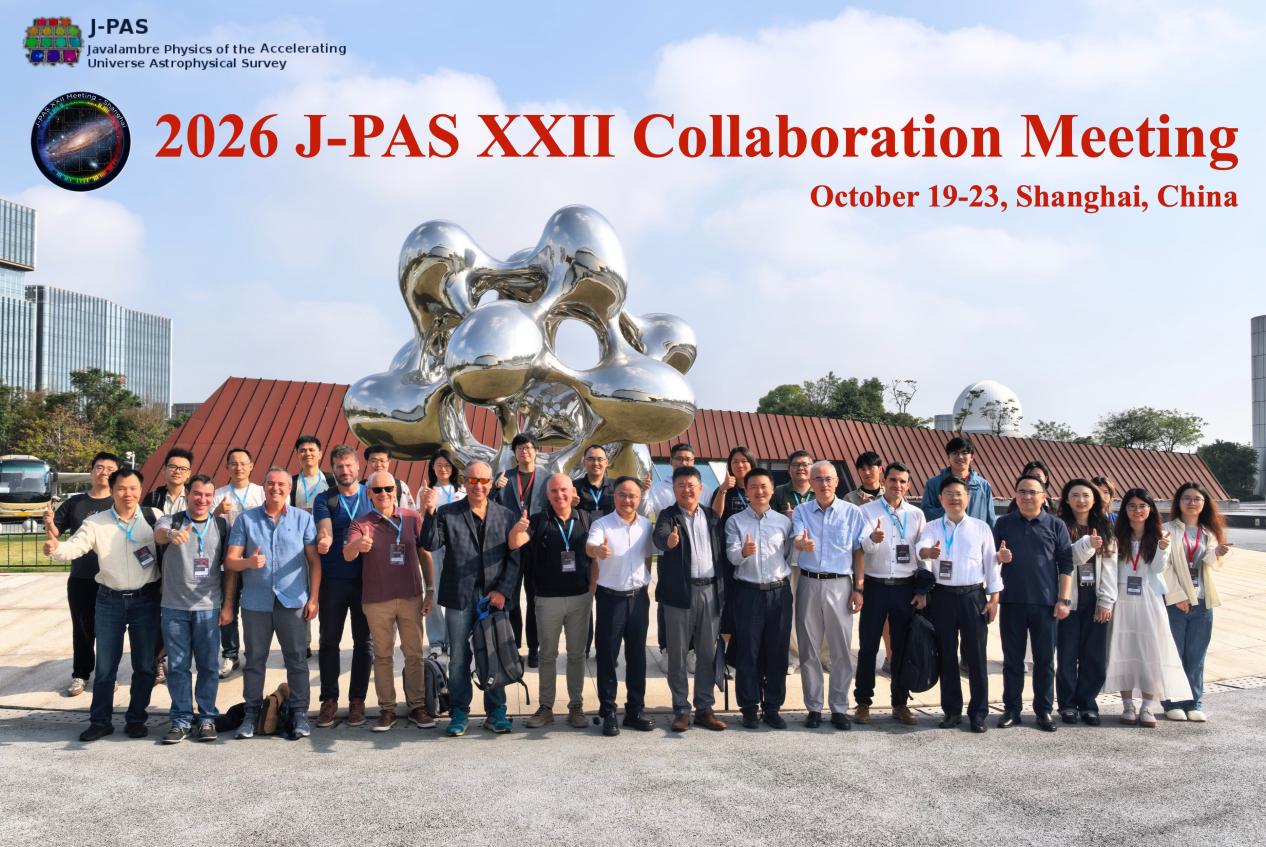
The 2026 J-PAS XXII Collaboration Meeting was held in Shanghai from October 19 to 23, 2026. Organized by the Shanghai Astronomical Observatory of the Chinese Academy of Sciences (SHAO, CAS) and co-organized by the Shanghai Astronomy Museum (a branch of the Shanghai Science and Technology Museum), the meeting marked the first time that the annual J-PAS Collaboration Meeting was hosted in China. Researchers from Spain, Brazil, Japan, China, and other countries participated in the meeting both in person and online. Chinese participants represented a wide range of institutions, including the National Astronomical Observatories, Xinjiang Astronomical Observatory, University of Chinese Academy of Sciences, Beijing Normal University, University of Science and Technology of China, Shanghai Jiao Tong University, Xiamen University, and Yunnan University. More than 80 people attended the conference in total.
The Javalambre Physics of the Accelerating Universe Astrophysical Survey (J-PAS) is conducted using the 2.55 m Javalambre Survey Telescope (JST250) and the 1.2-gigapixel JPCam panoramic camera at the Javalambre Observatory in Spain. Featuring a 56-filter photometric system, including 54 narrowband filters, J-PAS aims to cover approximately 8,500 square degrees of the northern sky. Its multi-band observations across the optical wavelength range of approximately 350–1000 nm provide photometric data with spectral information comparable to low-resolution spectroscopy. By deriving accurate photometric redshifts to estimate the distances of celestial objects, J-PAS aims to construct a three-dimensional map of the large-scale structure of the Universe, providing valuable data for investigating dark energy, cosmic structure formation, and galaxy formation and evolution.
The meeting featured discussions on the latest progress in J-PAS observations, data processing, photometric calibration, and planned data releases. Participants presented recent research findings in cosmology, galaxy evolution, active galactic nuclei, and stellar populations. Chinese research teams also introduced the development and scientific progress of major astronomical facilities and missions in China, including WFST, Mephisto, EP, CSST, LAMOST, JUST, SVOM, and CHILI. In addition, participants engaged in discussions on coordinated observations between J-PAS and Chinese astronomical facilities, data sharing, and international exchanges and collaboration involving early-career researchers.
The meeting further strengthened international collaboration within the J-PAS consortium and promoted the scientific exploitation of multi-band survey data and synergies across astronomical projects.
Download attachments:




