Precessing Magnetic Jet Engine Model Reveals the Power Source of a Rare "Heartbeat" Gamma-Ray Burst
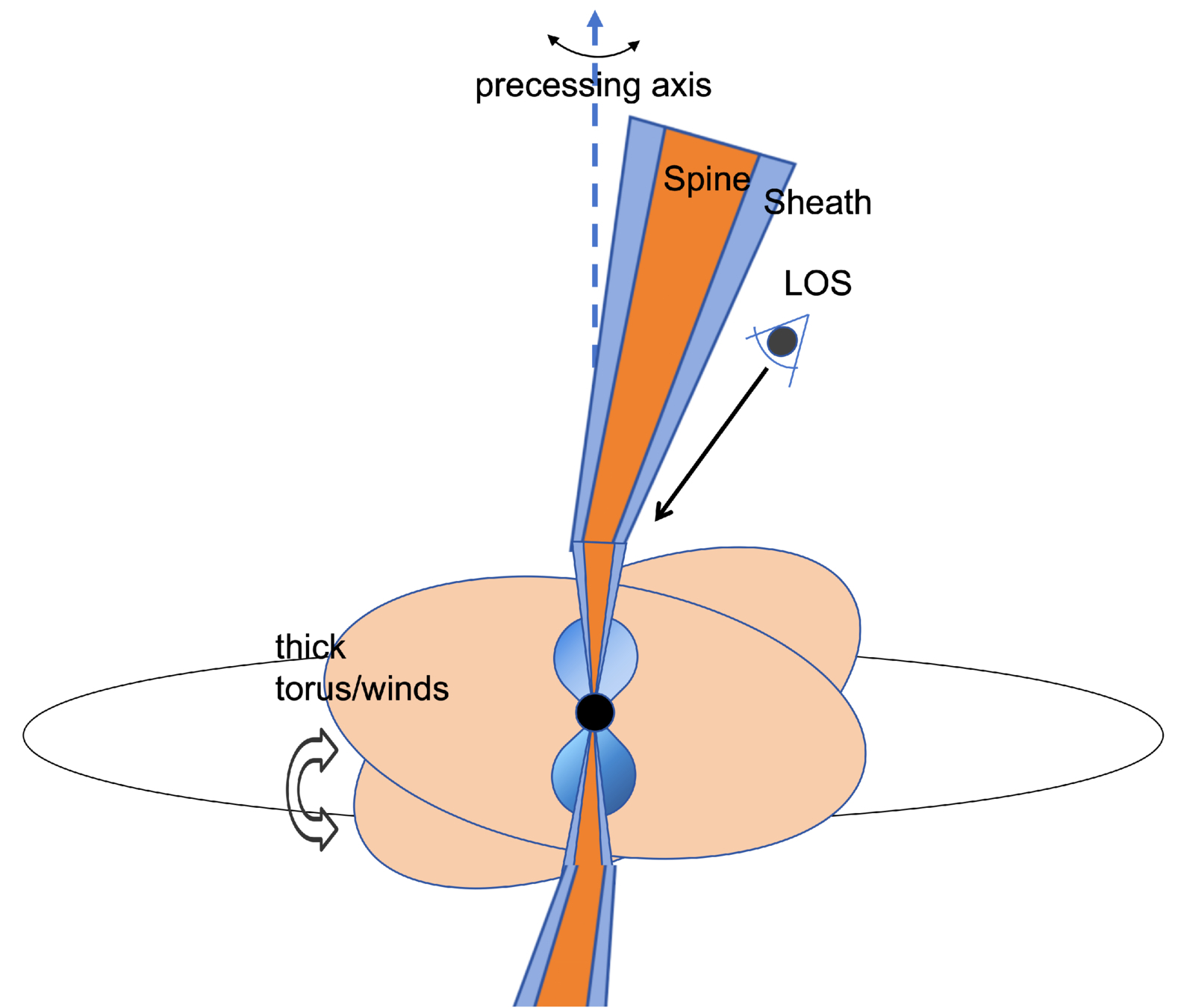
Geometry of the precessing, magnetically dominated, structured-jet model proposed for GRB 250702B.
Prof. Tao An from the Shanghai Astronomical Observatory (SHAO) proposed a novel "Precessing Magnetic Jet Engine" model to explain the peculiar Gamma-Ray Burst (GRB) 250702B, discovered on July 2, 2025. Over more than three hours, this GRB exhibited periodic flares approximately every 47 minutes. The new model not only elucidates the physical origin of this "heartbeat" but also resolves the mysteries surrounding its extremely hard spectrum and apparent excess energy. This paper is published on December 2, 2025, in the Astrophysical Journal Letters.
GRB 250702B was detected by high-energy observatories including the Fermi satellite and Konus-Wind. Its uniqueness lies in its temporal structure: the entire burst lasted about 3.2 hours, during which three distinct, intense gamma-ray pulses were observed with intervals that were integer multiples of a base period of approximately 2,825 seconds. Notably, about a day prior to this event, China’s "Einstein Probe" satellite detected a softer X-ray burst at the same location, serving as a precursor to the main event. This combination of "early warm-up + hour-scale heartbeat" is extremely rare in GRB observations.
GRBs are among the most violent explosions in the universe. GRB 250702B was not only rhythmic but also exhibited an exceptionally hard spectrum and unusually high luminosity, posing significant challenges to established astrophysical models. Researchers found that standard GRB models failed to simultaneously explain two key characteristics of GRB 250702B: The Origin of the Stable "Clock": It is generally believed that a GRB's central engine is violently chaotic. Traditional theories struggle to explain an engine that repeats three explosions at nearly fixed intervals over several hours, while occasionally skipping cycles. The Energy and Spectrum Paradox: Using a standard uniform "top-hat" jet model to fit the afterglow results in an extremely narrow jet opening angle of only about 0.4 degrees, which, when extrapolated, leads to a real energy that far exceeding order of magnitude narrower than typical long GRBs. When extrapolated, this implies an intrinsic energy output so large that it exceeds the limits of existing jet-formation theories.
In short, existing theories either could not explain the precise timing or resulted in an unnatural "energy monster."Thus, a new model was urgently needed to offer a more reasonable explanation.
To solve this mystery, Prof. Tao An proposed a new comprehensive picture: a rapidly spinning black hole producing a slowly rotating "cosmic lighthouse."
Specifically, the model envisions a black hole (with a mass several times that of the Sun) surrounded by a slightly tilted, thick accretion disk feeding it matter. Due to general relativity effects, this thick disk does not rotate simply but precesses like a wobbling gyroscope. As the black hole accretes matter, it launches a highly magnetized, relativistic jet. This jet is not uniform; it resembles a layered flame with a "spine-sheath" structure: a narrow, fast, and bright core (spine) surrounded by a wider, slower, and fainter layer (sheath).
If our line of sight were perfectly aligned with the jet axis, we would see continuous bright gamma radiation. However, for GRB 250702B, our viewing angle is slightly off-axis. As the jet slowly precesses, the narrow, bright "spine" only sweeps across our line of sight briefly, once per precession cycle. The rest of the time, we see little to no radiation. Consequently, this continuous engine appears to us as a cosmic heartbeat flashing every 47 minutes. Throughout the 3.2-hour activity, the truly bright gamma pulses last only about 100 seconds each, resulting in a "duty cycle" of roughly 2.6%, which is a natural consequence of this geometric effect.
The new model also answers why GRB 250702B appeared impossibly energetic.
Regarding the radiation mechanism, the study suggests the jet is dominated by strong magnetic fields, acting as an efficient "cosmic generator" capable of naturally producing the observed hard-spectrum and bright gamma rays without requiring extreme modifications to conventional models. By adopting a structured jet in which the jet core is brighter and more energetic than the outer layers, and by considering a mildly off-axis viewing geometry, the model successfully reproduces the observed afterglow while keeping the intrinsic energy within the normal range of long GRBs. This adjustment brings the calculated intrinsic energy back within the normal range for long GRBs.
Essentially, GRB 250702B is no longer an inexplicable monster, but an extreme yet understandable case of a bright long GRB.
A significant implication of this work is that it does not strictly specify the progenitor of GRB 250702B (e.g., micro-tidal disruption events where a stellar-mass black hole disrupts a star, a black hole transpiring into the envelope of a helium star, the tidal disruption of a white dwarf by an intermediate-mass black hole, and ultra-long GRBs, among others). Instead, it provides a generalized "engine landscape." As long as a tilted thick disk forms around a black hole and launches a highly magnetized jet, this mechanism of "precessing jet + spine-sheath jet structure + geometric viewing effect" can operate.This indicates that the new model has broad applicability and potential to explain a wider range of gamma-ray burst phenomena.
The paper outlines several predictions for verification through future observations: High-time-resolution gamma-ray polarization observations should reveal a regular rotation of the polarization angle coinciding with the "heartbeat" cycle. Frequency domain analysis of light curves should reveal fingerprints of this period, even during relatively "quiet" phases. In later stages, Very Long Baseline Interferometry (VLBI) could directly resolve the angular size and shape of the jet, providing direct visual evidence for the model.
Prof. Tao An stated that the team will continue to utilize the "Einstein Probe" X-ray telescope, the Five-hundred-meter Aperture Spherical radio Telescope (FAST), and international large radio telescope arrays to conduct long-term, multi-wavelength follow-up observations of this source and similar extreme explosive phenomena, aiming to further unveil the secrets behind the universe's most violent engines.
This work is supported by the National Natural Science Foundation of China (NSFC) under the Five-hundred-meter Aperture Spherical radio Telescope (FAST) Special Program.
Article Link: https://iopscience.iop.org/article/10.3847/2041-8213/ae2028
Scientific Contact: Tao An antao@shao.ac.cn
Download attachments:




