Important Progress in Galaxy Cluster Dynamics Research at Shanghai Astronomical Observatory
Recently, a research team led by Prof. Peng Wang at the Shanghai Astronomical Observatory (SHAO), Chinese Academy of Sciences (CAS), achieved significant progress in the field of galaxy cluster angular momentum. Utilizing large-sample spectroscopic data from the Sloan Digital Sky Survey (SDSS), the team systematically revealed for the first time that galaxy clusters exhibit significant spin coherence on the celestial projection plane. This achievement, titled "The Cosmic Dance: Observational Detection of Coherent Spin in Galaxy Clusters," was published in 《The Astrophysical Journal Letters》, providing new observational clues for a deeper understanding of dynamical properties at the galaxy cluster scale.
Within the cosmological framework of hierarchical structure formation, Tidal Torque Theory predicts that primordial density perturbations acquire angular momentum through tidal interactions with the surrounding inhomogeneous matter distribution prior to non-linear collapse. As the largest virialized structures in the universe, the spin of galaxy clusters contains critical information regarding their formation, dynamics, and the influence of large-scale structures. Previous observations have mostly focused on spin studies of single or small samples of galaxy clusters, lacking a unified statistical framework. Based on spectroscopic observational data from a large sample of galaxy clusters, this study realizes the observational statistical detection of coherent rotation in galaxy clusters for the first time.
The study innovatively proposes a simple and reproducible "redshift-hemisphere method." By identifying the direction within the projection plane that maximizes the redshift difference between member galaxies in two regions (divided by a trial axis), a projected spin axis is determined for each galaxy cluster, thereby achieving the observational statistical detection of coherent rotation in galaxy clusters.
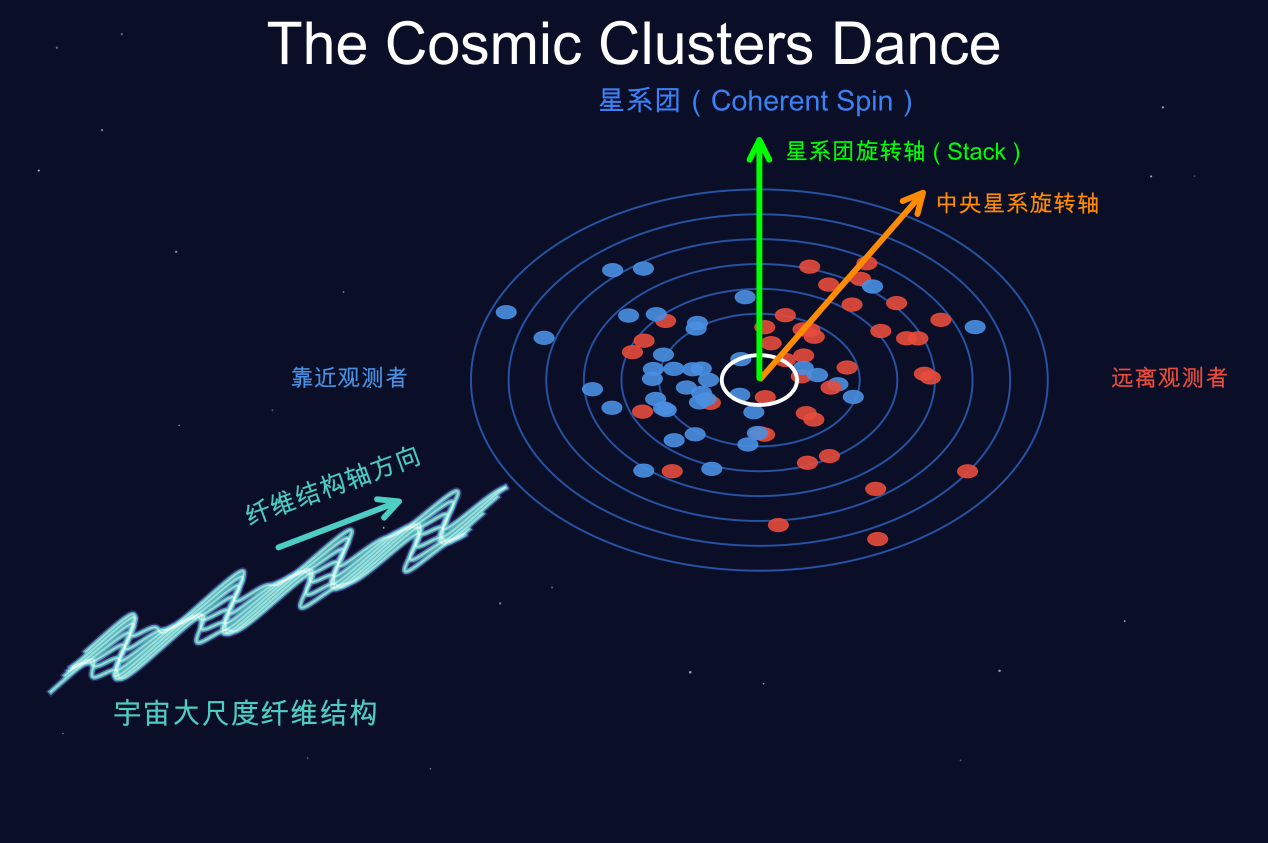
Scientific Cartoon: schematic diagram of the galaxy cluster spin axis. Galaxy clusters exhibit significant coherent spin shaped jointly by internal dynamics and large-scale structures.
Systematically revealing galaxy cluster coherent spin. The team selected two sets of public galaxy group catalogs constructed based on different algorithms, thereby excluding the influence of galaxy group classification algorithms, and finally selected corresponding galaxy cluster samples for analysis. The study found that the observed spin signal distribution deviates significantly from the random control group, systematically and robustly confirming the coherent rotation of galaxy clusters. Further analysis reveals that rotation velocity increases with galaxy cluster mass.
Preliminary exploration of the angular momentum transport process. The research highlights the function of galaxy clusters as "relay stations" in intermediate-scale environments during the process of transporting angular momentum from cosmic large-scale filamentary structures to small-scale galaxies. It preliminarily explores the physical mechanisms of how angular momentum is accreted, maintained, and redistributed across cosmic spatial scales spanning several orders of magnitude.
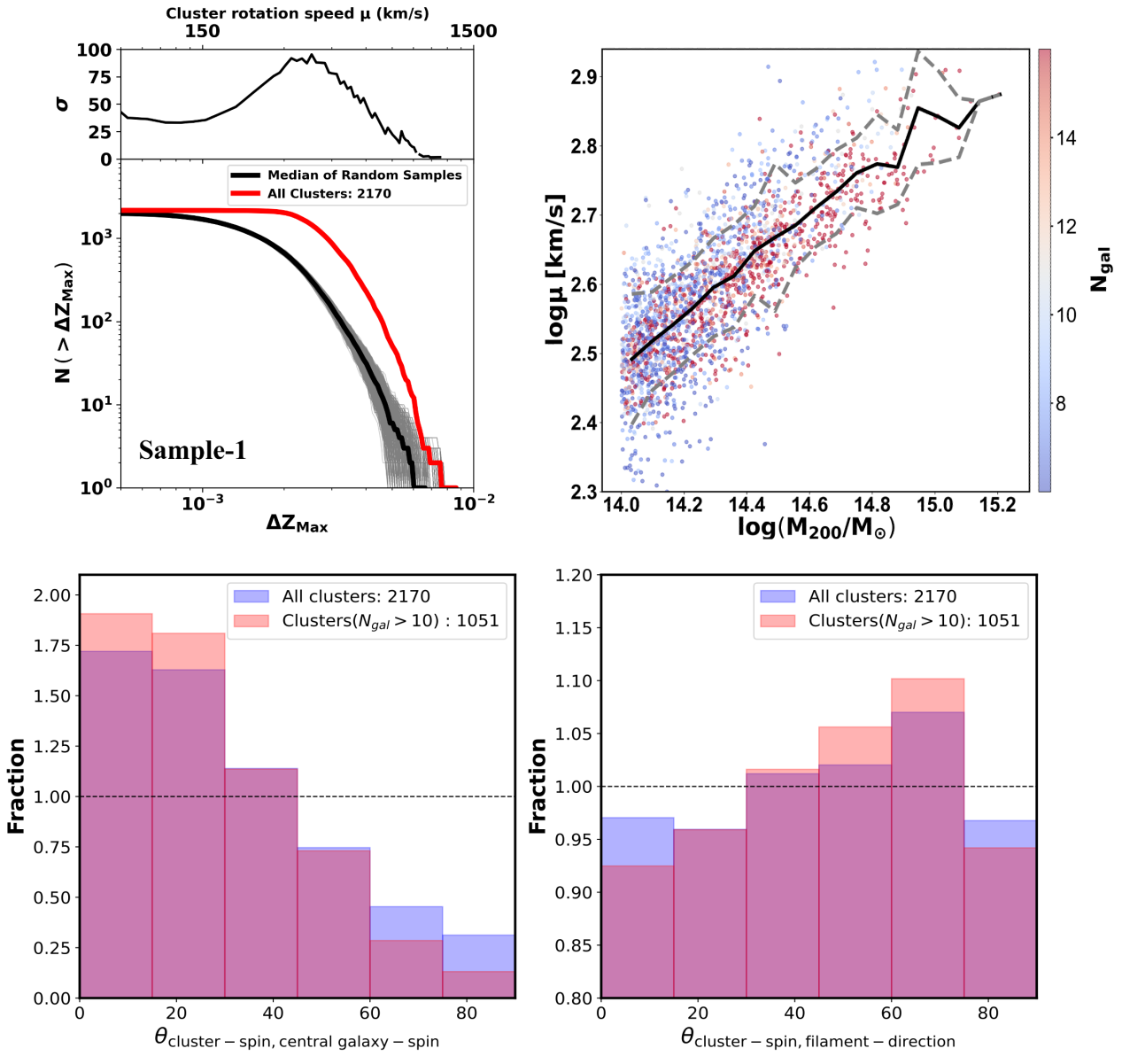
Scientific results figures. Top-left: cumulative distribution of galaxy cluster spin signals; Top-right: galaxy cluster rotation velocity-mass relation; Bottom-left: correlation between galaxy cluster spin and central galaxy spin; Bottom-right: correlation between galaxy cluster spin and the axis of nearby large-scale filaments.
The first author of this study is Xiaoxiao Tang, a first-year PhD student at the Shanghai Astronomical Observatory, and the corresponding author is Peng Wang. The project was supported by the Major Program and General Program of the NSFC, the Scientific Research Program of the China Manned Space Program, and Shanghai Rising-Star Program (Category A).
Paper Link:https://doi.org/10.3847/2041-8213/ae2273
Scientific Contact: Wang Peng, pwang@shao.ac.cn
Download attachments:




