Understanding the Variability of Local Analogs of Little Red Dots
An international research team led by the Early Universe and High-Redshift Galaxy Group at the Shanghai Astronomical Observatory, Chinese Academy of Sciences, has conducted a systematic variability study of seven low-redshift analogs of the compact red sources known as Little Red Dots (LRDs). From an independent time-domain perspective, the study provides new evidence that at least some LRD analogs host actively accreting black holes or active galactic nuclei (AGN). It also offers valuable nearby benchmarks for interpreting the variability of LRDs in the early Universe and assesses the uncertainties affecting current variability studies of high-redshift LRDs. The results were published in The Astrophysical Journal on July 10, 2026.
Since their discovery in 2023, the physical nature of LRDs has remained a subject of intense debate. These sources typically exhibit extremely compact morphologies, and broad emission lines have been detected in the spectra of some objects. They have therefore often been interpreted as systems dominated by actively accreting black holes or AGN[1]. Determining the true nature of LRDs is crucial for understanding how black holes formed and grew in the early Universe and for testing different black hole seeding models[2].
However, as more observations have become available, the physical picture has grown increasingly complex rather than clearer. A variety of theoretical scenarios have been proposed to explain the distinctive V-shaped spectral energy distributions of LRDs. These include black holes enshrouded by dense gas (e.g.,[3-5]), gravitationally unstable outer accretion disks (e.g.,[6]), and composite spectral energy distributions produced jointly by an AGN and its host galaxy. Which physical mechanism dominates these enigmatic sources remains an open question in studies of the early Universe.
Variability is one of the key observational signatures used to identify AGN. The brightness of the accretion flow surrounding an active black hole commonly changes irregularly with time, making stochastic variability a characteristic feature of AGN activity. Previous studies, however, found that high-redshift LRDs generally show only weak variability, or no significant variability at all [7]. This apparent lack of brightness fluctuations seems difficult to reconcile with an AGN-dominated scenario and has raised doubts about whether LRDs are powered by active black holes.
Yet high-redshift LRDs are extremely faint, and existing time-domain observations are often limited by sparse temporal sampling, low signal-to-noise ratios, and restricted wavelength coverage. Their measured variability properties therefore remain highly uncertain. In contrast, low-redshift LRD analogs are brighter and can be monitored over longer time baselines with denser sampling. Ground-based time-domain surveys such as the Zwicky Transient Facility (ZTF) can continuously track their brightness variations, allowing researchers to search for active central black holes through the amplitude, characteristic timescale, and stochastic nature of the variability.
Building on the team’s previous searches for low-redshift LRD analogs [8-9], the researchers analyzed their ZTF light curves over a time baseline of approximately five to six years. Three of the seven sources exhibited detectable variability. The two brightest objects showed stochastic variability with amplitudes and characteristic timescales consistent with those typically observed in AGN. These results provide important observational evidence that the objects host active central black holes.
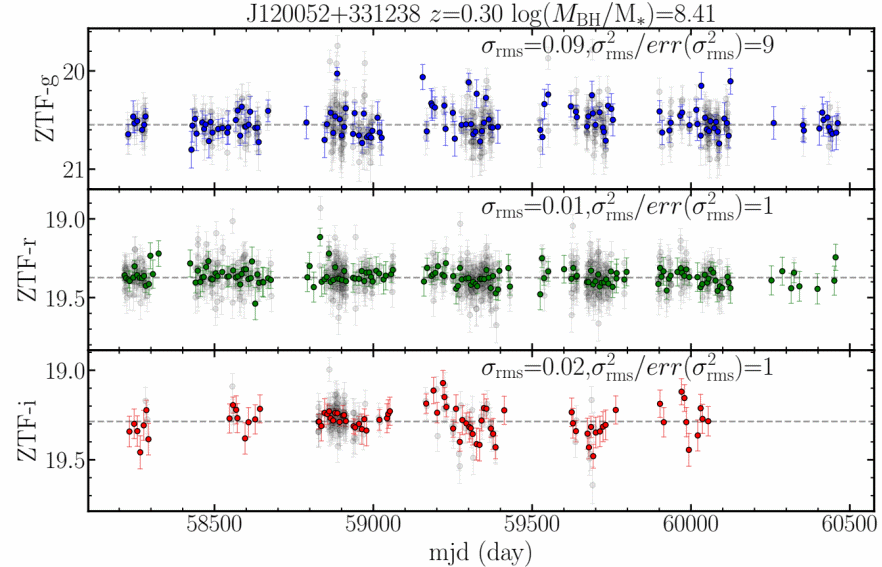
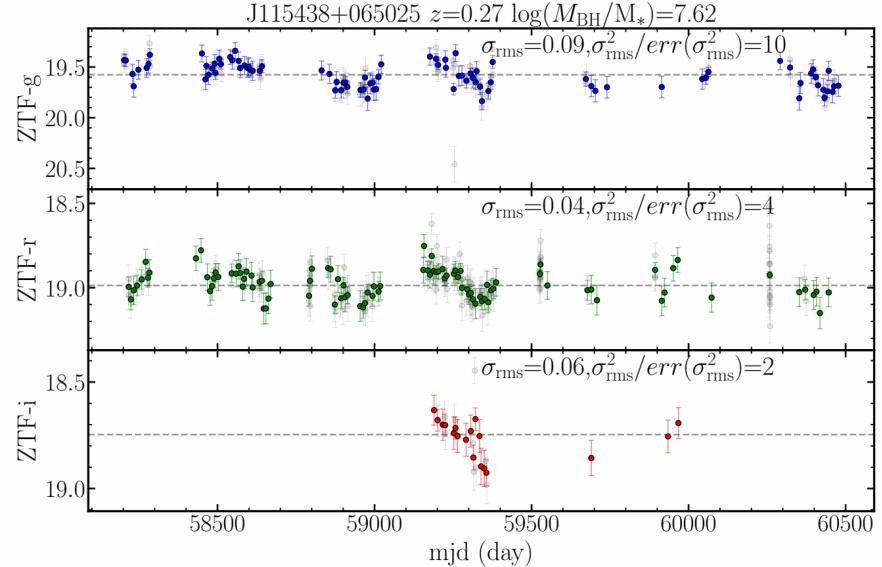
Figure 1. Example ZTF light curves of nearby analogs of Little Red Dots. Gray points show individual observations, while colored points represent data rebinned into 7-day intervals.
The team also used simulations to examine how observational limitations affect variability measurements. The analysis showed that sparse temporal sampling can substantially suppress, or even conceal, the intrinsic variability signal of an AGN. Consequently, the absence of detected variability in high-redshift LRDs does not necessarily rule out the presence of actively accreting black holes.
Dr. Ruqiu Lin, the first and corresponding author of the paper, who received her PhD from the Shanghai Astronomical Observatory and is currently a postdoctoral researcher at the University of Massachusetts Amherst, said: “For the other nearby analogs without significant variability detections, the upper limits on their variability amplitudes are broadly consistent with the average limits measured for high-redshift LRDs. This provides additional evidence that nearby analogs and high-redshift LRDs may share similar time-domain properties. Our analysis also shows that the non-detection of variability in current high-redshift observations may be partly caused by limited temporal sampling and sensitivity.”
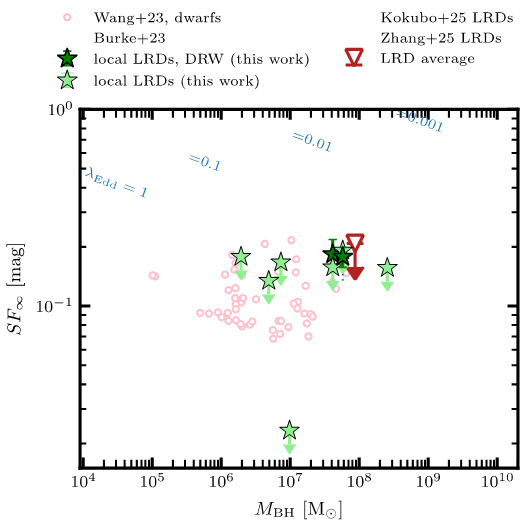
Figure 2. Variability amplitude as a function of black hole mass. Light green stars indicate the variability upper limits for the seven low-redshift analogs of Little Red Dots. Purple and red symbols represent previously reported high-redshift Little Red Dot samples, respectively, while the dark red triangle marks their average upper limit.
Prof. Zhenya Zheng, a corresponding author of the paper, deputy director of the Shanghai Astronomical Observatory, and a researcher at the institute, added: “Nearby analogs offer clear advantages in time-domain monitoring, detectability, and wavelength coverage. Future follow-up observations with higher precision, denser cadence, and broader multiwavelength coverage will help us further constrain the relationship between central black holes, accretion activity, and host galaxies, and will provide stronger clues to the physical nature of LRDs in the early Universe.”
DOI: https://iopscience.iop.org/article/10.3847/1538-4357/ae74c6
Reference:
[1]Matthee J., Naidu R.~P., Brammer G., Chisholm J., Eilers A.-C., Goulding A., Greene J., et al., 2024, ApJ, 963, 129. doi:10.3847/1538-4357/ad2345
[2]Pacucci F., Nguyen B., Carniani S., Maiolino R., Fan X., 2023, ApJL, 957, L3. doi:10.3847/2041-8213/ad0158
[3]Naidu R.~P., Matthee J., Katz H., de Graaff A., Oesch P., Smith A., Greene J.~E., et al., 2025, arXiv, arXiv:2503.16596. doi:10.48550/arXiv.2503.16596
[4]Inayoshi K., Maiolino R., 2025, ApJL, 980, L27. doi:10.3847/2041-8213/adaebd
[5]Liu H., Jiang Y.-F., Quataert E., Greene J.~E., Ma Y., 2025, ApJ, 994, 113. doi:10.3847/1538-4357/ae0c19
[6] Zhang C., Wu Q., Fan X., Ho L.~C., Wu J., Zhang H., Lyu B., et al., 2026, NatAs, 10, 753. doi:10.1038/s41550-026-02785-x
[7]Kokubo M., Harikane Y., 2025, ApJ, 995, 24. doi:10.3847/1538-4357/ae119e
[8]Lin R., Zheng Z.-Y., Jiang C., Yuan F.-T., Ho L.~C., Wang J., Jiang L., et al., 2025, ApJL, 980, L34. doi:10.3847/2041-8213/adaaf1
[9]Lin R., Zheng Z.-Y., Yuan F.-T., Wang J.-X., Jiang C., Jiang N., Wang L., et al., 2024, SCPMA, 67, 109811. doi:10.1007/s11433-024-2412-3
Scientific Contacts: ZHENG Zhenya zhengzy@shao.ac.cn
Download attachments:




