Constraining Ultralight Scalar and Dark Photon Dark Matter with Pulsar Timing Arrays
Recently, a team led by Dr. Kuo Liu and Dr. Siyuan Chen from the Shanghai Astronomical Observatory, Chinese Academy of Sciences, together with Prof. Xingjiang Zhu from Beijing Normal University, has made significant progress in testing dark matter using pulsar timing array (PTA) data. The study was published in Physical Review D.

Dark matter accounts for approximately 27% of the energy density content of the Universe, yet its fundamental nature remains elusive. While the standard cold dark matter paradigm has proven remarkably successful on cosmological scales, it continues to face persistent small-scale challenges, notably “core–cusp problem”, “missing satellite problem”, and “too-big-to-fail problem”. Ultralight dark matter (ULDM), also known as fuzzy dark matter, represents a particle-physics proposal designed to alleviate these tensions. In this scenario, the dark matter particle has a typical mass around 10-22 eV, for which the corresponding de Broglie wavelength becomes comparable to galactic scales, thereby naturally inducing wave-like phenomena on those scales.
Pulsar timing array (PTA) experiments monitor tens of highly stable millisecond pulsars to obtain high-precision measurements of their pulse times of arrival, effectively forming a Galactic-scale detector primarily designed to detect the nanohertz gravitational waves. PTA also offers a promising avenue to search for ULDM signals, as the wave nature of ULDM may leave an imprint in the timing residuals. Such signals generally arise through two channels: gravitational effects and interactions. For example, ultralight scalar dark matter induces oscillations of the spacetime metric via gravitational effects, producing an additional gravitational time delay in the pulse signals; dark photon dark matter, by contrast, couples to ordinary matter, generating an effective “fifth force” that perturbs the pulse arrival times through the Doppler effect.
Using the third data release of the Parkes Pulsar Timing Array (PPTA DR3) and the second data release of the European Pulsar Timing Array (EPTA DR2), the team searched for the gravitational signal of ultralight scalar dark matter and the “fifth force” signal of dark photon dark matter. In the analysis, the difference in dark matter density between Earth and the pulsars was taken into account, and pulsar distance information was incorporated. The results revealed no significant signal for either dark matter candidate. The team accordingly placed stringent constraints on the parameter space of these dark matter models (see Figs. 1 and 2).
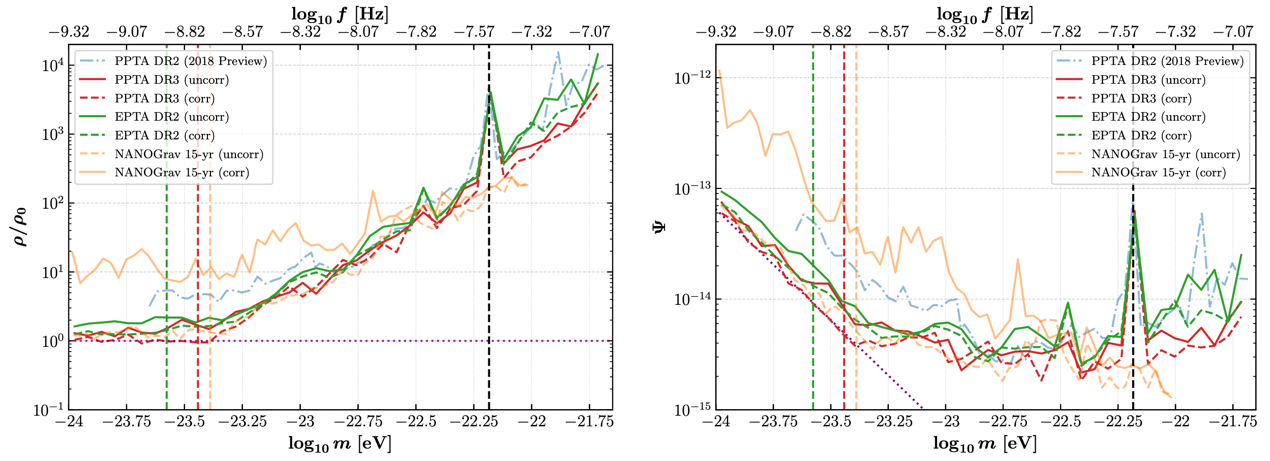
Fig 1: Upper limits on ultralight scalar dark matter parameters derived from PPTA DR3 (red) and EPTA DR2 (green) data. Left: the local dark matter density. Right: the dimensionless oscillation amplitude. Solid and dashed lines correspond to the uncorrelated and correlated cases, respectively. The purple dotted line indicates the reference value assuming the local dark matter density of 0.4 GeV/cm³.
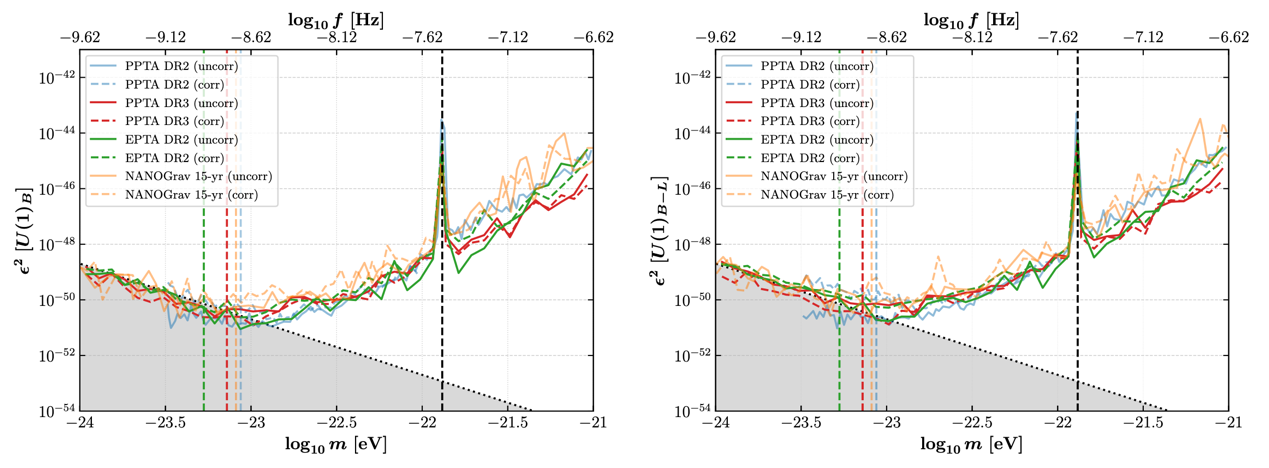
Fig 2: Constraints on dark photon coupling strength derived from PPTA DR3 (red) and EPTA DR2 (green) data. Left: U(1)B interaction. Right: U(1)B-L interaction. The black dotted line and the gray shaded region mark the parameter space where gravitational effects exceed the fifth force coupling. This demarcation is based on the simplified assumption that the gravitational oscillation amplitude produced by ultralight vector dark matter is three times that of ultralight scalar dark matter.
The results show that the PTA constraints on ultralight scalar dark matter are already approaching the local dark matter density, posing a serious challenge to such models. For dark photon dark matter, the limits on the coupling strength have also reached the level of its own gravitational signal, i.e., the time delay induced by oscillations of the gravitational potential. As a result, the coupling signal tends to become degenerate with the gravitational signal, making the two difficult to distinguish. To further search for dark matter signals in the future, it will be necessary to exploit the correlation between dark matter density fluctuations at the Earth and at the pulsars in order to disentangle the gravitational signal.
This work not only expands the scientific frontiers of pulsar timing arrays, but also establishes new benchmark constraints for the theoretical and experimental exploration of ultralight dark matter. With the continued advancement of nanohertz gravitational-wave detection capabilities, the parameter space of dark matter models will be progressively narrowed, laying a solid observational foundation for uncovering the nature of dark matter.
The first author of this study is Xiaosong Hu, a Ph.D. student jointly supervised by Beijing Normal University and the Shanghai AstronomicalObservatory. This work was supported by the National Key Research and Development Program of China, the Fundamental Research Funds for the Central Universities, and the Matching Funds for Major Research Projects at Beijing Normal University (Zhuhai).
DOI: https://journals.aps.org/prd/abstract/10.1103/wff3-b1fs
Scientific contacts:
Kuo Liu, Shanghai Astronomical Observatory, Chinese Academy of Sciences, liukuo@shao.ac.cn
Siyuan Chen, Shanghai Astronomical Observatory, Chinese Academy of Sciences, siyuan.chen@shao.ac.cn
Xingjiang Zhu, Beijing Normal University, zhuxj@bnu.edu.cn
Download attachments:




