Search for Near-Earth Asteroid Pairs and Study of Their Orbital Evolution
The research team utilized orbital similarity criteria and numerical simulations to systematically screen known near-Earth asteroids, identifying multiple groups of potential candidates that may share a common origin, and determining their possible separation times. This study not only deepens our understanding of the evolutionary mechanisms of near-Earth asteroids and the formation process of small bodies in the solar system but also effectively expands the sample of near-Earth asteroids, providing a basis for selecting sources for future deep-space exploration missions targeting near-Earth asteroids. Recently, the Shanghai Astronomical Observatory of the Chinese Academy of Sciences, in collaboration with Anhui Normal University, has made new progress in the search for near-Earth asteroid Paircandidates and the study of their orbital evolution. The findings were published in the international astronomical journal The Astrophysical Journal.
Near-Earth asteroids are asteroids with a perihelion distance of less than 1.3 astronomical units (AU); these celestial bodies may approach Earth at close range, posing a potential risk of impact with Earth. An asteroid pair refers to two asteroids that exhibit high orbital similarity within the parameter space of their orbits but are not gravitationally bound together. The orbits of near-Earth asteroids are influenced by both planetary gravitational forces and the Yarkovsky non-gravitational effect; their evolution is highly chaotic, making it difficult to maintain such orbital similarity over the long term, which results in an extremely rare number of confirmed asteroid pairs with shared origins—to date, only 7 such pairs have been identified.
The research team systematically calculated the pairwise orbital similarity criterion (DSH) for known near-Earth asteroids, performed numerical simulations spanning 20,000 years on candidate pairs with high similarity scores, and analyzed their historical encounter frequencies, minimum distances, and relative velocities to infer potential fragmentation times. The study identified three new candidate near-Earth asteroid pairs: 2012 QG8 and 2024 GE1 experienced a close encounter approximately 1,000 years ago, characterized by a distance of less than 10,000 km and a relative velocity below 1 m/s; this event may have resulted from a high-speed rotational breakup of a parent body driven by the YORP effect; 2022 MY3 and 2022 OP8 underwent a close approach approximately 100 years ago, with a distance of less than 2,000 km and a relative velocity below 1 m/s; while 2019 SK10 and 2012 SN30 experienced a close encounter approximately 16,000 years ago, which is hypothesized to represent an even older asteroid pair candidate.
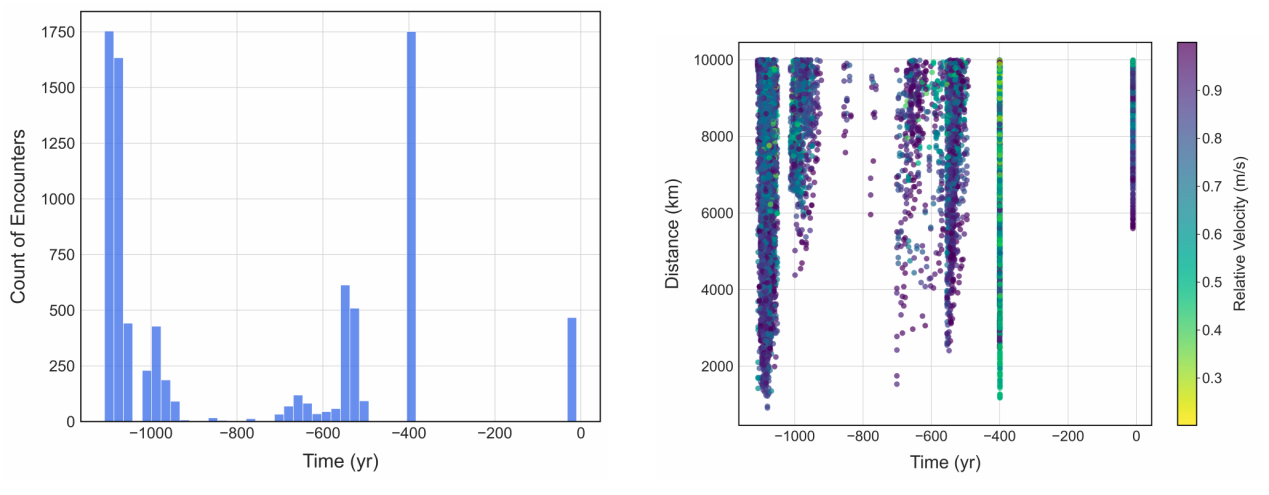
Figure 1: The left panel shows the distribution of close encounter frequencies for cloned particles between 2012 QG8 and 2024 GE1 over time. The right panel displays a scatter plot of close encounters between these two asteroids, where the color gradient ranges from light to dark shades to represent increasing relative velocities.
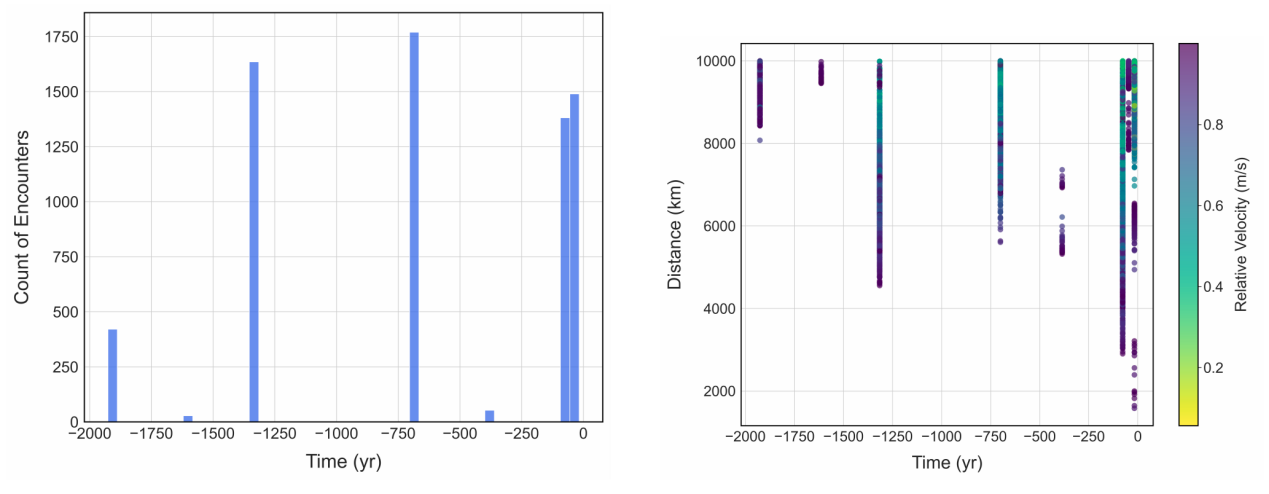
Figure 2: The left panel shows the distribution of close-proximity encounter frequencies for the cloned particles of 2022 MY3 and 2022 OP8 as a function of time. The right panel displays a scatter plot of close encounters between these two asteroids, where the color gradient from light to dark shades represents increasing relative velocities.
The study also evaluated the impact of the Yarkovsky non-gravitational effect on orbital evolution; the results indicate that the strong correlation between the first two pairs of young asteroids and the candidate objects remains robust.
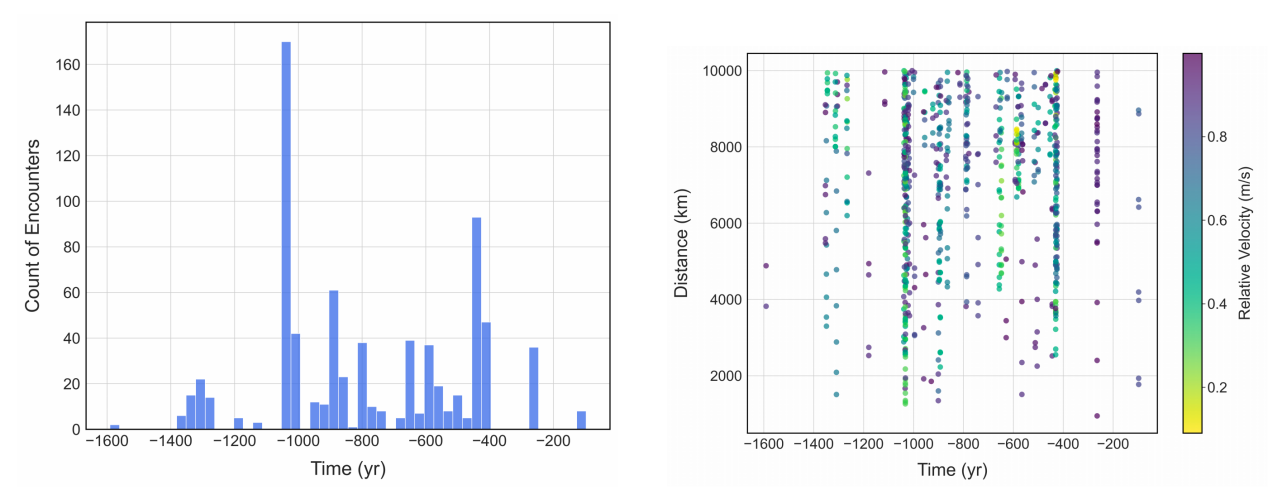
Figure 3: Simulation results with the addition of the Yakovsky effect. The left panel shows the time-dependent close-proximity encounter frequency distribution for the cloned particles of 2012 QG8 and 2024 GE1. The right panel displays a scatter plot of close encounters between these two asteroids, where the color gradient ranges from light to dark shades to represent increasing relative velocities.
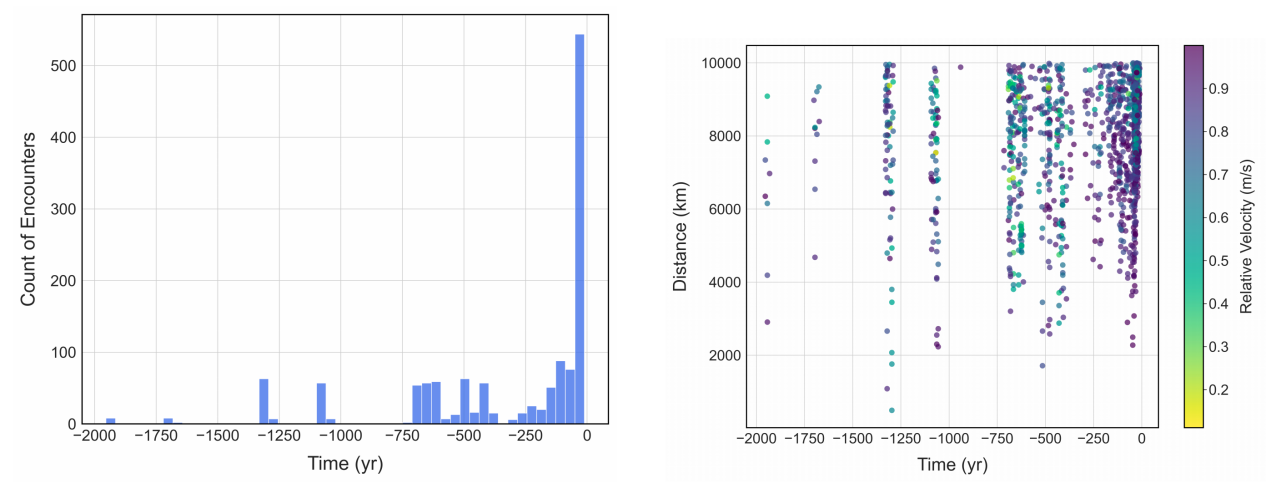
Figure 4: Simulation results with the addition of the Yakovsky effect. The left panel shows the time-dependent distribution of close encounter frequencies for the cloned particles of 2022 MY3 and 2022 OP8. The right panel displays a scatter plot of close encounters between these two asteroids, where the color gradient from light to dark shades represents increasing relative velocities.
The first author of this paper is Liu Ning, a master's student jointly trained by the Shanghai Astronomical Observatory and Anhui Normal University; the corresponding authors are Shi Jianchun from the Shanghai Astronomical Observatory and Jin Sheng from Anhui Normal University. This research was supported by grants from the National Natural Science Foundation of China, the astronomical telescope operation and maintenance fund of the Chinese Academy of Sciences, and the China Manned Space Program.
DOI:https://doi.org/10.3847/1538-4357/ae876e
Scientific Contact:
SHI Jianchun, jcshi@shao.ac.cn
Download attachments:




