Shanghai Astronomical Observatory Detects First Direct Evidence of Split Infall Flow Along Cosmic Filaments
Astronomers from the Shanghai Astronomical Observatory (SHAO) of the Chinese Academy of Sciences, in collaboration with researchers from Shanghai Jiao Tong University, have for the first time directly detected a split infall flow of matter along cosmic filaments toward galaxy clusters at both ends. Using spectroscopic galaxies from the Sloan Digital Sky Survey (SDSS), the team measured the velocity field in galaxy cluster–filament–cluster systems. The study was published in Science China Physics, Mechanics & Astronomy.

Figure 1 AI produced illustration:Due to the gravity of the two clusters, the filament in between can not maintain stability under its own gravity, and flows into the two clusters. This velocity can be measured by subtracting cosmic expansion and stacking multiple similar systems.
By selecting cluster pairs separated by 2–6 Mpc and extracting spectroscopic galaxies in the filament region between them, the researchers removed the Hubble flow and rigid-body motion through linear interpolation between the two clusters. The remaining excess redshift revealed the filament’s own infall motion. The velocity profile was found to reverse sign near the midpoint: filament segments closer to one cluster flow toward that cluster, while those closer to the other flow toward the other. This split infall pattern was detected at more than 5σ across a broad range of cluster and filament selections. For clusters of about 1014.3 solar masses, the maximum infall velocity is about 30 km/s, or about 20 km/s when projected along the line of sight. The results were validated through density–velocity correlation analysis, mass-dependence tests, and comparisons with cosmological simulations.
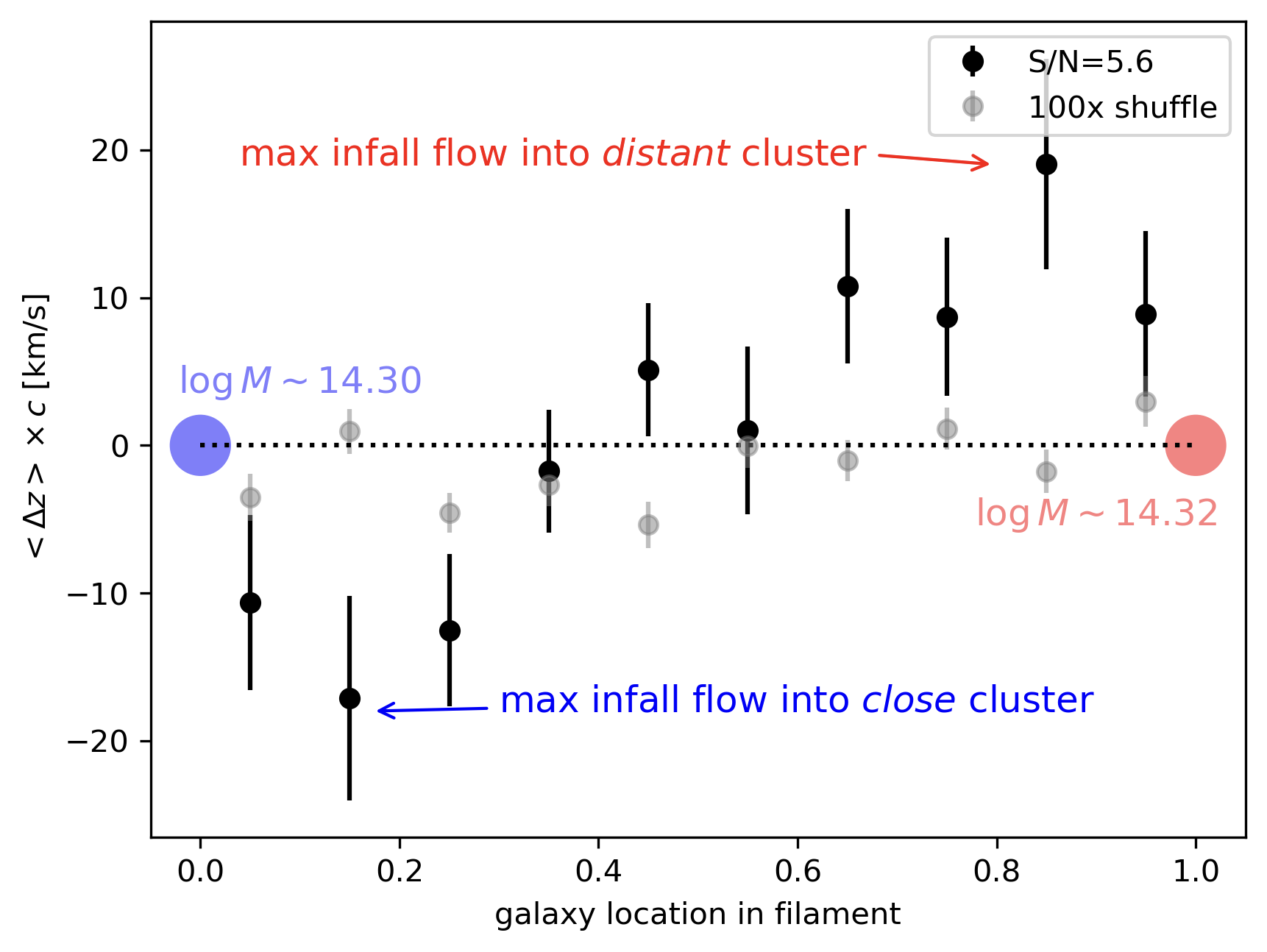
Figure 2 After stacking 360 cluster-filament-cluster systems and removing the removing the redshift due to cosmic expansion, the residual redshift △z represents the net velocity flow due to the pulling of the filaments on two sides and the self-gravitation of the filament.
“Our key idea is to use the geometry of cluster pairs to break the redshift degeneracy,” said Ji Yao, first author of the study and a researcher at SHAO. “After subtracting the rigid background, the residual excess redshift directly traces the filament’s own inflow.”
“This work opens a new window on quasi-linear velocity fields in the cosmic web,” said Huanyuan Shan, corresponding author and researcher at SHAO. “The split infall pattern is a direct manifestation of gravity in large-scale structure and offers a promising probe for mass measurements, gravity tests, and velocity-field reconstruction with upcoming large spectroscopic surveys.”
Cosmic filaments are the matter channels connecting galaxy clusters. Their velocity field encodes how matter flows into clusters and how gravity shapes the cosmic web. Directly observing this flow has been difficult because observed redshifts mix cosmic expansion with peculiar velocities. The new method avoids relying on linear assumptions used in traditional redshift-space distortion analyses, allowing a direct measurement on quasi-linear scales.
The study was supported by the National Natural Science Foundation of China and the Chinese Academy of Sciences. Collaborators include Pengjie Zhang, Xiaohu Yang, Jiale Zhou, and Jiaxin Han from Shanghai Jiao Tong University, and Peng Wang and Haojie Xu from SHAO.
DOI: https://doi.org/10.1007/s11433-026-3054-y
Scientific contacts:
YAO Ji, Shanghai Astronomical Observatory, ji.yao@shao.ac.cn
SHAN Huanyuan, Shanghai Astronomical Observatory, hyshan@shao.ac.cn
Download attachments:




