Filament Collision and Core Formation in Magnetized Molecular Clouds
A collaboration of researchers from the Shanghai Astronomical Observatory and the University of California at Berkeley has carried out the currently most comprehensive investigation to date of the complex physical interactions among gas dynamics, turbulence, and magnetic fields inside filamentary molecular clouds. Using high-resolution numerical simulations, the team traced the full evolutionary path from the formation of long, slender filamentary molecular clouds— composed of many filamentary substructures—to the birth of dense cloud cores and their subsequent evolution. The results have recently been accepted for publication in the Astrophysical Journal.
The team used the multi-physics code ORION2, which features adaptive mesh refinement, to perform a large-scale simulation of an environment with a moderately strong magnetic field and supersonic turbulence at a Mach number of 10. The simulated region spans 4.55 pc in length. With adaptive refinement, the highest resolution achieved is 458 au, giving the simulation a dynamic range of three orders of magnitude in spatial scale. This allows the simulation to capture the formation of a massive filamentary cloud 4.4 pc long, resolve the formation of filamentary substructures with a median FWHM of 0.03–0.04 pc, and follow core formation along these substructures (Figure 1)
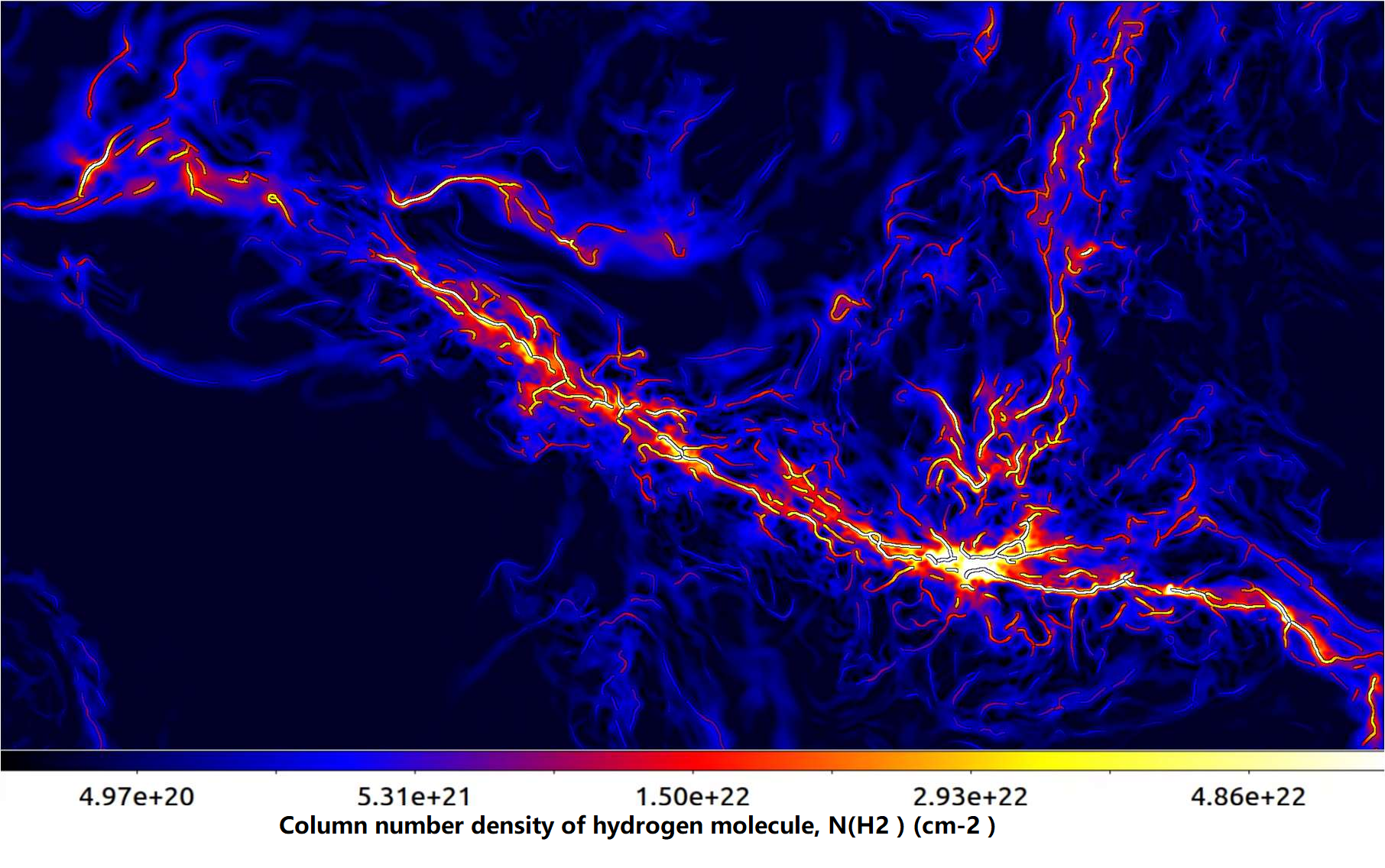
Figure 1. Column density map of a 4.4 pc-long filamentary cloud composed of many filamentary substructures from the simulation. The mean magnetic field is perpendicular to the image.
Before gravity is activated, many low-density, subparsec-long filaments (blue) already exist throughout the entire simulation region as a result of supersonic turbulence. They are pushed together by the large-scale flows toward converging locations. The low-density subfilaments within the main filament collide and merge, becoming denser (green) and longer. Later, some very dense subfilaments become unstable and fragment into dense cores (red) at various locations along subfilaments or at their intersections.
With this simulation, the team provides solid evidence that filamentary substructures are the building blocks of filamentary clouds. They find that filamentary substructures first form in interstellar space through supersonic turbulence. These short, low-density filaments are then pushed together by large-scale turbulent flows to form long filamentary clouds. During this assembly process, the low-density structures—now filamentary substructures of the larger cloud—merge with one another and become longer and more massive. They remain stable, owing to the presence of the magnetic field, until they become supercritical. Dense cores form preferentially where subfilaments collide and merge. Over time, cores can also merge with each other, providing an efficient channel for rapid mass growth. In denser, more congested environments, such mergers are potentially a dominant channel for assembling massive cores and forming massive stars (Figure 2).
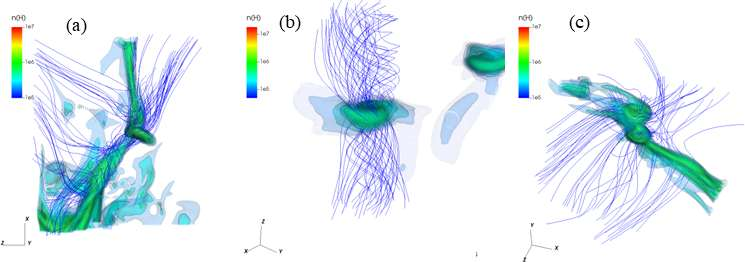
Figure 2. Volume number density, n(H) (cm-3), showing (a) a dense core forming after the collision of two subfilaments; (b) helical magnetic field structures of a rotating core; (c) the merger of two dense cores. Blue lines are magnetic fields.
A core evolves in a less crowded region of the simulation. Through interactions and mergers with connected subfilaments and nearby gas structures, it gains angular momentum and begins to rotate. The rotating core then undergoes rapid gravitational collapse, forming a flattened core, and its rotation twists the magnetic field into a helical structure.
This work concludes that supersonic turbulence and magnetic fields are crucial in the formation of thin, low-density filamentary structures at early times. The magnetic field is important for the stability of forming long filaments. Once subfilaments become supercritical through merging, gravity dominates and leads to core formation. Merging cores lead to fast rotation and provide favorable conditions for the formation of binary systems. The first author and corresponding author of the study is Pak-Shing Li, a researcher at the Shanghai Astronomical Observatory. Collaborators are Professors Christopher McKee and Richard Klein at the University of California at Berkeley.
DOI:https://doi.org/10.3847/1538-4357/aea6cb
Science contact: Li Pak-Shing pakshingli@shao.ac.cn
Download attachments:




