

International Collaboration
The Sino-German Young Partner Groups
Six Sino-German Max Planck Partner Groups have been successively founded between SHAO/CAS and the Max-Planck-Institut for Astrophysics (MPA) since 2000, led by Chinese scientists JING Yipeng, YANG Xiaohu, LI Cheng, LU Rusen, GUO Hong, and ZHU Ling, together with distinguished German partners. Holding the joint science goals of exploring cosmic structure simulations, galaxy formation and evolution, AGN, galaxy interactions, and etc., the groups have produced internationally recognized outcomes and cultivated a strong domestic research community.
The first partner group was established in April 2000 as the first of its kind in the national astrophysical community, and was directed by Prof. JING Yipeng of SHAO with Prof. Gerhard Boerner of the MPA as the German partner to explore dark matter and dark energy in cosmology. The group has sent seven visiting students to the MPA to conduct researches for an average of one year, and successfully held three rounds of Sino-German joint meetings in astrophysics, one of which was convened in Germany. The research partnership has made numerous achievements resulting in the publication of more than 40 high-level SCI papers. The MPA chairman positively evaluated this cooperative program at its final appraisal, indicating that the MPA would continue to establish new partner groups in the future. Professor Gerhard Boener has made prominent contributions to the promotion of Sino-German collaboration in astrophysics sciences and granted the China International Science and Technology Cooperation Award and the Chinese Government Friendship Award in 2010.
The second partner group was approved by the MPA and CAS in 2005, and was officially launched in August 2008 with Prof. YANG Xiaohu (SHAO) and Prof. Volker Springel (MPA) as the heads on each side. The main areas of cooperation are numerical simulation of fluid and galaxy formation. During its operation between 2005 and 2011, the partner group has supported four doctorate students each spending one year at the MPA on cooperative research, successfully held three Sino-German joint meetings in astrophysics (with one convened in Germany), and published close to 40 high-level SCI papers.
The third partner group started in January 2011 led by Prof. LI Cheng (SHAO) and Prof. Guinevere Kauffmann (MPA), making SHAO the only institute at that time to host three such groups in China. Both partners were jointly dedicated to the study of cold gas accretion as well as star formation and evolution. The Chinese and German sides of this partner group have undertaken a series of research tasks, adopting the cooperative mode used by the previous groups. The two sides published more than 20 SCI papers, and in addition, the leaders of both sides led the group to take part in the fourth phase of the Sloan Digital Sky Survey (SDSS-IV). The partner group was highly commended by the international appraisal committee when passing its mid-term evaluation in October 2013.
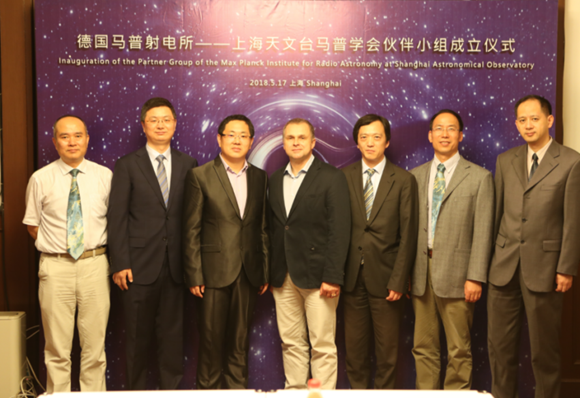
To vigorously advance cutting-edge international research in radio astronomy and further strengthen international cooperation, the fourth partner group was established in May 2018, with co-principal investigators Prof. LU Rusen (SHAO) and Prof. Anton Zensus, Director of the Max Planck Institute for Radio Astronomy (MPIfR). This group conducts joint research on frontier astrophysical topics, including black holes and jets, while supporting the exchange and co-training of doctoral students.
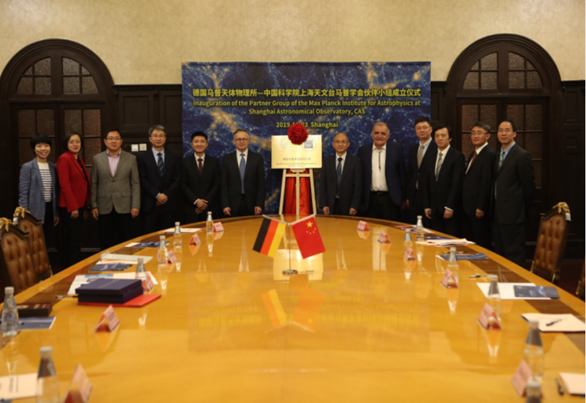
The fifth partner group was founded in November 2019, with the German lead being Prof. Volker Springel, an internationally renowned astronomer, Executive Director of the MPA, and a member of the German National Academy of Sciences. The Chinese lead is Prof. GUO Hong Guo (SHAO). This group carries out collaborative research on frontier astrophysical topics such as galaxy formation and evolution, and AGN feedback, utilizing hydrodynamic numerical simulations.
The sixth partner group was established in January 2022. The German lead is Prof. Annalisa Pillepich, an internationally distinguished astronomer at the Max Planck Institute for Astronomy (MPIA), and the Chinese lead is Prof. ZHU Ling (SHAO). This group integrates hydrodynamic numerical simulations with dynamical structural modeling of real galaxies to conduct joint research on frontier topics concerning the formation and evolution of galactic structures.
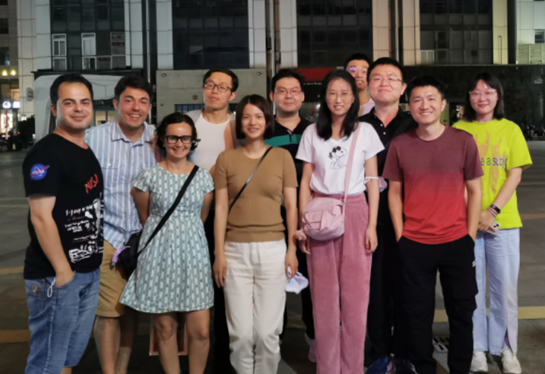
All the groups maintain a vibrant academic atmosphere and harmonious working relationships among members, fostering close collaboration in scientific research. Their activities include co-supervision of doctoral students, support for early-career researchers in participating in international collaborative projects, organization of academic conferences, and the completion of numerous research outputs with significant international impact. These efforts have cultivated domestic research teams in the aforementioned fields and nurtured a number of emerging academic leaders.


