

Research News
A key step forward in neutral hydrogen cosmology: MeerKLASS makes the first direct detection of the 21-cm signal on cosmological scales
The international MeerKAT Large Area Synoptic Survey (MeerKLASS) Collaboration has used the MeerKAT radio telescope in South Africa to directly detect the neutral hydrogen 21-cm signal on cosmological scales for the first time, achieving a signal-to-noise ratio of 6.2. This milestone marks an important step towards establishing 21-cm intensity mapping as an independent tool for cosmological research and lays the groundwork for future precision cosmological observations with the Square Kilometre Array (SKA). Associate Professor Jingying Wang of the Shanghai Astronomical Observatory (SHAO), Chinese Academy of Sciences, is a member of the MeerKLASS Steering Team and serves as the collaboration's Calibration Pipeline Lead. She led the development of the calibration pipeline and was primarily responsible for the high-precision data calibration and the construction of three-dimensional data cubes, providing key calibrated data products for this measurement. The findings were published online on 3 November 2026 in Monthly Notices of the Royal Astronomical Society (MNRAS).

Figure 1. Illustration of the MeerKLASS Collaboration's direct detection of the neutral hydrogen 21-cm signal on cosmological scales.
Neutral hydrogen is a valuable tracer of the distribution and evolution of matter in the Universe. By observing its 21-cm radio emission, astronomers can study how matter gathers under gravity to form galaxies, galaxy clusters and the vast network of filaments known as the cosmic web. Traditional galaxy surveys rely on detecting individual galaxies. In contrast, 21-cm intensity mapping measures the combined hydrogen emission from large patches of sky without needing to distinguish individual galaxies, providing statistical information about the three-dimensional distribution of matter in the Universe. With its high survey speed and ability to cover enormous cosmic volumes, this technique offers a promising approach to studying the large-scale structure of the Universe, its expansion history and the nature of dark energy.
Detecting the cosmological neutral hydrogen signal, however, is extremely challenging. Astrophysical foreground emission from our own Galaxy and other radio sources can be around 10,000 times stronger than the signal itself, while instrumental effects and calibration errors further complicate its extraction. Over the past decade, researchers have detected the cosmological 21-cm signal through cross-correlations with external galaxy surveys. Directly measuring the large-scale clustering of neutral hydrogen, without relying on external galaxy surveys, has remained a major challenge in the field.
The study is based on MeerKLASS L-band deep-field observations carried out in 2021, covering approximately 236 square degrees of sky. These data probe neutral hydrogen at an effective redshift of about 0.42, corresponding to roughly 4.5 billion years ago. Unlike conventional radio interferometric observations, MeerKLASS operated MeerKAT's 64 dishes as independent telescopes in single-dish mode, enabling efficient mapping of large areas of sky. The team used the same observational data as in its earlier deep-field study but adopted a new analysis strategy. By splitting the data according to observing times and individual dishes, the researchers created four relatively independent subsets. Astrophysical foregrounds were removed separately from each subset before the datasets were cross-correlated to suppress instrumental noise and some systematic effects. Using these internal cross-power spectra, the team achieved a direct detection of the neutral hydrogen 21-cm auto-power spectrum over a wavenumber range of 0.095–0.245 h Mpc⁻¹, with an overall signal-to-noise ratio of 6.2. The result provides a statistical measurement of the large-scale clustering of neutral hydrogen in the cosmic web and new observational constraints on a parameter combination related to its abundance and spatial clustering properties.
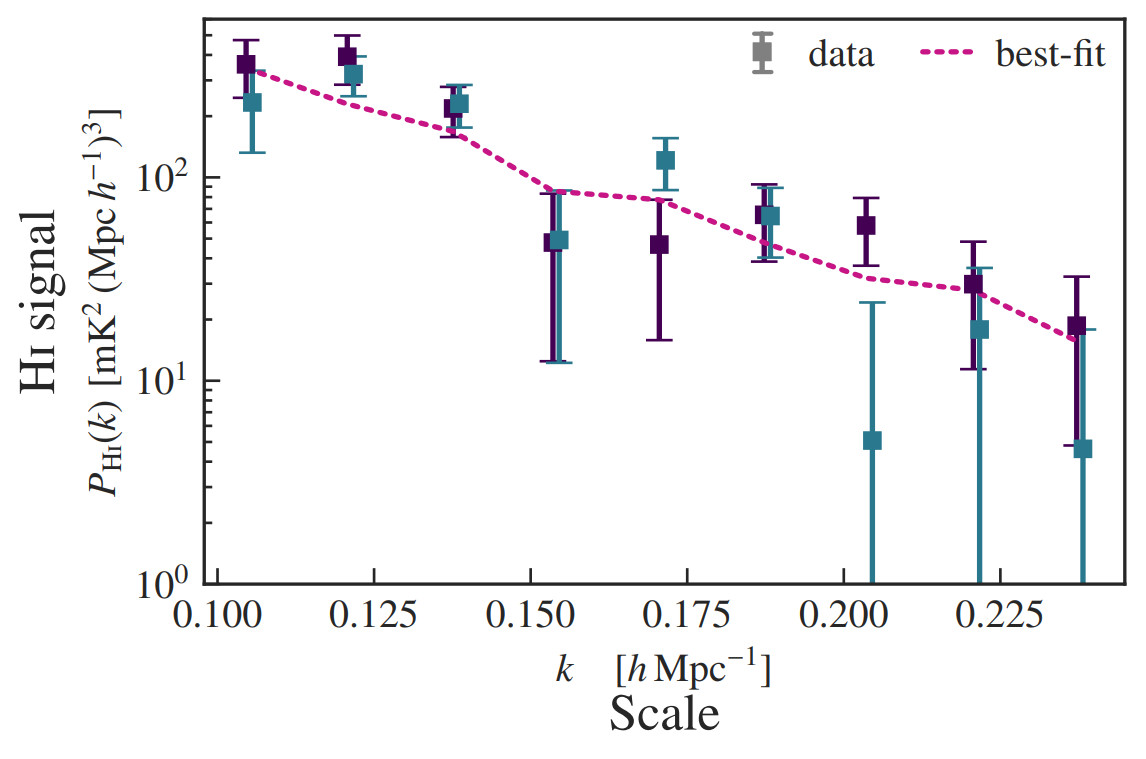
Figure 2. The neutral hydrogen 21-cm power spectrum measured by MeerKLASS on cosmological scales, together with the best-fitting model. The two sets of data points represent cross-power spectrum measurements between different subsets of the observations.
High-precision data calibration and the construction of high-quality three-dimensional data cubes provided an important foundation for this breakthrough. At SHAO, Jingying Wang has long led the development of KATcali, the calibration pipeline for MeerKLASS single-dish observations, and has been responsible for key aspects of the data calibration and the production of three-dimensional brightness-temperature data cubes. The pipeline combines modelling of the telescope's instrumental response, Bayesian inference and iterative self-calibration to reduce systematic errors in the observations. In the earlier deep-field analysis, the observational noise level was reduced to 1.21 mK, only 1.2 times the theoretical thermal noise. This brought the MeerKLASS deep-field observations into the neutral hydrogen-dominated regime on some cosmological scales, creating the conditions needed for a direct detection. Building on the same high-quality observational data, the team further suppressed contamination through foreground removal and cross-correlation analysis between different data subsets, ultimately achieving the direct detection of the cosmological 21-cm signal.
"This result represents an important breakthrough after more than a decade of sustained effort by the international MeerKLASS Collaboration," said Jingying Wang. "The challenge of 21-cm intensity mapping lies not only in detecting the faint cosmological signal, but also in accurately controlling instrumental systematics and foreground contamination. The progress from high-precision data calibration to the detection of the neutral hydrogen auto-power spectrum has provided valuable experience for future large-scale cosmological surveys with the SKA."
The achievement reflects the contributions of researchers from seven countries across three continents. It would not have been possible without the excellent sensitivity and stability of the MeerKAT telescope, built and operated by the South African Radio Astronomy Observatory (SARAO).
As a precursor to the SKA, MeerKAT is demonstrating key observing and data-processing techniques for future, much larger cosmological surveys of neutral hydrogen. Since 2023, the MeerKLASS Collaboration has continued collecting data at lower radio frequencies to probe more distant regions of the Universe. Eventually, MeerKLASS expects to map a volume of the Universe more than a thousand times larger than that used for this detection, providing new opportunities to investigate the growth of large-scale structure, the expansion of the Universe and the nature of dark energy.
Wang's long-standing experience in MeerKLASS data calibration and processing has also supported her broader involvement in SKA science. She has recently taken up the role of Co-chair of the SKA Cosmology Science Working Group. In this role, she will contribute to cosmology science planning and international cooperation, while promoting China's participation in the field.
This research was supported by the SKA programme of China's Ministry of Science and Technology and the National Natural Science Foundation of China.
Paper: https://doi.org/10.1093/mnras/stag1911
Further reading: https://academic.oup.com/mnras/article/537/4/3632/7997695
Scientific contact: Jingying Wang, Shanghai Astronomical Observatory, Chinese Academy of Sciences
Email: jywang@shao.ac.cn


